The best camera sliders with vertical movement make it easier to create smooth reveals, tracking shots, parallax moves, and repeatable time-lapse sequences. Motorized control adds consistency, while adjustable travel lengths and payload ratings determine how useful a slider will be with your camera setup.
This roundup compares 10 motorized sliders from GVM, iFootage, and NEEWER, ranging from compact mini models to longer carbon-fiber rails. Use the guide below to match features such as app control, rotary movement, battery operation, and load capacity to your shooting style.
Best 10 Camera Sliders with Vertical Movement Picks for 2026
Best Overall
GVM 32-Inch Motorized Carbon Fiber Slider

- Vertical, horizontal, and 45-degree shooting
- App-controlled six-mode motion programming
- Portable carbon fiber build with carry bag
Best For: Versatile cinematic and time-lapse shooting
Best Compact Option
IFOOTAGE Shark Slider PICO 2-Axis

- 15.7-inch tabletop-friendly motorized slider
- 360-degree pan rotation with 255mm travel
- Supports phones and lightweight cameras
Best For: Portable product and tabletop videos
Best for Long Tracking Shots
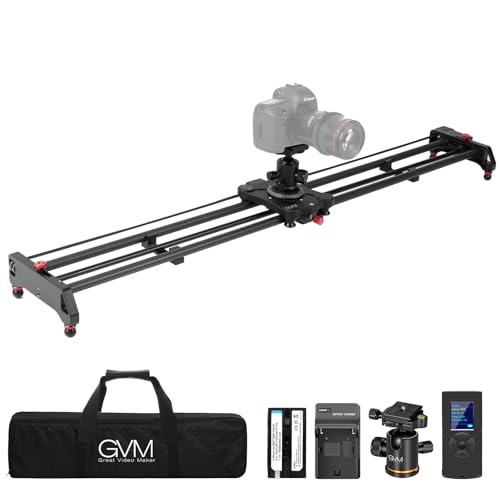
- 48-inch rail for extended camera travel
- Remote-controlled video and time-lapse settings
- 120-degree panorama and tripod mounting ports
Best For: Studio tracking shots and repeatable time-lapses
Best for Pocket Cameras

- Compatible with DJI Pocket, action cameras, and phones
- 360-degree pan with USB-C Pocket integration
- Quiet motor and seven-hour battery
Best For: Mobile creators using compact cameras
Best for Easy Setup

- 80cm motorized rail with app control
- Supports up to 45° tilt movement
- Includes 4400mAh battery
Best For: Versatile video, panorama, and time-lapse shooting
Best Advanced Option

- 86cm slider with multi-axis control
- Programs up to eight motion points
- Adds AI tracking and touchscreen control
Best For: Complex cinematic moves and gimbal-based shooting
Best Compact Dolly

- Lightweight 3.75-pound motorized dolly
- 90° tilt and 360° ball-head rotation
- Quiet motors and up to five-hour battery life
Best For: Portable angled camera movement and basic time-lapse work
Best Multi-Angle Value

- Supports vertical, horizontal, and 45-degree shooting
- Includes time-lapse and automatic round-trip modes
- Works with cameras and phones up to 2.5 kg
Best For: DSLR users seeking versatile motorized camera movement
Best Long-Travel Option
47.2-Inch NEEWER Motorized Slider

- Provides 120 cm of camera travel
- Supports app control and time-lapse shooting
- Handles up to 11 lb horizontally
Best For: Long tracking shots and repeatable creator workflows
Best Compact Carbon-Fiber Pick

- Supports 45-degree tilt and 120-degree panoramas
- Includes app control and a 4400mAh battery
- Handles up to 11 lb horizontally
Best For: Portable outdoor video and time-lapse setups
Best Overall – GVM 32-Inch Motorized Carbon Fiber Slider
For creators seeking camera sliders with vertical movement, the GVM 32-inch motorized slider stands out for its multi-angle setup, app control, and carbon fiber construction. It supports programmable tracking, panoramic, time-lapse, and video modes, with adjustable legs for leveling.
Best For: Vloggers, filmmakers, and photographers who want versatile app-controlled motion in a portable package.
Pros:
- Supports horizontal, vertical, and 45-degree angle shooting.
- App control allows adjustment of start and end points, speed, pauses, and dwell time.
- Six shooting modes support tracking, panorama, time-lapse, and video work.
- Lightweight carbon fiber construction includes a carry bag and adjustable legs.
Cons:
- At 32 inches, it offers less travel than the longer 48-inch GVM model.
- Its motorized and app-based controls may be more than casual users need.
This is a strong all-around choice when vertical positioning matters alongside programmable motion. Multiple mounting ports and included shutter cables also make it adaptable to different camera setups.
Best Compact Option – IFOOTAGE Shark Slider PICO 2-Axis
The IFOOTAGE Shark Slider PICO is a compact option for camera sliders with vertical movement, especially in tabletop and smartphone setups. Its motorized slide combines with 360-degree pan rotation, while onboard controls provide simple A/B moves without requiring the app.
Best For: Product videos, food content, tabletop scenes, smartphones, and lightweight action cameras.
Pros:
- Compact 15.7-inch design weighs approximately 1.9 pounds.
- Combines 255mm of slide travel with 360-degree pan rotation.
- Onboard controls support A/B points, speed adjustment, and looping.
- App programming supports up to eight keyframes for complex moves.
Cons:
- Payload drops to 1.1 pounds for vertical operation.
- Additional mounts and a PD 30W-or-higher charger are sold separately.
- Shorter travel is less suited to large studio cameras or wide tracking shots.
With built-in feet, a phone holder, and up to seven hours of horizontal battery operation, PICO is practical for solo creators. Its lower vertical payload makes careful camera and accessory selection important.
Best for Long Tracking Shots – GVM 48-Inch Motorized Slider
The 48-inch GVM slider is worth considering when camera sliders with vertical movement need longer travel and more elaborate programmed motion. It offers tracking, horizontal, 120-degree panoramic, video, and time-lapse modes, with remote control for detailed shot settings.
Best For: Studio filmmakers and photographers who need extended camera travel, repeatable motion, and time-lapse control.
Pros:
- 48-inch travel provides more room for extended tracking shots.
- Supports tracking, horizontal, 120-degree panorama, video, and time-lapse modes.
- Remote control adjusts speed, endpoints, dwell time, pauses, shot count, and looping.
- Multiple 1/4-inch and 3/8-inch ports support tripod mounting.
Cons:
- Its 5.42 kg weight is substantially less portable than the compact PICO models.
- The larger folded size may require more storage and transport planning.
- It is not water resistant.
This model favors capability and reach over portability. It is a better fit for controlled studio work or productions where longer, repeatable camera movements matter more than a lightweight kit.
Best for Pocket Cameras – iFootage Shark Slider PICO
The iFootage Shark Slider PICO pairs a compact motorized rail with 360-degree pan rotation, making it a flexible choice among camera sliders with vertical movement for small cameras and phones. Direct USB-C integration with DJI Pocket cameras adds coordinated motion control.
Best For: Smartphone, DJI Pocket, and action-camera creators who want compact, quiet, programmable movement.
Pros:
- Supports DJI Pocket 3/4, Action 5/6, and smartphones.
- USB-C integration with DJI Pocket cameras enables coordinated motion control.
- Five modes include video, time-lapse, stop motion, panorama, and multi-target.
- Quiet brushless motor, seven-hour battery, and 1.9-pound construction suit mobile shooting.
Cons:
- Its compact size provides less rail travel than full-size sliders.
- The listed 2.4-pound payload limits heavier camera combinations.
- Advanced features may be unnecessary for simple fixed-camera moves.
This PICO is particularly appealing for creators already using DJI Pocket or action-camera gear. Its quiet motor, wireless connectivity, and programmable keyframes provide considerable control without the bulk of a full-size slider.
Best for Easy Setup – NEEWER ER1 Motorized Slider
The NEEWER ER1 is a strong all-around choice for camera sliders with vertical movement, combining an 80cm motorized rail with app or remote control. It supports horizontal loads up to 11 pounds and tilting loads up to 5.5 pounds, making it suitable for many DSLR and mirrorless camera setups.
Best For: Creators who want smooth video, panorama, and time-lapse movement with adjustable tilt capability.
Pros:
- Supports horizontal movement and shooting at up to a 45° tilt.
- Offers app control, manual, video, and time-lapse modes.
- Quiet stepper motor, included 4400mAh battery, and tripod mounting threads.
Cons:
- Maximum load drops to 5.5 pounds when tilted 45°.
- Minor shake may occur during macro photography.
- 2.4G remote control and Type-C charger are not included.
With its longer rail, carbon-fiber construction, and multiple shooting angles, the ER1 offers a flexible setup for product videos and cinematic camera moves. Its tilt support is useful, though heavier rigs should be kept within the reduced angled-load rating.
Best Advanced Option – IFOOTAGE Shark Nano II
The IFOOTAGE Shark Nano II is built for advanced camera sliders with vertical movement and coordinated multi-axis shots. Its 86cm rail works with DJI gimbals through the included RS Adapter, while touchscreen and app controls allow detailed path programming.
Best For: Filmmakers who need programmable multi-point motion, gimbal integration, and subject tracking.
Pros:
- Supports synchronized multi-axis movement, including vertical tilts.
- Programs up to eight customizable motion points.
- Includes AI face and object tracking, stabilization, and five shooting modes.
- Quiet brushless motor and built-in IPS touchscreen support on-location control.
Cons:
- Its advanced features may be more than casual users need.
- DJI gimbal integration relies on the included custom RS Adapter.
- The supplied notes do not specify a maximum camera load.
The Nano II stands out when repeatable, complex movement matters more than simple rail operation. Its tracking, stabilization, and multi-point programming make it particularly capable for product demonstrations, interviews, and sophisticated time-lapse work.
Best Compact Dolly – NEEWER DL400 Motorized Dolly
The NEEWER DL400 is a compact motorized dolly for creators seeking camera sliders with vertical movement in a lighter, simpler format. Its ball head provides 90° tilt and 360° rotation, while the app offers manual, live-video, and time-lapse control.
Best For: Portable camera setups that need quiet motion, adjustable speed, and basic angled shooting.
Pros:
- Lightweight 3.75-pound dolly with a 6.6-pound maximum load.
- Ball head supports 90° tilt and 360° rotation.
- Quiet dual motors operate below 30dB.
- Includes an NP-F750 battery rated for up to five hours of runtime.
Cons:
- Time-lapse photography requires a separately purchased shutter cable.
- Do not begin at the fastest speed when moving uphill, as shaking may occur.
- Its 30° manual left-right movement is more limited than a full rail system.
The DL400 favors portability and straightforward operation over extensive programming. It is a practical option for lighter camera rigs, provided you observe the speed guidance on inclines and purchase the required cable for time-lapse triggering.
Best Multi-Angle Value – 27-Inch GVM Motorized Slider
If you need camera sliders with vertical movement, the GVM 27-inch motorized slider offers a practical combination of automated motion and flexible mounting. It supports horizontal, vertical, and 45-degree shooting, with adjustable feet for leveling and tripod use.
Best For: DSLR users who want motorized time-lapse, video, and round-trip shooting with multiple mounting options.
Pros:
- Supports vertical, horizontal, and 45-degree shooting, including slopes up to 70 degrees on a tripod.
- Offers time-lapse, video, and automatic round-trip shooting modes.
- Includes adjustable non-slip feet and multiple 1/4-inch and 3/8-inch mounting holes.
- Works with cameras, DSLRs, video cameras, and cellphones, up to 2.5 kg.
Cons:
- Its 27-inch length provides less travel than the longer NEEWER option.
- The slider is not water resistant.
Choose this model when multi-angle capability and broad compatibility matter more than maximum rail length. The included carrying bag, controller, remote cable, and power bank adapter add practical convenience for shoots.
Best Long-Travel Option – 47.2-Inch NEEWER Motorized Slider
The 47.2-inch NEEWER ER1 is a strong choice among camera sliders with vertical movement when you want extended travel and app-based control. Its carbon-fiber rail supports horizontal loads up to 11 pounds and tilting loads up to 5.5 pounds at 45 degrees.
Best For: Creators filming longer tracking moves, product videos, and time-lapse sequences with a DSLR or camera setup.
Pros:
- Long 120 cm rail provides extended camera travel for tracking shots.
- Supports app control and optional 2.4G remote control, with manual, video, and time-lapse modes.
- Silent stepper motor and included 4400mAh NP-F750 battery support quiet, extended operation.
- Carbon-fiber construction, four roller bearings, and 1/4-inch and 3/8-inch mounting holes improve portability and setup flexibility.
Cons:
- The charger and 2.4G remote control are not included.
- Minor shake may occur during macro photography.
- Maximum tilt capacity is lower than the horizontal 11-pound rating.
This is the better fit when rail length is a priority. Its 45-degree tilt support adds vertical movement, while app control and a quiet motor make it suitable for repeatable filming setups.
Best Compact Carbon-Fiber Pick – 80 cm NEEWER ER1-80 Slider
For camera sliders with vertical movement in a more compact format, the NEEWER ER1-80 combines an 80 cm carbon-fiber rail with app control and 45-degree tilt support. It carries up to 11 pounds horizontally or 5.5 pounds when tilted.
Best For: Outdoor photographers and video creators who want a lighter, shorter motorized slider with automated movement.
Pros:
- Supports horizontal, 45-degree tilt, tracking, and 120-degree panorama setups.
- Offers app control plus compatibility with an optional 2.4G RT-08 remote.
- Includes manual, constant-speed video, slow-start/stop, and time-lapse modes.
- Uses a silent stepper motor, four roller bearings, and an included 4400mAh NP-F750 battery.
Cons:
- The charger and optional remote control are not included.
- Its 80 cm rail has less travel than the 120 cm version.
- It is not water resistant.
The ER1-80 balances portability and capability for users who do not need the longest possible rail. Its tripod mounting points and carbon-fiber construction make it practical for mobile setups, while the 45-degree mode adds vertical movement.
How We Picked These Camera Sliders with Vertical Movement
We focused on motorized camera sliders that can create controlled, repeatable movement rather than relying only on manual pushes. The selection includes compact sliders for tabletop work, longer rails for wider camera moves, and models with features that support vertical or multi-axis motion. We also considered travel length, control methods, portability, power options, time-lapse support, and compatibility with common camera and tripod setups.
Because “vertical movement” can refer to either a slider mounted vertically or a system with an additional rotary or multi-axis function, check each model’s specifications carefully. A motorized rail may move the camera along its track but still require a suitable tripod, support system, or compatible head for a true vertical setup.
Quick Comparison
- Best for compact setups: iFootage Shark Slider PICO models offer short travel and a smaller footprint for phones, tabletop scenes, and lightweight cameras.
- Best for longer moves: The 47.2-inch and 48-inch GVM and NEEWER models provide more travel for cinematic tracking and gradual time-lapse motion.
- Best for multi-axis creativity: The iFootage Shark Nano II adds a 360-degree rotary axis for more complex movement.
- Best for app-based control: Several GVM and NEEWER models offer wireless or app control for speed, direction, and programmed movement.
- Best for portability: Shorter carbon-fiber sliders are generally easier to transport than long aluminum or extended-rail systems.
Key Buying Factors for Camera Sliders with Vertical Movement
Travel Length and Installation
Choose rail length according to the shot, not simply the largest available size. A 15- to 16-inch slider suits product videos and confined spaces, while 31.5-inch, 34-inch, 47.2-inch, and 48-inch models allow broader camera moves. For vertical use, confirm that the slider can be securely mounted and that your tripod or support system can handle the combined weight.
Payload and Camera Balance
Check the stated load capacity with the camera, lens, battery, plate, and any fluid head included. Vertical operation places greater demands on the motor and mounting points, so leave a safety margin rather than operating at the maximum rating.
Control, Speed, and Repeatability
App or remote control is useful for setting speed, direction, round trips, and time-lapse intervals without touching the camera. Look for smooth low-speed operation and repeatable positioning if you plan to match multiple takes or automate long sequences.
Power and Portability
Battery-powered models are convenient on location, but check the included battery type, charging method, and expected runtime. Carbon-fiber rails can reduce weight, while longer sliders may require more careful transport and stronger support.
Who Should Buy Which Camera Sliders with Vertical Movement?
Choose a compact iFootage PICO if you mainly shoot products, phones, tabletop scenes, or lightweight cameras. Choose a 31.5- to 34-inch GVM or NEEWER model for a practical balance of travel, portability, and app-controlled motion. Choose a 47.2- or 48-inch slider when long, slow tracking shots and expansive time-lapse moves matter more than compact storage. Choose the iFootage Shark Nano II if rotary movement and more advanced multi-axis compositions are central to your work.