A camera slider can add controlled, cinematic movement to interviews, product videos, time-lapses, and social content without requiring complex gear. The best beginner models balance smooth travel, straightforward setup, useful mounting options, and a price that matches your shooting style.
We compared compact manual dollies, carbon-fiber tracks, and app-controlled motorized sliders to help you choose a camera slider for beginners that fits your camera, workspace, and creative goals.
Best 10 Camera Slider for Beginners Picks for 2026
Best Compact Pick

- Straight or circular movement
- Quiet rubber-padded wheels
- Includes adjustable phone clamp
Best For: Portable tabletop and smartphone shooting
Best Smart Mini Slider

- 255mm motorized travel with 360° pan
- Onboard A/B and loop controls
- App supports up to 8 keyframes
Best For: Repeatable tabletop and solo-creator videos
Best Manual Track
Adjustable Carbon Fiber Slider

- 16-inch carbon-fiber rail
- Adjustable legs and bubble level
- Supports horizontal, vertical, and angled setups
Best For: Learning manual tracking with cameras and camcorders
Best Long-Travel Motorized Pick
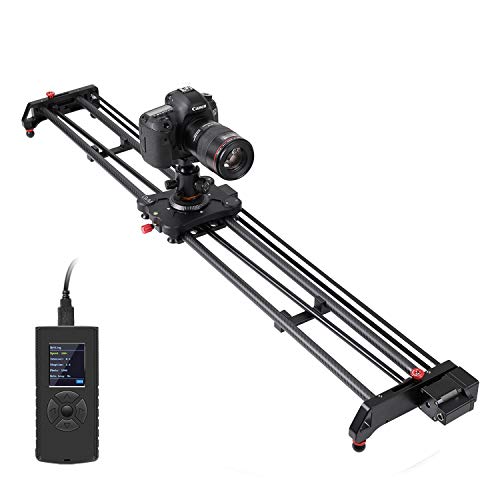
- 48-inch carbon-fiber travel
- Programmable tracking and time-lapse modes
- Includes battery, controller, cables, and bag
Best For: Long tracking, time-lapse, and panoramic shots
Best Portable Pick
Zecti 24-Inch Carbon Fiber Slider

- Lightweight 654g travel-friendly design
- Adjustable legs and multiple mounting threads
- Manual slider supports several shooting directions
Best For: Beginners seeking an easy-to-carry manual slider
Best Automated Option
NEEWER ER1 Motorized Camera Slider

- App-controlled motorized movement
- Manual, video, and time-lapse modes
- Supports up to 11 pounds horizontally
Best For: Beginners who want repeatable motion and time-lapse control
Best Compact Kit

- Includes ball head, phone clamp, and action mount
- Adjustable legs suit uneven surfaces
- Compact 615g design for travel
Best For: Beginners using phones and action cameras
Best App-Controlled Pick
NEEWER DL400 Motorized Camera Dolly

- App control for manual, live, and time-lapse modes
- Quiet dual motors and five speed settings
- Includes NP-F750 battery with up to five hours of runtime
Best For: Beginners who want phone-controlled camera movement
Best Versatile Rail
GVM 27-Inch Motorized Camera Slider

- Supports video, time-lapse, and round-trip shooting
- Works on the ground or with a tripod
- Adjustable feet and multi-angle shooting support
Best For: Beginners learning rail-based camera movement
Best Long-Track Upgrade
GVM 48-Inch Carbon Fiber Slider

- 48-inch rail for extended tracking shots
- App enables detailed programmable motion
- Includes six shutter cables and a carrying bag
Best For: Creators who want long, programmable camera moves
Best Compact Pick – Pocket Manual Camera Dolly
For beginners searching for a camera slider for beginners, the NEEWER SD001 offers a compact way to create straight-line or circular movement without batteries or app setup. Its rubber-padded wheels and adjustable ball head make it practical for tabletop, floor, phone, and lightweight camera shots.
Best For: Beginners creating tabletop, smartphone, action-camera, or lightweight mirrorless-camera moves.
Pros:
- Supports straight and circular movement by adjusting the wheels.
- Quiet rubber wheels work across floors, tables, and camera sliders.
- Includes a rotatable phone clamp with vertical and horizontal positioning.
- Compact 7.76-ounce design is easy to carry outdoors.
Cons:
- Not suitable for telephoto lenses.
- Action-camera adapter is sold separately.
- Manual movement requires consistent hand control.
The SD001 is a straightforward entry point when portability and creative tabletop angles matter more than long tracking distance or automated motion. Check your camera weight and mounting requirements before buying.
Best Smart Mini Slider – Motorized Tabletop PICO
The IFOOTAGE Shark Slider PICO is a useful camera slider for beginners who want repeatable movement with minimal setup. Its onboard controls handle basic A/B moves and looping, while the app adds keyframes for more advanced product, food, time-lapse, and stop-motion videos.
Best For: Solo creators making repeatable tabletop videos with phones, DJI Osmo Pocket cameras, or action cameras.
Pros:
- Provides 255mm of motorized travel and 360-degree pan rotation.
- Onboard controls allow A/B points, speed adjustments, and looping without the app.
- App supports up to eight keyframes for more complex moves.
- Built-in feet, carrying case, and up to seven hours of horizontal battery operation improve portability.
Cons:
- Payload is limited to 2.4 pounds horizontally or 1.1 pounds vertically.
- Additional mounts and a PD 30W-or-higher charger are sold separately.
- Its 15.7-inch travel is intended for shorter tabletop moves.
Choose the PICO if automated, repeatable motion is more important than a full-length rail. Beginners can start with the physical controls and move to app-based keyframes as their setups become more ambitious.
Best Manual Track – Adjustable Carbon Fiber Slider
The Zecti 16-inch slider is a practical camera slider for beginners who want a conventional rail and hands-on control. Its adjustable legs, bubble level, multiple mounting holes, and carbon-fiber construction support horizontal, vertical, and angled setups.
Best For: Beginners learning manual tracking shots with cameras, camcorders, smartphones, or compatible telephoto-lens setups.
Pros:
- Four precision bearings and a double interior carbon-fiber rail system support smooth movement.
- Removable adjustable legs and non-skid feet help with uneven surfaces.
- Multiple 1/4-inch and 3/8-inch mounting holes expand placement options.
- Includes a carrying bag and weighs about 600 grams.
Cons:
- Supplied notes warn that overtightened screws can cause noise and rough movement.
- Phone holder is not included.
- Sixteen-inch travel is shorter than a full-length production slider.
The Zecti is a good learning platform for beginners who want to practice controlling camera speed manually. Be prepared to fine-tune the screws if the carriage feels noisy or stiff.
Best Long-Travel Motorized Pick – 48-Inch GVM Motorized Slider
The GVM 48-inch motorized slider suits beginners who need longer, programmable camera movement for tracking, time-lapse, and panoramic work. It supports automatic round trips, adjustable speed and intervals, and both motorized and manual operation.
Best For: Creators producing longer tracking shots, time-lapses, and panoramic camera moves with heavier camera setups.
Pros:
- Offers 48 inches of travel for extended camera moves.
- Supports adjustable start and end points, speed, torque, intervals, stop times, and automatic looping.
- Includes a battery, charger, controller, shutter cables, extension cable, and carrying bag.
- Carbon-fiber rails and adjustable feet support stable setups.
Cons:
- At 11.8 pounds and 48 inches long, it is less portable than mini sliders.
- Its feature set may be more than beginners need for simple tabletop videos.
- Maximum recommended load is listed as 5 kilograms, so setup weight should be checked carefully.
The GVM is the strongest choice here for beginners planning larger productions rather than casual tabletop work. Its long rail and automation provide room to grow, but the size and weight call for a dedicated shooting setup.
Best Portable Pick – Zecti 24-Inch Carbon Fiber Slider
For beginners looking for a camera slider for beginners setup they can carry easily, the Zecti 24-inch model offers a straightforward manual design with adjustable legs, multiple mounting threads, and compatibility with cameras, phones, and action cameras. Its carbon fiber rails and four precision bearings are intended for quiet, stable movement, though overtightened screws may cause noise or stiffness.
Best For: Beginners who want a lightweight manual slider for travel, tabletop work, and flexible shooting angles.
Pros:
- Lightweight 654g design includes a carrying bag.
- Supports horizontal, vertical, diagonal, and sideways operation.
- Multiple 1/4-inch and 3/8-inch mounting holes support cameras and other gear.
- Adjustable legs, non-skid feet, and a bubble level help with setup.
Cons:
- Manual operation does not provide automated time-lapse movement.
- Movement can become noisy or less smooth if the screws are overtightened.
- Maximum recommended load is 4.4 pounds.
The Zecti is a practical entry point for learning basic slider technique without adding much weight to a camera bag. Check the tension before shooting, especially if the carriage does not glide smoothly.
Best Automated Option – NEEWER ER1 Motorized Camera Slider
If you want a camera slider for beginners that can repeat movements automatically, the NEEWER ER1 adds app control, manual operation, video mode, and time-lapse settings to a longer 31.5-inch rail. Its motor supports substantial horizontal loads, while the included battery is designed for extended shooting.
Best For: Beginners creating time-lapses, product videos, and repeatable camera moves with a motorized system.
Pros:
- App control and optional 2.4G remote control support several operating modes.
- Silent stepper motor allows programmed back-and-forth movement.
- Supports up to 11 pounds horizontally and 5.5 pounds at a 45-degree tilt.
- Includes a 4400mAh NP-F750 battery and carbon fiber construction.
Cons:
- The 2.4G remote control is not included.
- A 5V 2A Type-C portable charger is not included.
- Minor shake may occur during macro photography.
The ER1 is the most feature-rich choice here, but its motor, battery, and app controls add more setup complexity than a manual slider. It makes sense when repeatability matters more than absolute simplicity.
Best Compact Kit – NEEWER CS1M 16-Inch Slider
For beginners assembling a camera slider for beginners kit around a phone or action camera, the NEEWER CS1M is a compact 16-inch option supplied with a 360-degree ball head, phone clamp, and action-camera mount. Its adjustable legs and bubble level make it easier to position on uneven surfaces.
Best For: Beginners who shoot with smartphones, GoPros, Insta360 cameras, or lightweight mirrorless setups.
Pros:
- Includes a phone clamp, action-camera adapter, and adjustable ball head.
- Four precision bearings are designed for smooth, quiet sliding.
- Adjustable legs elevate from 2 to 5cm and help level the slider.
- Supports horizontal, vertical, and 45-degree tilt shooting.
Cons:
- Its 16-inch rail provides less travel than the longer models.
- Maximum load is 4.4 pounds horizontally and 2.2 pounds when tilted or vertical.
- It is not water resistant.
The CS1M is a well-rounded starter kit when portability and included mounting accessories matter. Its shorter rail and lower tilted-load rating make it better suited to compact cameras and close-up content than heavy professional rigs.
Best App-Controlled Pick – NEEWER DL400 Motorized Camera Dolly
For beginners shopping for a camera slider for beginners, the NEEWER DL400 offers a relatively approachable motorized setup with app control, multiple speeds, and a rechargeable battery. Its compact dolly design is suited to controlled movement with compatible DSLR cameras.
Best For: Beginners who want phone-controlled motion for video, live shooting, or time-lapse work.
Pros:
- NEEWER App supports Manual, Live Video, and Time Lapse modes.
- Quiet dual motors operate below 30 dB.
- Includes an NP-F750 battery with up to five hours of runtime.
- Offers five speeds plus a ball head with 360-degree rotation and 90-degree tilt.
Cons:
- Time-lapse photography requires a separately purchased camera shutter cable.
- Its maximum load is 6.6 pounds, so heavier setups may not be suitable.
- The supplied guidance cautions against starting at the fastest speed when moving uphill.
The DL400 is a practical entry point for creators who value wireless control and quiet operation. Beginners should confirm their camera’s compatibility and consider the shutter-cable requirement before choosing it for time-lapse projects.
Best Versatile Rail – GVM 27-Inch Motorized Camera Slider
The GVM 27-Inch motorized slider is a flexible camera slider for beginners who want room to experiment with video, time-lapse, and round-trip shooting. Its aluminum-alloy rail can be used on the ground or with a tripod and supports several shooting angles.
Best For: Beginners seeking a traditional rail slider with multiple mounting options and shooting modes.
Pros:
- Supports time-lapse, video, and automatic round-trip shooting.
- Multiple 1/4-inch and 3/8-inch screw holes support ground or tripod use.
- Adjustable non-slip feet help with leveling and balance.
- Can be used for horizontal, vertical, and 45-degree shooting, with a stated 70-degree tripod slope capability.
Cons:
- Its maximum recommended load is 2.5 kg, limiting heavier camera setups.
- The 27-inch rail is less suited to very long tracking moves.
- It is not water resistant.
This GVM model is a solid learning platform for beginners who want more positioning flexibility than a simple tabletop slider. The included carrying bag and broad device compatibility also make it practical for moving between setups.
Best Long-Track Upgrade – GVM 48-Inch Carbon Fiber Slider
For beginners who want a camera slider for beginners with more reach and advanced controls, this 48-inch GVM model combines a carbon-fiber rail with app operation and programmable movement. It is designed for tracking, panoramic, time-lapse, and video shooting.
Best For: Beginners and growing creators who need long tracking moves and more detailed motion programming.
Pros:
- Provides a 48-inch tracking length for extended camera moves.
- App control supports programmable start and end points, speed, intervals, stopping time, and looping.
- Supports tracking, panoramic, time-lapse, and video capture modes.
- Includes six shutter-release cables, an extension cable, and a carrying bag.
Cons:
- At 4 kg, it is relatively heavy to transport.
- Its listed battery average life is two hours.
- The long 120 cm folded size requires more storage and transport space.
This slider offers substantial room to grow beyond basic motion shots, but its size and weight make it less convenient than compact beginner options. Choose it when long, programmable moves matter more than portability.
How We Picked the Best Camera Slider for Beginners
We focused on the features that matter most when learning camera movement: smooth travel, setup simplicity, portability, mounting flexibility, and control options. The roundup includes manual sliders for hands-on operation, compact models for phones and lightweight cameras, and motorized options for repeatable moves, time-lapse work, and automated panning.
We also considered track length, construction materials, drive systems, app controls, included accessories, and whether each slider can support common cameras, action cameras, or phones. A longer rail can create wider movements, but a compact slider may be easier to level, transport, and use in a small studio.
Quick Comparison
| Slider type | Best for | Main advantage | Potential limitation |
|---|---|---|---|
| Manual compact slider | Phones, action cameras, and beginners | Simple, affordable operation | Movement depends on the user |
| Manual carbon-fiber slider | Travel and lightweight camera kits | Portable track with smooth carriage travel | Usually lacks automated repeatability |
| Motorized slider | Time-lapse and repeatable video moves | Programmable or consistent motion | Needs power and more setup |
| Long slider | Wide cinematic moves | Greater travel distance | Heavier and less convenient to transport |
Key Buying Factors for a Camera Slider for Beginners
Track Length and Portability
Short sliders around 16 inches are easier to use on desks and small sets. Models around 24 to 31.5 inches offer a useful middle ground, while 48-inch sliders are better for broad camera moves but need more room and stronger support.
Manual or Motorized Movement
Manual sliders are easier to understand and typically require less maintenance. Motorized models are worth considering if you want repeatable moves, automated round trips, panoramic shots, or time-lapse sequences. Check how the controls work—some rely on onboard controls, while others use a phone app.
Camera Compatibility and Payload
Confirm the slider’s load capacity before mounting a camera, lens, cage, monitor, or fluid head. Phone clamps and action-camera mounts are useful for lightweight setups, but a larger interchangeable-lens camera may require a sturdier carriage and support points.
Support, Leveling, and Mounting
Look for a stable base, adjustable feet, or compatible tripod mounting points. A ball head can simplify framing, but it does not replace a stable support system. Longer rails are especially likely to benefit from two support points to reduce flex.
Power and Control Features
For motorized models, check battery requirements, charging options, app compatibility, speed control, direction settings, and whether the slider can repeat a programmed move. These details affect how practical it will be on location.
Who Should Buy Which Camera Slider for Beginners?
- New filmmakers on a budget: Choose a compact manual slider to learn camera movement without dealing with batteries or apps.
- Phone and action-camera creators: Look for a model with an included clamp or action-camera mount and a short, portable rail.
- Traveling creators: A carbon-fiber slider around 16 to 24 inches offers a practical balance of portability and motion range.
- Time-lapse and product-video shooters: Choose a motorized slider with repeatable movement and app or interval controls.
- Studio and commercial users: A 31.5- to 48-inch motorized slider is better suited to wide moves, larger sets, and consistent production workflows.
The right Camera Slider for Beginners is the one you can set up securely and use regularly. Start with the shortest, simplest model that supports your camera and planned shots; upgrade to motorized control or a longer track when your projects genuinely require it.