Building a home gym in a spare room, garage corner, or apartment does not mean giving up barbell training. The best squat racks for small spaces balance a compact footprint with dependable support for squats, presses, pulls, and other foundational lifts.
This roundup compares 10 space-conscious racks, from folding wall-mounted designs to portable stands and full power cages, so you can choose equipment that fits your room, training style, and available barbell length.
Best 10 Squat Racks for Small Spaces Picks for 2026
Best Wall-Mounted Pick

- Folds to about a 2-inch projection for storage
- 1,000-pound stated capacity
- Includes pull-up, safety, and row attachments
Best For: Wall-mounted home gyms with very limited floor space
Best Adjustable Half Rack

- Compact footprint for rooms, garages, or basements
- 22 height settings and adjustable width
- 950-pound stated capacity with safety arms
Best For: Compact freestanding training setups
Best Full-Featured Cage

- 1,000-pound stated capacity
- Includes pulley, dip, landmine, and storage attachments
- 63-inch depth and 47-inch width
Best For: Dedicated home or garage gyms needing one multifunction station
Best Portable Stands
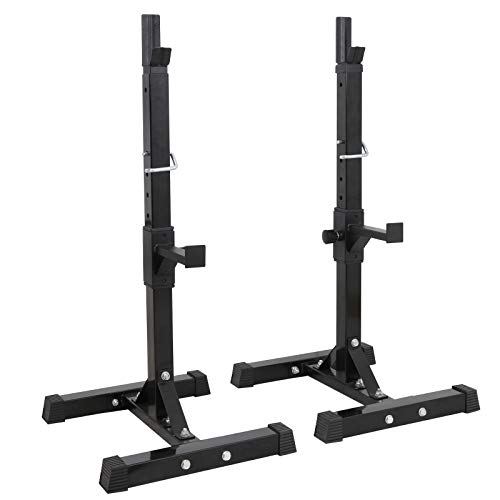
- Very compact 17.7-by-20.1-inch listed footprint
- Height adjusts from 40 to 66 inches
- 550-pound stated capacity with 13-position spotters
Best For: Small rooms and portable squat or bench setups
Most Versatile

- Folds to 4.3 square feet
- Five training configurations
- Dual independent pulley system
Best For: Compact home gyms needing rack and cable functionality
Best Compact Value
K KiNGKANG Adjustable Squat Rack
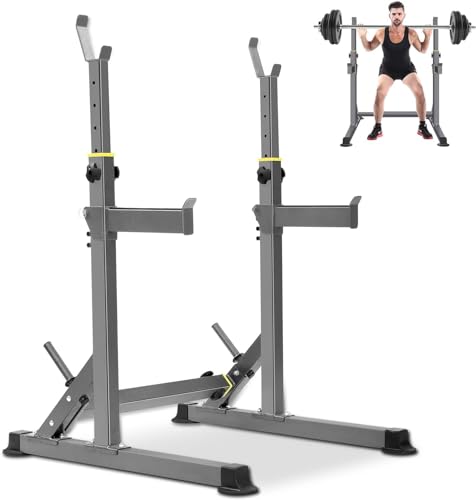
- Foldable and portable frame
- Adjustable width and height
- Listed 600-pound load capacity
Best For: Essential barbell training in apartments and smaller home gyms
Best Full-Size Setup

- Power cage with pulley system
- 28 adjustable rack positions
- Integrated plate and bar storage
Best For: Dedicated home gyms with room for a full cage
Best Adjustable Value
KiNGKANG Adjustable Squat Rack

- 13 height and 10 width settings
- 690-pound stated capacity
- Includes barbell storage and rubber feet
Best For: Flexible home workouts with varied users
Best Space-Saving Power Rack
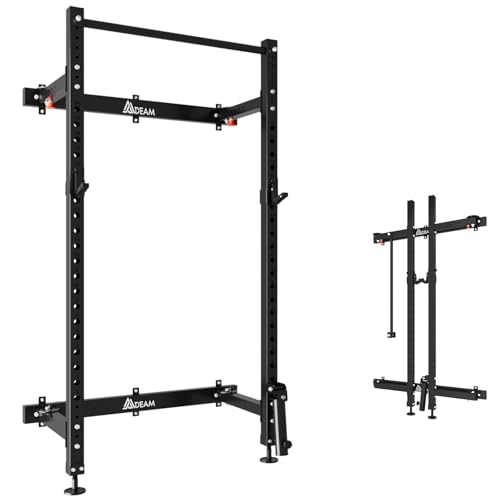
- Folds for storage in about 15 seconds
- Wall-mounted steel frame rated to 1,000 pounds
- Includes pull-up bar, J-hooks, and landmine
Best For: Garages and basements with suitable wall space
Best Compact Freestanding Stand

- Adjusts from 35.1 to 41.8 inches wide
- 600-pound stated capacity with H-shaped base
- Includes barbell storage racks
Best For: Wall-free home strength training
Best Wall-Mounted Pick – Mikolo Folding Squat Rack
For lifters prioritizing floor space, this folding wall-mounted rack is one of the more space-conscious squat racks for small spaces. It folds from a 19.7-inch projection to a roughly 2-inch folded profile and includes a pull-up bar, J-hooks, safety catches, and a T-bar row attachment.
Best For: Home gyms with an available wall and limited floor space.
Pros:
- Folds for storage in about 15 seconds.
- 2-by-2-inch, 13-gauge steel uprights are rated for up to 1,000 pounds.
- Includes a pull-up bar, protective J-cups, safety catches, and T-bar row attachment.
- Mounting stringer and metal studs are included.
Cons:
- Requires secure wall mounting and suitable installation space.
- Its 47-inch width and 85.8-inch height still need to fit your room.
This is the strongest space-saving choice here when wall mounting is practical. Its folding design preserves usable floor area, while the included attachments support more than basic squats and presses.
Best Adjustable Half Rack – FLYBIRD SR1 Squat Rack
The FLYBIRD SR1 is a practical option among squat racks for small spaces, combining a compact footprint with adjustable width for 6- and 7-foot barbells. Its 22 height settings and extended safety arms make it suitable for varied home strength routines.
Best For: Lifters who want a compact, freestanding rack with flexible adjustments.
Pros:
- Compact design measures about 39 by 41.3 by 83 inches according to the product description.
- Supports up to 950 pounds with 2-by-2-inch steel construction.
- Offers 22 height positions and adjustable width for 6- and 7-foot barbells.
- Includes extended safety arms, a landmine attachment, band pegs, and a padded pull-up bar.
Cons:
- Its 83-inch height may be restrictive in rooms with low ceilings.
- It is a half rack rather than a fully enclosed power cage.
Choose this model if you want freestanding flexibility without dedicating an entire room to a rack. The adjustable dimensions and included attachments add versatility while keeping the design relatively compact.
Best Full-Featured Cage – ULTRA FUEGO Power Cage
The ULTRA FUEGO is a full power cage for buyers who want one station to cover many exercises. It is larger than other squat racks for small spaces, but its included pulley system, landmine, dip handles, and storage pegs can consolidate multiple pieces of equipment.
Best For: Dedicated home or garage gyms that can accommodate a 63-by-47-inch footprint.
Pros:
- Supports up to 1,000 pounds with 50-by-50-millimeter uprights and heavy steel bases.
- Includes a pulley system, lat-pulldown bar, landmine, dip handles, J-hooks, and safety bars.
- Provides multiple adjustment levels for J-hooks, safety bars, and dip handles.
- Six weight-plate storage pegs and four band pegs help organize accessories.
Cons:
- Its 63-inch depth and 82.7-inch height require more room than a folding or standalone rack.
- The many attachments may make setup and organization more involved.
This cage is best viewed as a compact all-in-one gym rather than a minimal rack. It uses more floor space, but the broad accessory package may reduce the need for separate cable, dip, and landmine stations.
Best Portable Stands – F2C Adjustable Squat Rack
These separate adjustable stands are a straightforward choice for shoppers comparing squat racks for small spaces. With a footprint of about 17.7 by 20.1 inches and a height range up to 66 inches, they take up less room than a full rack and can be used for squats or bench pressing.
Best For: Beginners and space-conscious lifters who prefer portable barbell stands.
Pros:
- Small listed footprint of 17.7 inches deep by 20.1 inches wide.
- Height adjusts from approximately 40 to 66 inches.
- 13-position safety spotter arms support different exercises and user heights.
- H-shaped bases and rubber pads help with stability and floor protection.
Cons:
- 550-pound capacity is lower than the other listed options.
- Separate stands provide less enclosed support than a power cage.
- Connections should be fully tightened with a wrench before use.
This F2C set makes sense when minimal footprint and portability matter more than maximum capacity or extensive attachments. Its adjustable spotters add useful protection, but serious lifters should compare the 550-pound rating with their planned loads.
Most Versatile – WM3-V4 Folding Squat Rack
For shoppers comparing squat racks for small spaces, the WM3-V4 stands out as a multifunctional wall-mounted system that folds for storage. It occupies 4.3 square feet when folded and expands to 12.3 square feet for training, while combining rack, pulley, cable crossover, lat pulldown, and pull-up functions.
Best For: Apartment, garage, or basement users who want one compact setup for strength and cable training.
Pros:
- Folds down to 4.3 square feet for storage.
- Offers five configurations and 15 pulley-height adjustments.
- Supports more than 80 listed exercises, including squats, deadlifts, rows, and pull-ups.
- Dual independent pulleys support simultaneous workouts and supersets.
Cons:
- Wall-mounted installation requires careful setup and suitable mounting space.
- Ships in two boxes, so components may arrive separately.
- Its broad feature set may be more than users seeking a basic squat stand need.
This is the most feature-rich option in the group, especially if cable exercises matter as much as barbell work. Its folding design helps reclaim floor space, but buyers should plan the installation before ordering.
Best Compact Value – K KiNGKANG Adjustable Squat Rack
The K KiNGKANG is a straightforward choice among squat racks for small spaces, with a foldable frame and adjustable width and height. It is designed for home squats, bench presses, shoulder presses, and other barbell movements without the footprint of a larger power cage.
Best For: Home lifters who want a portable, adjustable rack for essential barbell exercises.
Pros:
- Foldable design suits apartments, garages, and basements.
- Width adjusts from 27.9 to 47.2 inches.
- Height adjusts from 33.85 to 64.9 inches.
- Heavy-duty steel frame is listed with a 600-pound maximum load.
Cons:
- It does not include the pulley and cable-training features found on the other listed systems.
- The supplied dimensions list a maximum height of 65.5 inches, which may be limiting for some overhead movements.
- Warranty coverage is 180 days for manufacturing defects.
Choose this rack when adjustability and storage matter more than having a full power-cage enclosure. It provides a practical foundation for core barbell lifts while keeping the equipment relatively portable.
Best Full-Size Setup – SunHome Power Cage Squat Rack
The SunHome Power Cage offers a more complete home-gym setup, pairing a power cage with a pulley system, cable crossover, dip handles, J-hooks, and storage. Although it is less compact than a folding rack, its built-in organization can help keep a dedicated training area orderly.
Best For: Users with a dedicated workout area who want a high-capacity cage and multiple exercise stations.
Pros:
- Power cage supports squats, bench presses, pull-ups, dips, and push-ups.
- Offers 28 adjustable positions for J-hooks and spotter arms.
- Includes pulley and adjustable cable crossover functionality.
- Built-in storage includes four weight-plate posts and two barbell hooks.
Cons:
- At 46.9 inches deep, 42.4 inches wide, and 84.9 inches high, it needs more room than folding racks.
- The 84.9-inch height may require checking ceiling clearance before purchase.
- Its 115-pound frame is less convenient to move than a portable squat rack.
This is the strongest fit for a permanent home gym rather than a room that must be cleared after each workout. Measure both floor space and ceiling height carefully, then take advantage of its storage and exercise-station versatility.
Best Adjustable Value – KiNGKANG Adjustable Squat Rack
For shoppers comparing squat racks for small spaces, the KiNGKANG adjustable rack offers a flexible freestanding setup with adjustable height and width. Its 13 height settings and 10 width settings make it easier to fit different users and training areas, while the rubber feet help protect flooring.
Best For: Home lifters who want a highly adjustable rack for squats, presses, and other barbell exercises.
Pros:
- Height adjusts from 36.2 to 60 inches, with 10 width settings from 29.9 to 46.3 inches.
- Thick 2-inch carbon-steel tubing supports up to 690 pounds.
- Rubber feet improve stability and help reduce floor scratching.
- Includes two removable barbell storage racks and trap-bar cylinders.
Cons:
- Its freestanding design requires dedicated floor space and is not foldable.
- The many adjustment settings may require more setup than a fixed rack.
This is a strong choice when adjustability matters more than absolute compactness. Measure your available area carefully, especially because the listed dimensions extend to about 46.4 inches wide and 37 inches deep.
Best Space-Saving Power Rack – Mdeam Folding Squat Rack
If floor space is your main concern, the Mdeam folding rack is one of the more space-conscious squat racks for small spaces. It mounts to the wall and folds from its open position for storage, making it suitable for garages, basements, and compact home gyms where a permanent freestanding footprint is inconvenient.
Best For: Home gym users who can wall-mount a rack and want to reclaim floor space between workouts.
Pros:
- Folds in about 15 seconds, with a listed folded size of 44×87 inches.
- 60×60 mm steel uprights and a stated 1,000-pound capacity provide a robust structure.
- Wall mounting helps reduce movement and tipping during training.
- Includes a pull-up bar, J-hooks, landmine, and stabilizer leveling feet.
Cons:
- Requires suitable wall mounting and installation space.
- The listed open dimensions are 44×25×87 inches, so ceiling height and clearance need checking.
- It is heavier and more involved to install than a simple freestanding stand.
The folding design is the key advantage here, but compactness depends on having a suitable wall and enough overhead clearance. Confirm the mounting surface and follow the included installation instructions before loading the rack.
Best Compact Freestanding Stand – CANPA Adjustable Squat Rack
The CANPA adjustable stand is a practical option among squat racks for small spaces because its freestanding design avoids wall installation and its width adjusts from 35.1 to 41.8 inches. The H-shaped base, non-slip feet, and safety locking system are designed to provide support for bench presses, squats, and overhead lifts.
Best For: Lifters who want a straightforward adjustable stand for home strength training without wall mounting.
Pros:
- Adjustable height and width accommodate different users and exercises.
- 2×2-inch steel tubing supports up to 600 pounds.
- H-shaped base and non-slip foot covers improve stability and help protect floors.
- Includes two barbell storage racks and works with a bench, barbell, or dumbbells.
Cons:
- Only six height settings are listed, offering less adjustment than some competing racks.
- As a freestanding stand, it does not fold away for storage.
- The nuts require two wrenches for proper tightening.
Choose this model if you need a compact, adjustable rack without committing to wall installation. Its listed footprint is about 23.5 inches deep by 41.8 inches wide, so it remains important to leave room for the lifter and barbell.
How We Picked These Squat Racks for Small Spaces
We focused on racks that address the main challenges of compact training areas: limited floor space, restricted ceiling height, storage needs, and the need to move or fold equipment when the room has another purpose. The selection includes wall-mounted folding racks, adjustable squat stands, half racks, and power cages with optional cable or accessory systems.
We also considered listed weight capacity, barbell compatibility, adjustability, safety features, included attachments, installation requirements, and whether a rack is better suited to light home workouts or heavier progressive training. Always verify the manufacturer’s specifications and hardware requirements before installation or use.
Quick Comparison
| Rack type | Best for | Main advantage | Potential limitation |
|---|---|---|---|
| Folding wall-mounted rack | Very small rooms | Folds away after training | Requires secure wall mounting |
| Adjustable squat stands | Portability and flexibility | Easy to reposition or store | Usually less stable than a cage |
| Half rack | General barbell training | Good balance of stability and footprint | May need separate storage solutions |
| Power cage | Frequent heavy training | Enclosed support and more attachments | Uses more floor and ceiling space |
| Rack with pulleys | Mixed strength workouts | Adds cable exercises without another machine | More parts and setup complexity |
Key Buying Factors for Squat Racks for Small Spaces
Measure the Full Setup
Measure height, width, depth, and clearance around the rack—not just its advertised footprint. Account for the barbell’s sleeve length, plate loading space, bench position, and room to walk safely. Folding models still need enough clearance to open fully.
Check Stability and Mounting
Freestanding stands should have a broad, stable base and secure adjustment points. Wall-mounted racks must attach to suitable structural framing or masonry using appropriate hardware. Do not rely on drywall alone. A rack’s stated capacity does not replace proper installation or safe lifting practices.
Match the Rack to Your Barbell
Compact racks may be designed around standard, seven-foot, or shorter barbells. Confirm the usable bar width, J-hook spacing, height range, and whether your bench fits between the uprights. Adjustable height is particularly useful when multiple people share the gym.
Consider Storage and Accessories
Dip handles, pull-up bars, landmine attachments, cable systems, and plate storage can expand training options, but they may increase the rack’s footprint and price. Choose only the accessories you will use regularly.
Who Should Buy Which Squat Racks for Small Spaces?
Choose a folding wall-mounted rack if reclaiming floor space is your top priority and you can install it securely. Select adjustable squat stands if you need portability, simple storage, or a lower-cost setup. A half rack is a strong middle ground for regular squats, presses, and bench work. Choose a full power cage if maximum containment and progressive strength training matter more than a minimal footprint. If you want one station for barbell and cable exercises, a pulley-equipped rack may justify its additional space and setup demands.