The best incline treadmill for a home gym should match your available space, training goals, user weight, and preferred workout intensity. These 10 models cover everyday walking, steady running, steep hill training, and heavy-duty use.
Before choosing, compare incline range, deck dimensions, motor output, folding design, speed controls, and weight capacity—not just the advertised horsepower or maximum grade.
Best 10 Incline Treadmill for Home Gym Picks for 2026
Best Heavy-Duty Pick

- 500-pound maximum user weight
- 0–15% automatic incline
- 55-by-20-inch cushioned belt
Best For: Users prioritizing capacity and a spacious running area
Best Guided-Workout Option

- 0–10% incline range
- iFIT-guided automatic adjustments
- KeyFlex cushioned deck
Best For: Users who want connected trainer-led workouts
Best for Steep Inclines

- Up to 40% manual incline
- 51-inch extended handrails
- 350-pound maximum user weight
Best For: Taller users focused on steep incline walking
Best Compact Heavy-Duty Value

- 400-pound maximum user weight
- 1–15% automatic incline
- Hydraulic folding and voice control
Best For: Users needing capacity and convenient storage
Compact Everyday Trainer
10% Manual Incline Home Treadmill
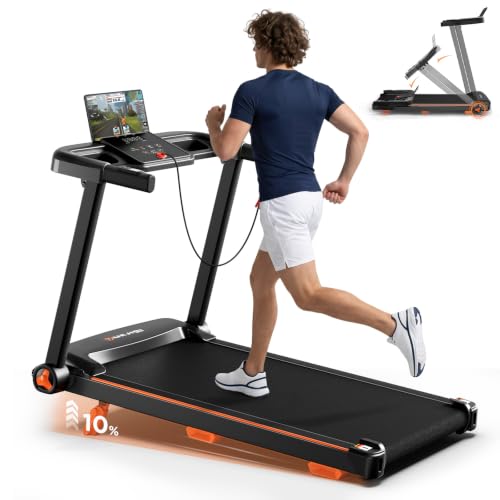
- 10% manual incline adds hill-focused challenge.
- Foldable 55-pound design suits small spaces.
- 300-pound capacity with 12 programs and Bluetooth.
Best For: Walkers, beginners, and space-conscious home gyms
Feature-Rich Running Station

- 20% automatic incline with 36 preset programs.
- Wide 18.5-inch belt and shock absorption.
- 350-pound capacity with Bluetooth and device desk.
Best For: Runners and larger users wanting varied, roomier workouts
Steep Hill Specialist

- 40% incline across five manual levels.
- Extended handrails and 350-pound capacity support stability.
- Quiet, foldable design with cushioning and transport wheels.
Best For: Steep hill walking, hiking preparation, and compact home gyms
Best with Extra Features
20-Level Auto-Incline Treadmill
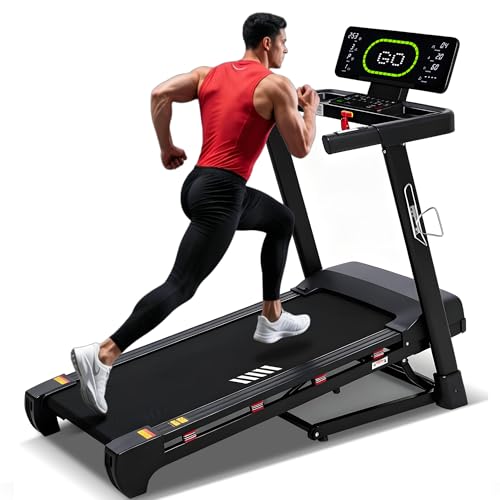
- 20 automatic incline levels and 12 MPH top speed
- 500-pound capacity with a 4.5 HP brushless motor
- 20-inch deck with cushioning and folding storage
Best For: Serious runners and high-capacity home gyms
Best Budget Space Saver
Compact 12% Manual-Incline Treadmill

- 12% manual incline for added walking intensity
- 41-pound foldable frame fits small spaces
- Quiet motor supports users up to 300 pounds
Best For: Walkers and apartment users with limited storage
Best Quiet Auto-Incline Pick
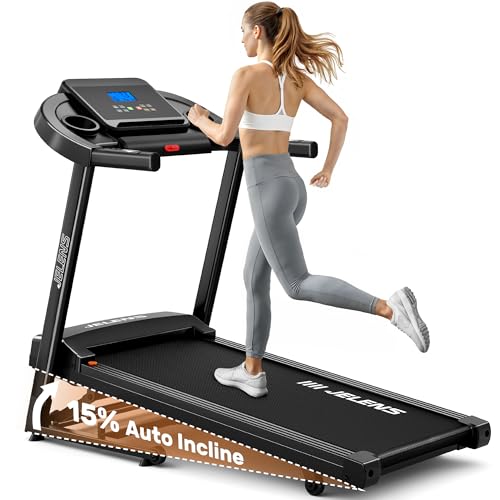
- 15 automatic incline levels with one-touch adjustment
- Below-40 dB motor and 330-pound capacity
- Foldable design with Bluetooth app connectivity
Best For: Quiet home walking and moderate jogging
Best Heavy-Duty Pick – 15% Incline Home Treadmill
If you need an incline treadmill for home gym workouts that can handle walking, jogging, and running, the WELLFIT TM029 combines a 15% auto incline with a 500-pound maximum user weight. Its 10 MPH top speed, roomy belt, and shock-absorbing deck make it a versatile choice for varied household training.
Best For: Users who want high weight capacity, automatic incline, and a spacious running surface.
Pros:
- Supports up to 500 pounds and reaches 10 MPH.
- Automatic incline adjusts from 0% to 15%.
- 55-by-20-inch belt includes five layers and eight shock absorbers.
- Bluetooth app connectivity, speakers, pulse sensors, and 12 programs.
Cons:
- At 120 pounds, it may require more effort to move.
- The 10 MPH maximum is below some performance-oriented treadmills.
Choose this model when stability and capacity matter more than a compact footprint. The combination of a wide deck, quiet brushless motor, and automatic incline gives it broad appeal for home cardio routines.
Best Guided-Workout Option – NordicTrack T Series
The NordicTrack T Series is an incline treadmill for home gym users who prefer guided training and connected features. It offers speeds up to 10 MPH, a 0–10% incline range, KeyFlex cushioning, and compatibility with iFIT workouts through a phone or tablet.
Best For: Walkers and runners who want trainer-led sessions, app integration, and automatic workout adjustments.
Pros:
- Supports speeds up to 10 MPH and incline up to 10%.
- iFIT can automatically adjust speed and incline during supported workouts.
- KeyFlex cushioning is designed to reduce joint impact.
- Can sync selected workout data with Strava, Garmin, and Apple.
Cons:
- Many smart features require an iFIT Train Membership.
- Its 18-inch-wide deck is narrower than some competing models.
- The listed maximum user weight is 300 pounds.
This is a strong fit for buyers motivated by structured programming rather than extensive built-in hardware controls. Confirm the membership requirements and available space before choosing it for your home gym.
Best for Steep Inclines – 40% Incline Walking Treadmill
For buyers seeking an incline treadmill for home gym hill and stair-style training, the CURSOR stands out with five manual settings reaching 40%. Its extended 51-inch handrails, reinforced base, and low-speed range make it especially suited to supported incline walking.
Best For: Taller users and walkers who want steep manual incline training with added handrail support.
Pros:
- Offers 0%, 10%, 20%, 30%, and 40% manual incline settings.
- Extended 51-inch handrails support a more upright posture.
- Supports users up to 350 pounds.
- Seven-layer belt and eight silicone shock absorbers add cushioning.
Cons:
- Manual incline requires changing the settings rather than automatic adjustment.
- Its 6.2 MPH listed speed range is better suited to walking and light jogging than fast running.
- The one-year manufacturer warranty is shorter than some alternatives.
The CURSOR is specialized rather than all-purpose: its headline strength is steep elevation work, not high-speed running. Its foldable design and transport wheels can also help users who need to store the treadmill between sessions.
Best Compact Heavy-Duty Value – 400-Pound Folding Treadmill
The WELLFIT 400+LB model is an incline treadmill for home gym users who need substantial capacity without giving up folding storage. It combines a 4.0 HP motor, 0–15% automatic incline, 400-pound capacity, and Bluetooth, app, and voice-control features.
Best For: Households wanting a foldable, high-capacity treadmill for walking, jogging, and incline workouts.
Pros:
- Supports up to 400 pounds with a reinforced alloy-steel frame.
- Offers 1–15 incline levels with console or voice adjustment.
- Folds with a soft-drop hydraulic system for easier storage.
- Includes 40 programs, Bluetooth connectivity, and an 18-by-43-inch cushioned belt.
Cons:
- The 8.8 MPH maximum speed is lower than the fastest running treadmills.
- The 43-inch deck length may feel short for users with a long running stride.
- The supplied notes list a 400-pound capacity but do not specify a full running-belt length beyond the 43-inch deck.
This model balances capacity, incline versatility, and storage-friendly design. It is most compelling for home users who want frequent incline cardio and a treadmill that can be folded away after training.
Compact Everyday Trainer – 10% Manual Incline Home Treadmill
If you want an incline treadmill for home gym use without committing to a bulky machine, this folding model focuses on practical daily cardio. Its manual 10% incline adds hill-focused challenge, while the 0.8–8.5 MPH speed range covers walking, jogging, and steady running.
Best For: Walkers, beginners, families, and small-space home gyms that need a foldable treadmill with moderate incline capability.
Pros:
- Manual incline provides added challenge without requiring a faster pace.
- Foldable design and 55-pound frame suit bedrooms, apartments, and multipurpose rooms.
- Supports up to 300 pounds and includes cushioning features, 12 programs, Bluetooth, and hand-pulse monitoring.
Cons:
- The 42 x 16-inch deck is more compact than the running surface on larger models.
- Manual incline requires adjustment rather than on-the-fly automatic control.
- Maximum speed is 8.5 MPH, which may be limiting for faster runners.
This is a sensible choice when storage, straightforward controls, and everyday versatility matter more than a large belt or steep powered incline. The 300-pound capacity and family-oriented speed range add useful flexibility for shared home use.
Feature-Rich Running Station – 20% Auto Incline Treadmill
For shoppers seeking an incline treadmill for home gym training, the ATEEDGE combines automatic elevation with a wide belt and a faster 10 MPH top speed. It is built for users who want more workout variety, stronger incline progression, and room to walk or run comfortably.
Best For: Larger users, runners, and home exercisers who value a wide deck, automatic incline, substantial program selection, and work-friendly features.
Pros:
- 20% automatic incline and 36 built-in programs support varied hill and endurance workouts.
- 18.5 x 45.5-inch belt provides more lateral room, with shock absorption for a smoother stride.
- 350-pound capacity, Bluetooth connectivity, handlebar controls, and a 10 x 26-inch device desk add versatility.
Cons:
- At 94 pounds, it is less convenient to move than a lightweight folding model.
- The 54.13-inch depth and nearly 27-inch width require more dedicated floor space.
- The desk may be useful for walking and working, but it can be unnecessary for focused running workouts.
With its wide belt, 20% automatic incline, and 350-pound capacity, this model is geared toward a more substantial home setup. It makes the strongest case for buyers who want training variety and a roomier platform rather than the smallest possible footprint.
Steep Hill Specialist – 40% Incline Walking Pad
This high-incline treadmill for home gym use is designed around steep walking rather than high-speed running. Five manual incline levels reach 40%, while the foldable frame, long handrails, and quiet brushless motor make it practical for hill training in a home office, bedroom, apartment, or compact gym.
Best For: Users focused on steep incline walking, hiking preparation, stair-style cardio, and low-speed home workouts.
Pros:
- 40% maximum incline and five manual levels provide unusually steep hill-training options.
- 51-inch dual handrails, reinforced support feet, and 350-pound capacity emphasize stability.
- Under-45dB operation, foldable storage, transport wheels, and cushioning support home convenience.
Cons:
- The 6.2 MPH maximum speed is better suited to walking, jogging, and light running than fast running.
- Incline changes are manual and require selecting among preset levels.
- The 38.6 x 15.4-inch belt is narrower and shorter than the ATEEDGE’s running surface.
The LONTEK stands out for buyers who specifically want steep elevation in a relatively compact machine. Its slower speed range and manual adjustments are trade-offs, but the high incline, extended handrails, and stability-focused construction make it a specialized option for challenging hill walks.
Best with Extra Features – 20-Level Auto-Incline Treadmill
If you want an incline treadmill for home gym workouts that can handle serious training, this model combines a 20-level automatic incline, speeds up to 12 MPH, and a reinforced 500-pound-capacity frame. Its wide deck and cushioning system also make it a practical option for runners who prioritize stability and comfort.
Best For: Runners and households seeking a sturdy, high-capacity treadmill for walking, running, hill training, or HIIT workouts.
Pros:
- 20 automatic incline levels and speeds from 0.6 to 12 MPH support varied workouts.
- 4.5 HP brushless motor and 500-pound weight capacity provide heavy-duty support.
- 20-inch-wide deck, dual-layer cushioning, and multiple shock absorbers improve running comfort.
- Folding design, Bluetooth speakers, app connectivity, and 36 preset programs add convenience.
Cons:
- At 128 pounds, it is substantially heavier than compact home treadmills.
- The 62-inch deck and 30-inch overall width require a dedicated workout area.
- It includes a one-year manufacturer warranty.
This is the strongest choice of the three for demanding home training. Its generous incline range, wide running surface, and high weight rating make it better suited to serious runners than space-focused buyers.
Best Budget Space Saver – Compact 12% Manual-Incline Treadmill
This compact incline treadmill for home gym use is designed for buyers with limited space and moderate training needs. It offers a 12% manual incline, speeds up to 6.2 MPH, and a folding frame that can be stored under a bed or in a closet.
Best For: Walkers, light joggers, and apartment dwellers who want an affordable, compact treadmill with hill-training capability.
Pros:
- 12% manual incline helps add hill-style intensity without requiring a large machine.
- Quiet 3.0 HP brushless motor operates below 50 dB and supports up to 300 pounds.
- Lightweight 41-pound frame folds to a 5.5-inch height for easier storage.
- Smart memory saves workout data when paused, while six-layer cushioning helps reduce impact.
Cons:
- The 6.2 MPH maximum speed is better suited to walking and light jogging than fast running.
- The 38-by-15-inch running surface is narrower and shorter than the other options here.
- The incline is manual, so it cannot be adjusted electronically during a workout.
This model makes the most sense when storage and portability matter more than running speed or deck size. Its compact design is convenient, but taller users and serious runners may prefer a larger treadmill.
Best Quiet Auto-Incline Pick – JELENS 15% Folding Treadmill
For a quieter incline treadmill for home gym spaces, the JELENS model pairs 15 levels of automatic incline with a 7.5 MPH top speed and a motor rated below 40 decibels. Its folding frame, app connectivity, and pulse sensors make it a versatile choice for walking, jogging, and guided workouts.
Best For: Home users who want automatic hill adjustments, quiet operation, and a foldable treadmill for walking or moderate jogging.
Pros:
- 15% automatic incline adjusts electronically through 15 slope levels.
- Quiet 3.0 HP motor operates below 40 dB and supports up to 330 pounds.
- Folding design, transport wheels, and hydraulic slow-down folding support easier storage.
- Bluetooth app connectivity, pulse sensors, and an LCD display track key workout metrics.
Cons:
- The 7.5 MPH maximum speed is more suitable for walking and jogging than fast running.
- The 15.75-by-43.31-inch belt is narrower and shorter than the heavy-duty model’s deck.
- Its automatic incline and app features may be more than casual walkers need.
The JELENS offers a useful middle ground between compact storage and automated incline training. It is especially appealing for buyers who want a quieter machine with connected features, though dedicated runners may want a faster treadmill with a longer deck.
How We Picked the Best Incline Treadmill for Home Gym
We selected these treadmills based on the features that matter most in a home setting: incline capability, speed range, deck size, motor rating, folding convenience, stated user capacity, and overall versatility. The lineup includes standard 10% to 15% incline machines, steep-incline models reaching 20% or more, and compact options designed for smaller rooms or walking-focused workouts.
Because specifications and included features can vary by listing or model variant, confirm the exact deck dimensions, warranty, assembly requirements, noise level, and subscription requirements before purchasing.
Quick Comparison
- Best for general home workouts: Choose a model with automatic incline, at least a 10 MPH top speed, and a reasonably wide running deck.
- Best for hill training: Look for 20% to 40% incline capability, while checking whether the incline is automatic, manual, or limited to specific speeds.
- Best for heavier users: Prioritize the highest verified weight capacity, a stable frame, a wide deck, and a strong return or warranty policy.
- Best for small spaces: A foldable treadmill or walking pad can reduce storage demands, but compact decks may feel restrictive for running.
- Best for budget-conscious buyers: Focus on the essentials—safe speed control, adequate cushioning, reliable incline operation, and a suitable deck—rather than entertainment extras.
Key Buying Factors for an Incline Treadmill for Home Gym
Incline Type and Range
Automatic incline is convenient for interval workouts and lets you adjust intensity without stepping off the belt. Manual incline models may cost less but require stopping to change the grade. A 10% to 15% range suits most walking and general fitness routines; steeper settings are useful for short hill intervals but can increase strain on the calves, knees, and motor.
Motor, Speed, and Deck Size
For frequent running, compare continuous-duty motor specifications where available, not only peak horsepower. A top speed around 10 to 12 MPH is generally more practical for runners than a walking-focused machine. Stride length and running pace also determine deck needs: a longer, wider surface improves comfort and reduces the chance of stepping near the edges.
Capacity, Stability, and Safety
Choose a treadmill with a stated user capacity comfortably above the heaviest intended user. A heavier frame, extended handrails, emergency stop key, stable side rails, and a non-slip belt can make incline sessions more secure. Leave clearance around the machine and use it on a level floor.
Storage and Daily Convenience
Measure the treadmill both unfolded and folded, including ceiling clearance for steep incline positions. Check wheel placement, folding assistance, belt lubrication needs, display readability, preset programs, pulse sensors, and whether app connectivity or paid memberships are optional or required.
Who Should Buy Which Incline Treadmill for Home Gym?
Walkers and beginners should choose a foldable model with simple controls, moderate incline, cushioning, and a comfortable handrail. Runners should prioritize a longer deck, higher speed, responsive controls, and a motor suited to frequent use. Users training for hills will benefit from a steep-incline treadmill, but should verify that the maximum grade works at the desired speed.
Heavier users or multiple-person households should favor the strongest capacity rating and a wide, stable deck over the smallest folded footprint. Apartment or office users may prefer a compact walking pad, provided its lower rails, shorter deck, and noise profile fit their routine. Whichever model you select, compare the exact variant and current seller terms before ordering.