A good cellular trail camera for wildlife lets you check activity without hiking into the area and disturbing the pattern you’re trying to learn. For hunters, landowners, and wildlife watchers, that means faster decisions and less wasted time.
In this roundup, we focused on models that balance reliable LTE performance, useful app access, strong image quality, and practical power options for long-term field use.
Best 10 Cellular Trail Camera for Wildlife Picks for 2026
Top Pick for Long-Run Scouting
TACTACAM Reveal X 3.0 Cellular Trail Camera

- Auto-connects to stronger AT&T or Verizon signal
- Built-in storage means no SD card is needed
- Up to 6+ month battery life with GPS tracking
Best For: Long-term scouting and remote property monitoring
Best for Smart Buck Detection
Moultrie Edge 3 Cellular Trail Camera

- AI buck detection helps cut false alerts
- 40MP photos plus 1080p video
- Auto-connects to four major U.S. networks
Best For: Deer hunters who want smarter alerts and quick scouting
Best Value Two-Pack
Moultrie Edge 3 Cellular Trail Camera 2-Pack
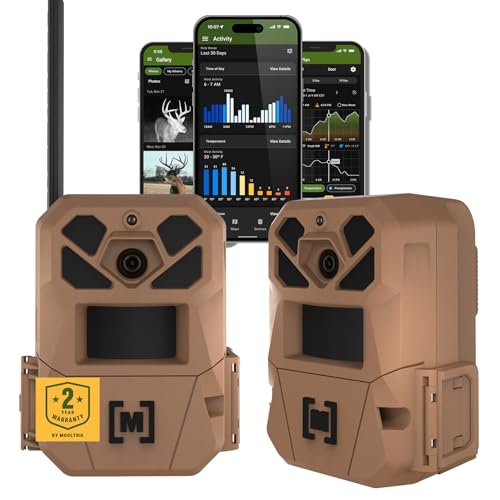
- Two-camera bundle for wider coverage
- AI buck detection with instant alerts
- 40MP photos and 0.5-second trigger
Best For: Covering multiple scouting spots with one purchase
Season-Long Power Pick
Moultrie Edge Solar Cellular Trail Camera

- Integrated solar panel and rechargeable battery
- AI buck detection with instant alerts
- Auto-connects to four major U.S. networks
Best For: Premium scouting with solar power and smarter alerts
Dual-Pack Non-Cellular Pick
GardePro E5S 2-Pack Trail Camera

- 64MP photos and 1296P HD video
- 0.1s trigger speed with 3 PIR sensors
- No-cellular, IP66 waterproof design
Best For: Low-cost wildlife scouting without remote transmission
App-Connected Value Pack

- Cellular photo transmission through the app
- Free plan includes up to 100 photos monthly
- Dual-SIM LTE with GPS and multiple capture modes
Best For: Remote wildlife monitoring on a budget
Live-View Solar Upgrade
2K Pan-Tilt Cellular Trail Camera

- 2K live view with 355° pan and 100° tilt
- Built-in SIM card and 7-day free data trial
- 6W solar panel with 10,400 mAh battery
Best For: Real-time wildlife viewing in remote locations
Top Pick for Long-Run Scouting – TACTACAM Reveal X 3.0 Cellular Trail Camera
If you want a cellular trail camera for wildlife that can stay out longer and keep sending images without much fuss, the TACTACAM Reveal X 3.0 is built for that job. It auto-connects to AT&T or Verizon based on the stronger signal, uses built-in storage so you do not need an SD card, and is designed for fast setup from the REVEAL app.
Best For: Hunters and landowners who want a low-maintenance camera for remote property monitoring and wildlife scouting.
Pros:
- Auto-connect multi-carrier LTE chooses the stronger AT&T or Verizon signal.
- Up to 6+ month battery life helps reduce trips into the woods.
- Built-in GPS and no SD card required simplify setup and tracking.
- Sub-half-second trigger and 3-shot burst help catch fast-moving game.
Cons:
- Battery life depends on how often the camera is triggered and how it is powered.
- Best results rely on cellular coverage at the camera location.
For buyers prioritizing long deployment and simple app-based monitoring, this model covers the essentials well. It is especially practical if you want a camera that can do more than scouting and also monitor gates, equipment, or remote acreage.
Best for Smart Buck Detection – Moultrie Edge 3 Cellular Trail Camera
The Moultrie Edge 3 is a strong cellular trail camera for wildlife if you want more than simple photo delivery. It adds AI buck detection, 40MP images, and live aiming through the app, so you can place it accurately and get more useful alerts from deer movement.
Best For: Deer hunters who want AI-assisted scouting, fast alerts, and app-based control.
Pros:
- AI buck detection helps reduce false alerts and focus on mature bucks.
- Automatically connects to four major U.S. networks with no SIM cards.
- 40MP photos and 1080p HD video provide detailed scouting images.
- 0.5-second trigger, 100ft range, and built-in GPS improve field use.
Cons:
- Requires a Moultrie Mobile plan, with flexible plans starting at $9.99.
- Best features are tied to the Moultrie app ecosystem.
This is a smart pick if your priority is identifying deer movement patterns instead of just collecting pictures. The combination of AI detection, quick triggering, and multi-carrier connectivity makes it a capable scouting tool for active hunting properties.
Best for Live Streaming Wildlife – SEHMUA 2K Cellular Trail Camera
If you want a cellular trail camera for wildlife that lets you check in live, the SEHMUA stands out with 2K HD live video and remote access from the Ucon app. It is built for off-grid use with 4G LTE, a built-in SIM, solar power support, and low-glow night vision for after-dark monitoring.
Best For: Wildlife watchers who want live viewing, solar-powered operation, and phone-based remote control.
Pros:
- 2K HD live streaming lets you watch wildlife in real time.
- Built-in 4G LTE SIM works with Verizon, T-Mobile, and AT&T networks.
- 4W solar panel supports long-term outdoor use and reduced charging trips.
- 0.2-second trigger, AI recognition, and 120° view improve capture coverage.
Cons:
- Data plans are required after the 7-day unlimited trial.
- Uses only the included non-detachable SIM card.
This model is a good fit if live access matters more than a basic photo feed. The tradeoff is ongoing data costs, but the solar support and wide viewing angle make it attractive for longer wildlife observation sessions.
Best Value Two-Pack – Moultrie Edge 3 Cellular Trail Camera 2-Pack
For buyers building out multiple setups, this two-pack version of the Moultrie Edge 3 gives you the same core features in a more expanded package. It suits a cellular trail camera for wildlife strategy where you want to cover more ground with AI buck detection, multi-carrier connectivity, and quick app-based scouting.
Best For: Hunters and land managers who need two cameras for broader property coverage.
Pros:
- Two cameras in one package for covering multiple locations.
- AI buck detection and instant alerts help narrow down deer activity.
- Auto-connects to four major U.S. networks for flexible coverage.
- 40MP photos, 1080p video, and 0.5-second trigger support detailed scouting.
Cons:
- Requires a Moultrie Mobile plan for cellular features.
- Not as simple a single-camera buy if you only need one setup.
This bundle makes sense when you want to spread coverage across food plots, trails, or entrances without buying cameras separately. It is a practical way to scale up scouting while keeping the same app, GPS, and alert features.
Solar Smart Scout – Loatos 4G LTE Trail Camera with 2K Live View
If you want a cellular trail camera for wildlife that’s built for remote scouting, the Loatos model focuses on convenience and constant connectivity. It comes with a pre-integrated U.S. SIM, works on major U.S. networks, and pairs that with solar power so you can place it farther from roads and outlets. The 2K live view and fast trigger speed make it a strong fit for keeping tabs on deer activity in real time.
Best For: Hunters and landowners who want solar-powered remote monitoring with live 2K viewing and built-in data.
Pros:
- Built-in U.S. SIM with 4G LTE support on Verizon, T-Mobile, and AT&T areas
- 2K live feed with silent 940nm infrared night vision
- 0.2-second trigger speed and dual storage options
- 4W solar panel and 7800mAh rechargeable battery for continuous power
Cons:
- Cell service is currently limited to the United States
- Cloud storage is only offered as a 30-day trial for new users
- Memory card is not included and supports up to 128GB
Overall, this is a practical pick if you want fewer setup hassles and more time checking wildlife activity from your phone. The mix of live viewing, solar charging, and low-light performance makes it especially useful for remote properties.
Season-Long Power Pick – Moultrie Edge Solar Cellular Trail Camera
The Moultrie Edge Solar is a strong cellular trail camera for wildlife when you want dependable power and easy remote access. Its integrated solar panel and rechargeable battery are designed for season-long use, while the app delivers photos, video requests, and settings changes without needing an SD card pull. With AI buck detection and a 4-carrier auto-connect system, it’s built for hunters who want fewer false alerts and simpler network setup.
Best For: Hunters who want a premium solar cellular camera with AI filtering and automatic carrier connection.
Pros:
- Integrated solar panel with built-in rechargeable battery pack
- AI buck detection helps reduce false alerts
- Auto-connects to the strongest of four major U.S. networks
- 40MP photos, 1080p HD video with audio, and 100-foot detection range
Cons:
- Uses a cloud-photo workflow, so it’s not aimed at SD-card-first users
- Higher-end feature set may be more than casual users need
- App-based setup and management may take some getting used to
This model stands out if you value dependable power and smarter alert filtering over bare-bones simplicity. It’s a well-rounded choice for scouting larger properties where remote management matters.
Budget Cellular Scout – SPYPOINT Flex-M Cellular Trail Camera
The SPYPOINT Flex-M is a practical cellular trail camera for wildlife if you want strong app features without paying top-tier pricing. It offers dual-SIM LTE connectivity, no Wi‑Fi requirement, and a free plan that transmits up to 100 photos per month. With photo, video, and time-lapse capture modes, it gives you flexible monitoring for hunting properties or general wildlife observation.
Best For: Value-focused buyers who want a cellular camera with a free photo plan and flexible capture modes.
Pros:
- Free photo transmission plan for up to 100 photos per month
- Dual-SIM LTE with cross-carrier coverage and no Wi‑Fi needed
- Photo, video, time-lapse, and time-lapse+ capture modes
- 28MP photos, 720p video with sound, and IP65 water resistance
Cons:
- Video resolution is lower than higher-end cellular trail cameras
- Solar panel compatibility requires a separate purchase
- Some advanced features depend on the SPYPOINT app and plan structure
For buyers comparing value, this camera leans into affordability and flexibility rather than maximum image quality. It’s a sensible option for monitoring wildlife on a budget while still getting cellular convenience.
Dual-Pack Non-Cellular Pick – GardePro E5S 2-Pack Trail Camera
If you want a cellular trail camera for wildlife alternative that keeps things simple and power-efficient, the GardePro E5S 2-pack is built for basic field scouting without Wi-Fi or cellular fees. It captures high-resolution photos and HD video, then stores everything locally for later review, making it a practical choice for deer trails, feeding areas, and other low-traffic observation spots.
Best For: Hunters and wildlife watchers who want a reliable non-cellular camera with strong image quality and low operating cost.
Pros:
- 64MP photos and 1296P HD video for sharp wildlife captures.
- Fast 0.1s trigger speed with 3 PIR sensors helps catch quick movement.
- No-cellular, no-WiFi design reduces power use and avoids data plans.
- IP66 waterproof housing and flexible time-lapse, motion, or hybrid modes.
Cons:
- Does not transmit images remotely; you must retrieve the SD card.
- AA batteries are required and sold separately.
- Solar support requires the separately sold GardePro SP350 panel.
Overall, this is a straightforward trail camera choice for buyers who care more about local image capture than live alerts. The two-camera pack adds value, but it is best suited to users comfortable checking the camera in person.
App-Connected Value Pack – SPYPOINT FLEX-M Twin Pack
The SPYPOINT FLEX-M Twin Pack is a strong cellular trail camera for wildlife if you want app-based viewing without needing Wi-Fi. It sends photos to your phone through cellular networks, supports multiple capture modes, and adds practical hunting features like GPS, making it a useful pick for scouting property and monitoring game remotely.
Best For: Hunters who want an affordable cellular camera pack with app access and flexible capture modes.
Pros:
- Cellular photo transmission works through the SPYPOINT app with no Wi-Fi needed.
- Free plan includes up to 100 photos per month, with paid upgrades available.
- Dual-SIM LTE and cross-carrier coverage help maintain connectivity.
- Photo, video, time-lapse, and time-lapse+ modes add versatility.
Cons:
- Video resolution is limited to 720p.
- Best features depend on an active cellular plan.
- Batteries and any solar accessories are separate considerations.
This model focuses on convenience and remote monitoring rather than high-end video quality. For buyers who want a workable cellular setup at a strong value, the twin pack makes it easier to cover more ground.
Live-View Solar Upgrade – 2K Pan-Tilt Cellular Trail Camera
This cellular trail camera for wildlife goes beyond standard fixed-angle monitoring by offering 2K live view and remote pan-tilt control from your phone. With a built-in SIM card, solar power, and motion alerts, it is designed for users who want to watch remote areas in real time instead of just collecting SD card footage.
Best For: Buyers who want live remote viewing, solar-powered operation, and flexible camera movement.
Pros:
- 2K live view with 355° pan and 100° tilt gives wide coverage.
- Built-in SIM card connects across Verizon, AT&T, and T-Mobile networks.
- 6W solar panel and 10,400 mAh battery support long-term operation.
- 0.2s motion trigger, no-glow night vision, and two-way audio add useful monitoring features.
Cons:
- Monthly data plans are required after the 7-day free trial.
- PTZ controls may be more than needed for simple trail use.
- Cloud or SD storage choice may add setup decisions.
For wildlife monitoring where live viewing matters, this model is the most feature-rich option here. The combination of solar charging, remote control, and cellular alerts makes it especially appealing for hard-to-reach locations.
How We Picked the Best Cellular Trail Camera for Wildlife
We prioritized the features that matter most in real-world use: dependable cellular connectivity, fast trigger speed, image and video quality, battery or solar performance, and simple app-based management. We also looked for models that are easier to deploy in remote areas and less likely to require frequent trips for maintenance.
Quick Comparison of What Matters Most
Not every Cellular Trail Camera for Wildlife is built for the same job. Some are better for deep woods where network consistency matters, while others are designed for high-volume scouting with solar support or multi-pack value. If you want the simplest setup, look for automatic carrier switching and app alerts. If you want the lowest upkeep, prioritize solar-ready or integrated solar models.
Key Buying Factors for a Cellular Trail Camera for Wildlife
Connectivity and Carrier Support
Multi-carrier or dual-SIM support can make a major difference in remote locations. If one network is weak on your property, automatic switching can help keep the camera online.
Image and Video Quality
Higher megapixel counts can help with detail, but sensor quality and processing matter too. For wildlife monitoring, clear nighttime captures and stable video are often more valuable than the highest headline resolution.
Trigger Speed and Detection Range
A faster trigger helps capture animals before they leave the frame. This is especially important on trails, field edges, and feeders where movement can be brief and unpredictable.
Power and Maintenance
Battery life, rechargeable packs, and solar charging affect how often you need to visit the camera. For hard-to-reach setups, longer runtime usually matters more than extra features.
App Experience and Data Plans
Because these cameras rely on cellular transmission, the app and subscription plan are part of the purchase decision. Look for straightforward image access, good notification controls, and data options that fit how often you expect the camera to send media.
Who Should Buy Which Cellular Trail Camera for Wildlife?
Choose a premium Cellular Trail Camera for Wildlife if you want the best balance of image quality, connectivity, and reliability. Pick a solar model if you want fewer battery swaps. Go with a two-pack if you’re covering multiple trails or want better value across a larger property. If you mainly need basic remote scouting, a simpler LTE model with strong app support will usually be the smartest buy.
In short, the best choice depends on how remote your setup is, how often you can service it, and how much detail you need from each capture.