A built-in camera screen can make focusing, exposure checks, and framing difficult—especially in bright daylight. The right external monitor gives you a larger view and practical tools without adding unnecessary complexity to your rig.
We selected 10 camera field monitors with HDMI input across different sizes, brightness levels, monitoring features, and budgets. Whether you shoot handheld video, interviews, events, or narrative work, this guide helps you match the monitor to your setup.
Best 10 Camera Field Monitors with Hdmi Input Picks for 2026
Bright Outdoor Pick

- 2800-nit touchscreen for daylight viewing
- 4K HDMI loop in/out with audio monitoring
- Waveform, 3D LUT, peaking, and false color tools
Best For: Outdoor shoots needing a large, bright touchscreen
Flexible Power Pick

- 2000-nit touchscreen with auto backlight control
- 4K HDMI loop in/out and broad format support
- NP-F, DC, and USB-C power options
Best For: Extended shoots with varied power and signal needs
Compact Bundle Pick
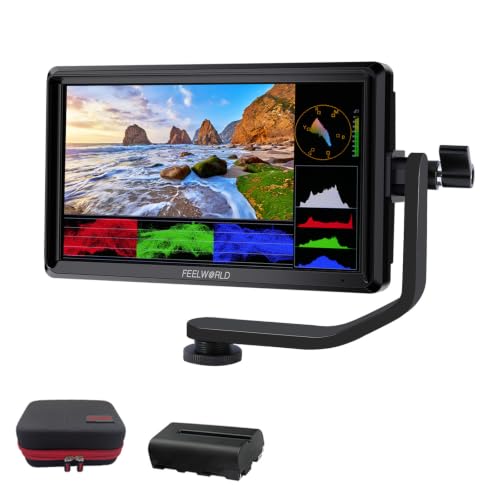
- 6-inch Full HD display for compact rigs
- 4K HDMI input and loop-out
- Includes battery, cable, sunshade, arm, and case
Best For: Handheld, gimbal, and stabilizer setups
Silent Pro Pick
GODOX GM6S Pro 5.5-Inch Monitor

- 2000-nit touchscreen with 4K HDMI loop-out
- Fanless CNC aluminum body for quiet shoots
- LUT, screenshot overlay, and anamorphic tools
Best For: Professional shoots requiring silent cooling and advanced tools
Best Brightness Pick
FEELWORLD F5 Prox 5.5-inch Monitor

- 1600-nit screen for outdoor visibility
- Focus, exposure, and LUT monitoring tools
- Lightweight mounting for rigs and gimbals
Best For: Outdoor filmmakers and mobile creators
Best Pro Feature Set
VILTROX DC-X3 6-inch 4K HDMI/SDI Monitor

- 2000-nit display with quick-release hood
- HDMI and 3G-SDI input/loop-out
- Touchscreen, scopes, LUTs, and triple power
Best For: Professional HDMI/SDI production workflows
Best Budget-Friendly Choice
FEELWORLD FW568 6-inch Monitor

- 6-inch Full HD IPS display
- 4K HDMI input/output up to 30Hz
- Scopes, focus tools, and 32 custom LUTs
Best For: Beginner creators and indoor content production
Best High-Brightness Pick
VILTROX DC-550 Touchscreen Monitor

- 1,200-nit 5.5-inch touchscreen
- 4K HDMI input and output
- Waveform, 3D LUT, and focus tools
Best For: Outdoor creators who want advanced monitoring in a compact setup
Best Large-Screen Value

- 7-inch IPS display
- Wide 480p-to-1080p format support
- Battery, ball head, and sunshade included
Best For: Creators seeking a larger, accessory-ready HD monitor
Best Lightweight Daylight Monitor

- 1,000-nit matte 7-inch screen
- Supports up to 4K30p HDMI input
- Only 278g with three mounting sides
Best For: Portable outdoor camera rigs needing a bright, lightweight display
Bright Outdoor Pick – VILTROX DC-A1 7-Inch Monitor
For filmmakers comparing camera field monitors with hdmi input, the VILTROX DC-A1 stands out for its 2800-nit brightness, 7-inch Full HD touchscreen, and 4K HDMI loop-through. It is designed for detailed outdoor monitoring while keeping professional exposure and focus tools within easy reach.
Best For: Outdoor shoots and crews that need a large, highly visible touchscreen with extensive monitoring tools.
Pros:
- Very bright 2800-nit display with a detachable sunshade hood.
- 4K HDMI 2.0 input and output support, plus headphone monitoring.
- Includes waveform, vectorscope, histogram, false color, peaking, and custom 3D LUT support.
- Supports NP-F batteries, DC power, and compatible USB-C power.
Cons:
- The built-in cooling fans may add noise in sound-sensitive setups.
- Its 7-inch size and multiple features may be more than compact rigs require.
The DC-A1 is a strong choice when daylight visibility and hands-on control matter most. Its combination of brightness, loop-out connectivity, and professional tools makes it particularly capable for outdoor production.
Flexible Power Pick – NEEWER F700 7-Inch Monitor
The NEEWER F700 is a practical option among camera field monitors with hdmi input, pairing a 2000-nit 7-inch touchscreen with 4K HDMI loop in/out. Its broad signal compatibility, shortcut buttons, and flexible battery arrangements suit demanding production days.
Best For: Shooters who want a bright 7-inch monitor with multiple power choices and extensive signal support.
Pros:
- 2000-nit Full HD touchscreen with manual and automatic backlight adjustment.
- Supports a wide range of HD and 4K HDMI formats with loop-out.
- Offers 3D LUT uploads, waveform, vectorscope, histogram, zebras, and focus peaking.
- Works with NP-F batteries, DC power, and USB-C, and can provide camera power through its DC output.
Cons:
- The listed weight increases substantially when two batteries are installed.
- The cooling fans may not suit every quiet recording environment.
- An SD card is required for firmware upgrades but is not included.
With its strong connectivity and power flexibility, the F700 is well suited to longer shoots and varied camera systems. It is a good fit for users who value practical controls and compatibility over the smallest possible setup.
Compact Bundle Pick – FEELWORLD S55 V3 Monitor
For compact rigs, the FEELWORLD S55 V3 provides a lightweight 6-inch Full HD display with 4K HDMI input and loop-out. This bundle adds a battery, cable, sunshade, tilt arm, and carry case, making it a convenient starting point for camera operators using handheld rigs, gimbals, or stabilizers.
Best For: Mobile shooters who want a compact monitor bundle with useful accessories included.
Pros:
- Compact 6-inch Full HD display with a wide 160-degree viewing angle.
- Supports 4K HDMI input and loop-out with headphone and audio-level monitoring.
- Includes battery, micro HDMI cable, sunshade, tilt arm, and protective carry case.
- Provides histogram, peaking, false color, zebra, zoom, and image-flip tools.
Cons:
- Its 500-cd/m² brightness is lower than the brighter monitors in this roundup.
- The included camera-power output requires a separate dummy battery or coupler.
- The 6-inch screen is smaller for teams monitoring from a distance.
The S55 V3 emphasizes portability and convenience rather than maximum daylight brightness. Its complete accessory bundle makes it especially appealing for creators building a compact monitoring setup without sourcing each component separately.
Silent Pro Pick – GODOX GM6S Pro 5.5-Inch Monitor
The GODOX GM6S Pro is a specialized choice among camera field monitors with hdmi input, offering a 2000-nit 5.5-inch touchscreen, lossless 4K HDMI input and loop-out, and a fanless metal body. Its color tools and anamorphic correction features target more advanced production workflows.
Best For: Professional shoots that need bright monitoring, silent cooling, and enhanced image-creation tools.
Pros:
- 2000-nit display with a 170-degree viewing angle for bright outdoor monitoring.
- Supports 4K HDMI input and loop-out through multiple HDMI ports.
- Fanless CNC aluminum construction provides silent cooling and physical durability.
- Includes custom LUT support, screenshot overlays, and anamorphic squeeze-ratio correction.
Cons:
- The 5.5-inch screen is smaller than the 7-inch options.
- NP-F batteries, DC, and USB-C power sources are not included according to the notes.
- The listed 2 kg weight may be substantial for a compact on-camera monitor.
The GM6S Pro is best when silent operation and specialized monitoring functions are priorities. Its fanless construction, bright panel, and anamorphic tools give it a distinct advantage for narrative, studio, and cinema-oriented workflows.
Best Brightness Pick – FEELWORLD F5 Prox 5.5-inch Monitor
If you need camera field monitors with hdmi input for outdoor shoots, the FEELWORLD F5 Prox stands out with a 1600-nit display. Its compact 5.5-inch screen combines practical focus and exposure tools with flexible mounting for DSLR, mirrorless, and cinema-camera setups.
Best For: Photographers, vloggers, and filmmakers who need a bright, portable monitor for outdoor production, travel, weddings, interviews, or gimbal work.
Pros:
- 1600-nit brightness improves visibility in direct sunlight.
- Includes focus peaking, waveform, histogram, and false color tools.
- Supports LUT preview for monitoring Log footage.
- Mounts on rigs, cages, gimbals, tripods, and handheld setups.
Cons:
- The 5.5-inch display is smaller than some six-inch alternatives.
- The supplied notes do not specify HDMI resolution or input/output details.
The F5 Prox is a strong choice when sunlight readability and essential monitoring aids matter more than a larger screen. Its lightweight design also makes it practical for mobile and gimbal-based shooting.
Best Pro Feature Set – VILTROX DC-X3 6-inch 4K HDMI/SDI Monitor
For demanding production setups, the VILTROX DC-X3 is one of the more versatile camera field monitors with hdmi input. It pairs a 2000-nit 6-inch display with HDMI and SDI connectivity, professional scopes, touchscreen controls, and multiple power options.
Best For: Professional filmmakers and crews who need sunlight-readable monitoring, HDMI/SDI signal support, audio monitoring, and extended on-set flexibility.
Pros:
- 2000-nit IPS display is designed for sunlight-readable monitoring.
- Provides 2 HDMI ports and 2 3G-SDI ports with input and loop-out support.
- Supports up to 4K at 30Hz signal transmission.
- Offers waveform, vectorscope, histograms, focus peaking, false color, and custom 3D LUT import.
Cons:
- Its 1.32 kg weight may be less suitable for lightweight camera rigs.
- The extensive professional feature set may be more than beginners need.
- The supplied display resolution is 1920×1080 despite 4K signal support.
The DC-X3 is the most production-oriented option here, especially for users working across HDMI and SDI systems. Its touchscreen, quick-release hood, and triple-power design add useful convenience for long outdoor shoots.
Best Budget-Friendly Choice – FEELWORLD FW568 6-inch Monitor
The FEELWORLD FW568 is a practical entry point for creators comparing camera field monitors with hdmi input. Its 6-inch Full HD IPS screen, monitoring aids, 4K HDMI input/output, and flexible battery support suit indoor shoots and everyday content production.
Best For: Beginner vloggers, social media creators, and videographers making interviews, tutorials, livestreams, product reviews, and other indoor content.
Pros:
- 6-inch 1920×1080 IPS display provides a larger framing view.
- Includes waveform, vectorscope, histogram, focus assist, false color, and peaking.
- Supports up to 32 custom LUTs for Log-shooting previews.
- Accepts 4K HDMI input/output up to 30Hz and supports NP-F or LP-E6 batteries.
Cons:
- 450-nit brightness is better suited to indoor use than bright sunlight.
- The supplied notes do not specify a built-in touchscreen.
- It lacks the SDI connectivity offered by the VILTROX option.
The FW568 makes sense for creators who want a larger external display and useful exposure tools without prioritizing extreme outdoor brightness or SDI. Its compact, lightweight design is particularly convenient for tripod and mobile setups.
Best High-Brightness Pick – VILTROX DC-550 Touchscreen Monitor
For camera field monitors with HDMI input, the VILTROX DC-550 stands out with a bright 5.5-inch touchscreen, 4K HDMI support, and a strong set of exposure and focus tools. Its 1,200-nit display is suited to outdoor shooting, while HDMI input and output support monitoring and signal pass-through.
Best For: Filmmakers and photographers who need a compact, daylight-viewable monitor with advanced image-analysis features.
Pros:
- Bright 1,200-nit 1920×1080 IPS touchscreen with a sunshade included
- Supports up to 4K 30Hz HDMI signals and provides HDMI output for pass-through
- Includes waveform, vectorscope, histogram, false color, focus assist, HDR, and 3D LUT support
- Comes with an NP-F550 battery and supports battery, DC, or USB-C power
Cons:
- The 5.5-inch screen is smaller than the displays on the other options here
- At approximately 1.1 pounds, it is not the lightest compact monitor
The DC-550 is a well-equipped choice when brightness and monitoring controls matter more than having the largest screen. Its included battery, cables, sunshade, and case also make it convenient for mobile production.
Best Large-Screen Value – NEEWER F100 7-Inch Monitor
The NEEWER F100 is a practical option among camera field monitors with HDMI input, offering a spacious 7-inch IPS screen and support for common HD video formats. Its included battery, ball head, sunshade, and multiple cables make it a flexible starting point for DSLR, mirrorless, and camcorder rigs.
Best For: Content creators who prioritize a larger viewing area, straightforward HDMI monitoring, and included mounting accessories.
Pros:
- Large 7-inch IPS display with a slim 17mm body and 1,280×800 resolution
- Supports a broad range of 480p through 1080p HDMI formats
- Includes peaking, histogram, false-color-style check-field tools, image flip, grids, and safe frames
- Includes a 4,400mAh F750 battery rated for up to 3.5 hours and a 360-degree mini ball head
Cons:
- 450-nit brightness is lower than the VILTROX and Portkeys monitors
- Its maximum display resolution is 1280×800 rather than 4K
- It has one HDMI port and does not offer HDMI output pass-through
The F100 favors screen size and kit completeness over high brightness or UHD support. It is a sensible choice for indoor work or shaded outdoor setups where a 7-inch monitor and included accessories are valuable.
Best Lightweight Daylight Monitor – Portkeys HD7H 7-Inch Monitor
For camera field monitors with HDMI input, the Portkeys HD7H combines a lightweight 7-inch design with 1,000-nit brightness and 4K30p signal support. Its shortcut keys, mounting threads, and practical focus and exposure tools make it well suited to portable DSLR and mirrorless camera rigs.
Best For: Mobile filmmakers who want a bright, lightweight 7-inch monitor with quick-access controls.
Pros:
- 1,000-nit 7-inch matte display for daylight viewing
- Accepts video signals up to 4K30p through HDMI and includes a headphone output
- Offers histogram, false color, focus peaking, zoom, and anamorphic de-squeeze tools
- Lightweight 278g housing with 1/4-inch mounting threads on three sides
Cons:
- Native resolution is 1280×720 despite supporting higher-resolution input signals
- Battery is not included
- Only one HDMI port is listed, with no HDMI output pass-through specified
The HD7H is a strong portability-focused choice for shooters who need outdoor visibility without adding much weight. Its flexible NP-F or 7.4-to-24V DC power options are useful, but the separate battery purchase should be included in the setup budget.
How We Picked These Camera Field Monitors with Hdmi Input
We focused on monitors that accept an HDMI camera feed and offer useful advantages over a standard built-in display. The shortlist considers screen size, resolution, brightness, touch controls, HDMI pass-through or loop output, support for 4K signals, and production aids such as waveform, vectorscope, false color, focus peaking, zebras, and 3D LUTs.
We also included a range of screen sizes and prices. Some models prioritize bright outdoor viewing, while others are better suited to lightweight rigs, basic framing, or more advanced on-set monitoring.
Quick Comparison
| What to Compare | Best For |
|---|---|
| 7-inch screen | Easy viewing on tripods, shoulder rigs, and sets |
| 5.5- to 6-inch screen | Compact cages, gimbals, and handheld cameras |
| 1,000 nits or more | Outdoor shooting and bright locations |
| 4K HDMI support | Higher-resolution camera workflows |
| HDMI loop output | Sending the feed to another display or recorder |
| Touchscreen and shortcut keys | Fast adjustments while operating |
Key Buying Factors for Camera Field Monitors with Hdmi Input
Brightness and Viewing Conditions
Brightness is one of the most important specifications. A 450-nit monitor may work well indoors or under shade, while models rated around 1,000 nits or higher are easier to see in direct daylight. A sun hood can further improve visibility without requiring maximum screen brightness all the time.
Signal Compatibility and Connections
Check your camera’s HDMI output type, resolution, and frame rate before buying. A monitor may accept a 4K input while displaying a lower-resolution image, so distinguish input compatibility from native screen resolution. If you need to feed another device, look for HDMI loop in/out rather than HDMI input alone. Shooters using SDI equipment should choose a monitor with the required SDI connection.
Monitoring Tools
Waveform and false color help evaluate exposure, while zebras provide quick highlight warnings. Focus peaking, magnification, and a sharp IPS panel make manual focusing easier. LUT support is valuable when viewing a log image with a more finished look, but it should complement—not replace—proper exposure tools.
Power, Mounting, and Size
Confirm the battery type, included power accessories, mounting points, and total weight. Larger 7-inch monitors are comfortable for assistants and tripod work but can make a small camera rig front-heavy. A 5.5- or 6-inch model is often a better balance for handheld or gimbal use.
Who Should Buy Which Camera Field Monitors with Hdmi Input?
Choose a high-brightness 7-inch monitor if you frequently work outdoors or want a large image for interviews, events, and tripod-based production. A compact 5.5- or 6-inch display is better for mobile rigs where weight and balance matter. If you shoot log footage or need precise exposure and focus checks, prioritize waveform, false color, peaking, and LUT features over screen size alone.
For simple framing and playback, an affordable 1080p HDMI monitor may be enough. If your workflow includes multiple displays, external recording, or a 4K camera signal, verify loop-through and input specifications before choosing. The best option is the one that fits your camera’s output, shooting environment, power system, and rig—not necessarily the brightest or most feature-packed model.