The best slant boards for squats can make heel elevation more consistent while supporting ankle-mobility work, calf stretching, and lower-body training. The right choice depends on stability, incline, surface area, and how you plan to use it.
We compared 10 wooden and adjustable squat wedges across capacity, traction, portability, and versatility so you can choose a board that fits your training setup and mobility goals.
Best 10 Slant Boards for Squats Picks for 2026
Best Adjustable Option
StrongTek Adjustable Wooden Slant Board

- Five incline positions from 15° to 35°
- Hardwood plywood with anti-slip treads
- Side handles make it easier to carry
Best For: Adjustable squat, calf-stretching, and mobility routines
Best Heavy-Duty Pair
1800-Lb Wooden Squat Wedge Blocks

- Stated 1800-pound weight capacity
- 15° heel-elevation angle with full-foot support
- Includes pair, bag, and training poster
Best For: Heavy weighted squats and portable lower-body training
Best Wide Platform
StrongTek 25° Wooden Squat Board

- Extra-wide 19.6-inch squat surface
- Fixed 25° incline for consistent training
- Stated 1000-pound hardwood construction
Best For: Stable, shoulder-width heel-elevated squats
Best Portable Design
1500-Lb Non-Slip Squat Wedge Pair

- Stated 1500-pound capacity with ABS core
- 15° angle and full-foot support
- Includes bag, poster, and instruction guide
Best For: Portable heel elevation, squats, and mobility work
Best for Easy Setup
Professional Wooden Slant Board
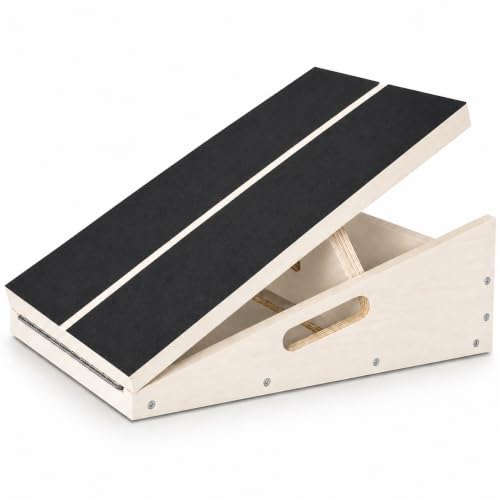
- Five settings from 15° to 35°
- 500-pound wooden construction
- Textured top with slip-resistant base
Best For: Adjustable squat practice, calf stretching, and ankle mobility
Best Full-Length Wedge

- 27-inch dual-foot platform
- Fixed 15-degree heel elevation
- Non-slip EVA foam construction
Best For: Stable home-gym squats, lunges, and ankle-mobility drills
Best for Comfort
Frylr Folding Wooden Slant Board

- Folds with handle and magnetic closure
- Four angles from 20° to 40°
- 500-pound layered-wood capacity
Best For: Portable mobility work, warm-ups, and squat practice
Best One-Piece Stability

- Wide, one-piece 27-by-10-inch platform
- Fixed 15° incline for squats and stretches
- 4,000-pound capacity with eight-year warranty
Best For: Stable, wide-footing lower-body training
Best Adjustable Design
Independent Metal Slant Platforms

- Four adjustable incline levels
- Independent platforms for varied stances
- 900-pound metal-frame capacity
Best For: Custom squat angles, split squats, and mobility work
Best Wide Wooden Board
Full-Grip Squat and Calf Stretcher

- 19.7-inch-wide hardwood platform
- Full anti-slip tread for secure footing
- 1,000-pound capacity with carry holes
Best For: Wide-surface home workouts and stretching
Best Adjustable Option – StrongTek Adjustable Wooden Slant Board
For shoppers comparing slant boards for squats, this StrongTek model stands out for its five adjustable incline positions from 15° to 35°. Its wooden construction, side handles, and anti-slip treads make it useful for heel elevation, calf stretching, and general lower-body mobility work.
Best For: Users who want one adjustable board for squats, stretching, and recovery-focused exercises.
Pros:
- Five incline settings provide more versatility than a fixed-angle board.
- Anti-slip safety treads help support secure foot placement.
- Hardwood plywood construction and side handles improve portability and durability.
- Its 16-by-12.5-inch surface supports a range of stretching and exercise movements.
Cons:
- It is taller and more substantial than compact wedge-style options.
- The notes do not specify a maximum weight capacity.
This is a flexible choice when your routine includes both heel-elevated squats and adjustable calf or ankle stretching. The multiple angles are particularly useful for users who do not want to commit to a single training position.
Best Heavy-Duty Pair – 1800-Lb Wooden Squat Wedge Blocks
These 15° squat wedge blocks are designed for heel elevation during squats while also supporting calf stretching and ankle-mobility work. The pair offers an 1800-pound stated capacity, full-foot support, non-slip surfaces, and a carrying bag for training at home, in the gym, or on the go.
Best For: Serious lifters who want a portable pair of sturdy wedges for weighted squats and mobility exercises.
Pros:
- Stated 1800-pound capacity suits heavy strength-training use.
- 15° angle supports heel-elevated squats and deeper squat positioning.
- Textured tops and non-slip bases help improve grip and stability.
- Includes two wedges, a training poster, and a carrying bag.
Cons:
- The fixed 15° angle offers less adjustability than multi-position boards.
- At about 12.58 by 6.1 inches per wedge, each foot has a more compact platform than a wide single board.
The two-piece format works well for users who want consistent heel elevation under both feet without using one long platform. Its portability and included training materials add convenience for gym and travel use.
Best Wide Platform – StrongTek 25° Wooden Squat Board
For users who prefer a broad, stable platform, this fixed 25° StrongTek board provides a 19.6-inch-wide surface for a more natural squat stance. Its three-point hardwood support, dual non-slip design, and stated 1000-pound capacity make it suited to heel-elevated squats, calf raises, and lower-body training.
Best For: Lifters who want extra room for shoulder-width foot placement on a single wooden slant board.
Pros:
- Extra-wide 19.6-inch surface accommodates a natural stance.
- Fixed 25° incline offers consistent heel elevation for squats and split squats.
- Textured top and anti-slip base strips help with grip and floor stability.
- Hardwood construction and three-point support carry a stated 1000-pound maximum.
Cons:
- The non-adjustable 25° angle is less versatile for users wanting multiple inclines.
- Its 19.6-inch length and 7.7-pound weight make it less compact for transport.
This board is a strong fit when platform width matters more than portability or adjustability. The single-piece design keeps both feet aligned on one surface and can also support stretching and mobility sessions.
Best Portable Design – 1500-Lb Non-Slip Squat Wedge Pair
This pair of 15° squat wedges combines a compact footprint with full-foot support for heel-elevated squats, calf stretches, and mobility drills. The high-density ABS core, textured silicone surface, and stated 1500-pound capacity give it a sturdy, portable profile for home or gym use.
Best For: Users seeking compact squat wedges with strong grip, a carrying bag, and guided training materials.
Pros:
- Stated 1500-pound capacity supports demanding weightlifting sessions.
- Leaf-textured silicone and a full-foot platform help provide traction and support.
- 15° bevel works for deep squats, calf stretches, and yoga mobility work.
- Includes a pair of wedges, training poster, carrying bag, and instruction guide.
Cons:
- The fixed 15° angle does not offer the adjustability of a multi-position board.
- Each wedge measures 11.8 by 5.9 inches, so the separate platforms provide less continuous width than a single board.
This is a practical middle ground for shoppers who want a durable alternative to foam or cork wedges without giving up portability. The included accessories also make it easier to add guided squat and stretching work to a home-gym routine.
Best for Easy Setup – Professional Wooden Slant Board
If you want slant boards for squats that can also support calf stretching and ankle-mobility work, this adjustable wooden model offers five incline choices. Its textured surface, slip-resistant base, and 500-pound capacity make it a versatile option for controlled home or gym routines.
Best For: Users who want adjustable angles for squats, calf stretching, ankle mobility, and warm-ups.
Pros:
- Five angle settings from 15 to 35 degrees allow gradual progression.
- 500-pound capacity and reinforced wooden supports provide a sturdy platform.
- Textured top and slip-resistant base help provide secure footing.
- Side handle, exercise guide, and three-year warranty add practical value.
Cons:
- Wood construction and a listed weight of 3.85 kg make it less lightweight than some portable options.
- Its 16-by-12.5-inch platform may feel compact for users wanting a full-length two-foot wedge.
This is a strong all-around choice when adjustability matters. The multiple settings let beginners start gently and more experienced users increase the incline for mobility drills or squat practice.
Best Full-Length Wedge – Large EVA Squat Wedge
This one-piece wedge is a practical choice among slant boards for squats if you prefer a broad, low-profile platform. Its 15-degree heel elevation is designed to support deeper squats, a more upright torso, ankle-mobility drills, and lower-body training.
Best For: Home-gym users who want a full-length, dual-foot wedge for squats, lunges, stretches, and mobility work.
Pros:
- 27-inch length provides room for both feet side by side.
- 15-degree incline supports heel elevation and ankle dorsiflexion during squats.
- Dense EVA foam is designed for regular use without cracking or compressing.
- Non-slip surface and base help it grip gym mats, hardwood, and low-pile carpet.
Cons:
- It has one fixed 15-degree angle rather than adjustable settings.
- The 27-inch platform is less convenient to transport than a compact folding board.
Choose this wedge if stability and usable surface area are higher priorities than portability or angle customization. Its low 2.8-inch profile also makes storage under furniture easier.
Best for Comfort – Frylr Folding Wooden Slant Board
For shoppers seeking portable slant boards for squats, the Frylr folding board combines adjustable inclines with a compact storage design. It folds to about 11.8 by 15.7 by 1.2 inches and includes a carry handle and magnetic closure for moving between home, office, and gym.
Best For: Users who need a foldable, adjustable board for mobility breaks, warm-ups, stretching, and squat practice.
Pros:
- Four fixed positions from 20 to 40 degrees offer adjustable stretch intensity.
- Folding construction, carry handle, and magnetic closure support portability and storage.
- 12-layer wood construction and a 500-pound capacity provide a solid training platform.
- Non-slip foot surface and bottom grip pads help support stable movement.
Cons:
- Its listed angle range starts at 20 degrees, so it may be less suitable for users wanting a gentler incline.
- The folding design adds moving parts compared with a simple one-piece wedge.
- The supplied dimensions and design may provide less full-length foot coverage than the larger EVA option.
This model stands out for people who store their equipment between sessions or take it to different locations. Its angle range is useful for progressing mobility work, while the folding frame keeps transport manageable.
Best One-Piece Stability – 15° Heel-Elevated Squat Wedge
If you want a stable setup for slant boards for squats, this one-piece wedge provides a continuous 27-by-10-inch platform rather than two separate blocks. Its 15-degree incline supports heel-elevated squats, lunges, calf raises, stretches, and mobility work.
Best For: Lifters who prioritize a wide, stable platform for squats and varied lower-body exercises.
Pros:
- One-piece design helps prevent alignment shifts and tipping between wedges.
- 15-degree angle supports heel elevation, calf stretching, and mobility drills.
- Anti-slip surface and six silicone pads are suitable for gym, grass, or other training areas.
- Crosslinked polyethylene construction is pressure-tested to 4,000 pounds and includes an eight-year warranty.
Cons:
- The fixed 15-degree angle does not offer incline adjustment.
- Its 27-inch length may take more storage space than compact wedge pairs.
This is a straightforward choice when stability and a broad standing surface matter more than portability or adjustable angles.
Best Adjustable Design – Independent Metal Slant Platforms
Among slant boards for squats, the EXURA stands out for adjustability and independent foot positioning. Its two metal platforms provide four incline levels, allowing different angles and stances for squats, split squats, calf stretches, and mobility work.
Best For: Lifters, athletes, and therapy users who need adjustable angles or asymmetric foot placement.
Pros:
- Two independent platforms accommodate wider stances and different foot angles.
- Four incline levels support gradual progression from mobility work to deeper stretches.
- Rubber grip tops and base mats help limit movement under load.
- Metal construction supports up to 900 pounds while remaining compact at 7.6 pounds.
Cons:
- The two-platform design requires positioning each side before use.
- Its compact surface may provide less continuous footing than a one-piece board.
This is the most versatile option in the group for users who want to fine-tune incline and stance rather than use one fixed angle.
Best Wide Wooden Board – Full-Grip Squat and Calf Stretcher
This hardwood option offers a broad 19.7-by-12.3-inch surface for slant-board squats, calf stretches, and rehabilitation exercises. Its fixed design and full anti-slip tread make it a practical choice for users who want a portable, ready-to-use platform.
Best For: Home-gym users and athletes seeking a wide wooden board for squats, stretching, and balance work.
Pros:
- Wide surface accommodates both feet and a range of lower-body movements.
- Full sandpaper top, baffle, and base are designed to improve grip.
- Hardwood plywood and two bottom ribbed panels support up to 1,000 pounds.
- Handle holes make the assembled board easier to carry.
Cons:
- It has one fixed position rather than multiple incline settings.
- At about 3.11 kilograms, it is heavier than a very compact wedge.
- The wooden construction may be less convenient to store than smaller platforms.
Choose this board if you value a generous surface, strong load rating, and easy handling over adjustable angles.
How We Picked the Best Slant Boards for Squats
We focused on the features that matter most during loaded squats and mobility drills: a stable base, reliable foot traction, useful incline geometry, adequate width, and construction that can handle repeated use. We also considered whether each board is adjustable, foldable, easy to store, or versatile enough for calf stretching and other lower-body exercises.
Product specifications such as stated weight capacity, dimensions, incline angle, non-slip materials, handles, and portability helped distinguish boards for home gyms from simpler stretching wedges.
Quick Comparison
| Best For | Look For | Why It Matters |
|---|---|---|
| Heavy squats | High capacity and broad base | Improves stability under load |
| Mobility work | Moderate incline and secure traction | Supports controlled calf and ankle stretching |
| Multiple users | Adjustable angle and wide platform | Accommodates different flexibility levels |
| Small spaces | Foldable design or compact wedge | Makes storage and transport easier |
Key Buying Factors for Slant Boards for Squats
Incline and Adjustability
A fixed 15- to 25-degree angle is simple and quick to use, but an adjustable board offers more control. Lower angles are generally easier for beginners or longer mobility sessions, while steeper settings can provide a stronger heel-elevated squat position. Choose adjustability if several people will use the board or if your mobility needs are changing.
Width, Length, and Stability
A wider platform gives your feet more room and can feel more secure during squats. Check the board’s length as well as its width, especially if you have larger feet or use a wider stance. A broad base, sturdy wood construction, and well-placed feet or pads help prevent rocking on hard floors.
Traction and Weight Capacity
Look for non-slip surfaces, silicone pads, textured feet, or other grip features. These are particularly important when the board is used with sweat, socks, or heavy weights. The stated capacity should comfortably exceed your body weight plus the load you lift, though capacity alone does not guarantee stability on every surface.
Portability and Versatility
Handles and foldable designs are useful when you move equipment between rooms or take it to a gym. If you want more than a squat wedge, consider a board that also supports calf stretching, foot mobility, or other lower-body drills.
Who Should Buy Which Slant Boards for Squats?
Choose an adjustable or wide slant board if you want one tool for progressive mobility work and heel-elevated squats. A fixed wooden wedge is a practical choice for dedicated squat training when you prefer simplicity and a consistent angle. High-capacity models suit heavier lifters, while compact or foldable boards work best for apartments, travel, and occasional stretching. If ankle mobility is your primary goal, prioritize a comfortable, grippy surface and an angle you can hold without pain rather than selecting the steepest option.