The right slant board can make calf stretching, squat positioning, and lower-leg mobility work more consistent. Adjustable models add flexibility by letting you change the incline for different exercises, users, and comfort levels.
We compared 10 adjustable slant boards across angle options, weight capacity, portability, materials, traction, and added features to help you choose a practical fit for your routine.
Best 10 Adjustable Slant Boards Picks for 2026
Best Overall

- Five adjustable angles from 15° to 35°
- Durable Lauan hardwood plywood construction
- Anti-slip treads and side carry handle
Best For: Users prioritizing a sturdy, portable wooden board
Best Modular Option
Stackable Squat Wedge Block Set

- Three blocks support multiple configurations
- Lightweight, shape-retaining EPP material
- Useful for stretching, squats, and step-ups
Best For: Users seeking versatile, stackable wedge angles
Best Portable Set
Calf Stretch Slant Board with Bands

- Five angles from 23° to 45°
- Lightweight wooden design for portability
- Includes two bands and exercise guidance
Best For: Portable stretching and band-assisted mobility routines
Best Heavy-Duty Design

- Steel frame supports up to 660 pounds
- Five angles from 15° to 40°
- Folding platform with full traction surface
Best For: High-capacity lower-body training and mobility work
Most Versatile
3-in-1 Adjustable Slant & Balance Board
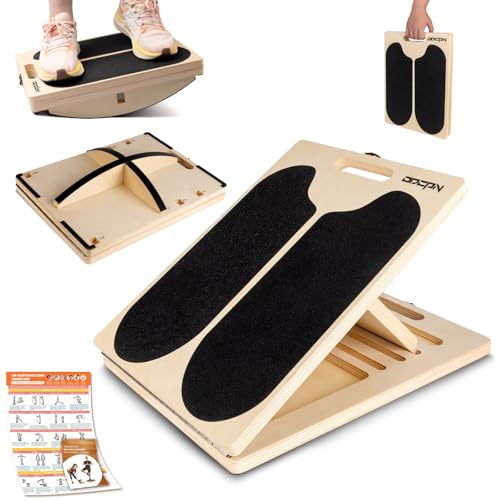
- Six angles from 20° to 45°
- Adds 180° and 360° balance modes
- Folds flat for storage and travel
Best For: Stretching plus balance and coordination training
Best Lightweight Pick
Portable Wooden Calf Stretch Board

- Weighs approximately 4.5 to 5 pounds
- Four settings from 30° to 45°
- Works for stretching, squats, and rehab
Best For: Portable higher-angle stretching and mobility work
Best Heavy-Duty Option
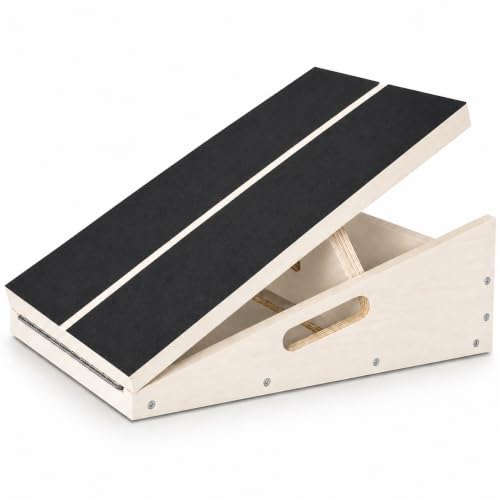
- Five angles from 15° to 35°
- Stated 500-pound weight capacity
- Textured top and slip-resistant base
Best For: Stable, progressive stretching and weight-bearing exercises
Best Portable Pick

- Five angles from 23° to 45°
- Foldable 4.6-pound design
- Includes workout poster and instructions
Best For: Portable calf and ankle stretching across varied fitness levels
Best Simple Pick
Steel Slant Board for Stretching and Squats

- Steel construction with 660-pound stated capacity
- Four angles from 15° to 40°
- Detachable padded tube for two exercise modes
Best For: High-load stretching and incline squat training
Best Angle Progression
Portable Wooden Calf Stretcher
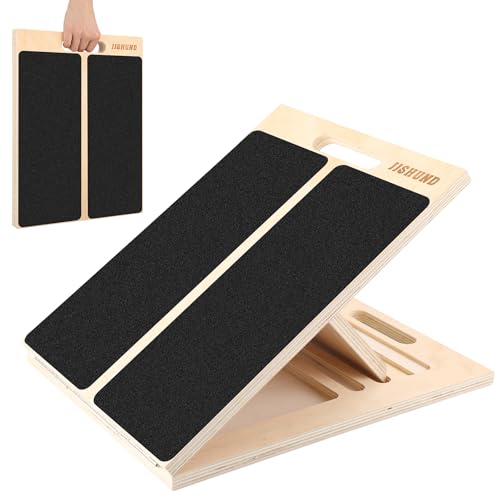
- Five angles from 20° to 45°
- Foldable design with carrying handle
- Anti-slip surface and bottom pad
Best For: Portable stretching with gradual angle progression
Best Overall – StrongTek Wooden Slant Board
For shoppers comparing adjustable slant boards, the StrongTek Wooden Slant Board stands out as a substantial, ready-to-use option with five incline settings. Its hardwood plywood construction, side handle, and anti-slip tread make it practical for calf stretching, squats, and mobility work at home, in the office, or while traveling.
Best For: Users who want a sturdy wooden board with a broad adjustment range and portable design.
Pros:
- Five angles from 15 to 35 degrees support gradual stretching and training.
- High-quality Lauan hardwood plywood is designed for durability.
- Anti-slip treads and a side carry handle improve usability.
- No assembly is required.
Cons:
- At 9 pounds, it is heavier than foam or compact wooden alternatives.
- The supplied dimensions may take more storage space than a folding board.
This is a sensible pick when stability and a larger, wood-built platform matter more than minimizing weight. Its five settings also make it easier to begin at a comfortable incline and progress gradually.
Best Modular Option – Stackable Squat Wedge Block Set
These adjustable slant boards use a modular three-piece wedge system rather than one hinged platform. The two 8.5-degree blocks and one 17-degree block can be used separately, paired under both heels, or stacked for a steeper calf-stretching incline.
Best For: Users who want flexible wedge configurations for squats, calf stretching, and step-up exercises.
Pros:
- Three EPP blocks create multiple angle and setup options.
- High-density EPP is lightweight and designed to retain its shape.
- Silicone grip points help improve floor contact.
- The expanded setup can connect into an aerobic step for step-ups.
Cons:
- It does not provide the single continuous platform of a traditional slant board.
- The supplied dimensions are compact, which may limit foot-placement room for some users.
The modular format is the main reason to choose this set. It offers more configuration flexibility than a fixed board, while remaining useful for warm-ups, heel-elevated squats, mobility work, and post-workout stretching.
Best Portable Set – Calf Stretch Slant Board with Bands
This adjustable slant board combines a lightweight wooden incline platform with two resistance bands, an exercise guide poster, and an instruction manual. Its five settings range from 23 to 45 degrees, giving users a progression from easier calf stretching to more demanding mobility work.
Best For: Beginners and portable-training users who want a board-and-band package for stretching and rehabilitation exercises.
Pros:
- Five adjustable angles provide a broad range of difficulty.
- At about 4.5 pounds, it is easy to carry between home, office, gym, and therapy settings.
- Non-slip EVA and PVC sandpaper surfaces are designed to reduce movement.
- Includes two latex-free TPE resistance bands and training guidance.
Cons:
- The listed maximum weight specifications are inconsistent: the notes cite both 460 pounds of support and a 300-pound maximum recommendation.
- The platform is relatively compact compared with larger wooden boards.
This is a useful all-in-one choice for shoppers who value portability and added resistance-band exercises. Before buying, pay close attention to the product’s stated weight limit and use the incline that matches your comfort level.
Best Heavy-Duty Design – HANDBODE Wooden Slant Board
For shoppers focused on load capacity, the HANDBODE is one of the more robust adjustable slant boards in this roundup. It pairs a multilayer wood platform with a 1.5 mm alloy-steel frame, five angle settings, and a full sand-grain traction surface for stretching and lower-body training.
Best For: Users who want a high-capacity board for calf stretching, heel raises, ankle mobility, and squat preparation.
Pros:
- Steel frame is rated for a total load of up to 660 pounds.
- Five settings from 15 to 40 degrees support varied exercises.
- Full-surface traction is designed for bare feet, socks, or training shoes.
- Folds for storage and requires no assembly.
Cons:
- The steel-and-wood construction may be less lightweight than foam options.
- Only one platform is included, with no bands or other accessories listed.
The HANDBODE makes the most sense when a firm foundation and high stated capacity are priorities. Its folding design helps offset the heavier-duty construction, making it suitable for regular use in a home gym, office, or gym bag storage area.
Most Versatile – 3-in-1 Adjustable Slant & Balance Board
If you want adjustable slant boards that also support balance training, this 3-in-1 wooden model offers six incline settings from 20° to 45°, plus 180° and 360° balance modes. Its textured PVC surface and non-slip EVA base are designed for stable use during calf stretching, mobility work, and balance exercises.
Best For: Users who want one portable board for calf stretching, ankle mobility, and progressive balance training.
Pros:
- Six adjustable angles accommodate gentle to more intense stretching.
- Combines slant-board work with 180° directional and 360° rotational balance modes.
- Folds flat and includes magnetic side panels, a training poster, and instructions.
- Wood construction is rated for up to 460 pounds in the product description.
Cons:
- The additional balance components may be unnecessary if you only need a basic calf stretcher.
- The product details list both a 460-pound capacity and a 300-pound maximum weight recommendation, so buyers should verify the applicable limit.
This is the most feature-rich option in the group. Choose it when balance and coordination training matter as much as incline stretching; for straightforward stretching, a simpler board may be easier to use.
Best Lightweight Pick – Portable Wooden Calf Stretch Board
Among adjustable slant boards, this lightweight wooden option keeps the design simple and portable. It provides four incline positions—30°, 35°, 40°, and 45°—for calf stretching, squats, mobility work, and rehabilitation exercises at home, in the office, gym, or clinic.
Best For: Beginners, athletes, and anyone who prioritizes a lightweight board with higher-angle settings.
Pros:
- Weighs about 4.5 to 5 pounds for convenient transport.
- Four adjustable positions support progressive stretching and weight-bearing exercises.
- Suitable for multiple settings, including home, office, gym, and physiotherapy clinics.
- Supports stretching, mobility, strength, posture, and rehabilitation routines.
Cons:
- It offers fewer angle settings than the other adjustable options in this roundup.
- No textured surface, carrying handle, or exercise guide is specifically listed in the supplied details.
This board is a practical choice when portability and uncomplicated operation are the priorities. Its range starts at 30°, so users seeking a gentler incline may prefer a model with a lower starting angle.
Best Heavy-Duty Option – 500-Lb Wooden Slant Board
For shoppers comparing adjustable slant boards for regular exercise, this wooden calf stretcher offers five settings from 15° to 35° and a stated 500-pound capacity. The textured top, slip-resistant base, and reinforced construction support calf stretching, ankle mobility, calf raises, squats, and warm-ups.
Best For: Home or gym users who want a sturdy, lower-angle board with a high stated weight capacity.
Pros:
- Five angle settings from 15° to 35° allow a gentler starting position.
- 500-pound capacity and reinforced wooden supports suit weight-bearing routines.
- Textured standing surface and slip-resistant base promote secure footing.
- Includes side carry handles, a visual exercise guide, and a 3-year warranty.
Cons:
- At 3.85 kg, it is heavier than the lightweight portable option.
- The maximum angle is 35°, which may not suit users seeking steeper inclines.
This is the strongest fit for buyers who value stability, carrying convenience, and a high stated capacity over minimal weight. The 15° starting angle also makes it suitable for gradually building into a deeper stretch.
Best Portable Pick – 5-Angle Wooden Slant Board
If you want adjustable slant boards for calf stretching at home, the gym, or while traveling, this foldable wooden model offers five angle choices in a relatively lightweight package. Its 23°–45° range supports gradual progression from easier stretches to more challenging positioning.
Best For: Beginners and experienced exercisers who want a portable board for calf, ankle, heel, leg, and flexibility work.
Pros:
- Five adjustable angles: 23°, 30°, 35°, 40°, and 45°.
- Foldable design weighs 4.6 pounds for easier transport.
- Wooden board supports stretching, mobility work, and selected strengthening exercises.
- Includes a workout poster and instructions.
Cons:
- The supplied details list a 300-pound maximum weight recommendation, so it may not suit every user.
- It does not include a warranty according to the product details.
This is a practical choice when portability and angle variety matter most. It provides more adjustment options than a fixed incline while remaining compact enough for home or gym storage.
Best Simple Pick – Steel Slant Board for Stretching and Squats
Among adjustable slant boards, this PROIRON model stands out for its steel construction and high stated load capacity. Four incline settings from 15° to 40° cover gentler daily stretching as well as more demanding calf and hamstring training.
Best For: Users who prioritize a steel frame, substantial load support, and a board that can also support incline squat work.
Pros:
- Steel construction with a stated 660-pound load capacity.
- Four adjustable angles ranging from 15° to 40°.
- 8mm NBR foam padding helps cushion the heel during stretching and squats.
- Detachable padded tube enables calf-stretcher and incline squat-bench modes.
Cons:
- At 5.78 kg, it is heavier than the wooden portable options in this roundup.
- It offers four angle settings rather than five.
The PROIRON is the stronger match for demanding training and users who want dual functionality. Its steel build and rubber feet emphasize stability, while the removable padded tube adds versatility beyond basic calf stretching.
Best Angle Progression – Portable Wooden Calf Stretcher
This portable wooden option is one of the more approachable adjustable slant boards for users who want clearly defined progression. Its five settings run from 20° to 45°, with the supplied guidance matching lower angles to rehabilitation-style work and higher angles to deeper stretching.
Best For: Home, office, gym, or outdoor users seeking a foldable board with a handle, graduated angles, and an anti-slip surface.
Pros:
- Five settings: 20°, 30°, 35°, 40°, and 45°.
- Foldable, with a hollow handle and a 4.8-pound weight.
- Textured top and bottom anti-slip features help limit movement.
- Suitable for calf, heel, ankle, leg, and mobility-focused stretching.
Cons:
- The stated maximum weight recommendation is about 200 pounds.
- Its wooden construction may be less suitable than steel for very high-load training.
This board makes sense for buyers who value portability and a simple angle progression. The 20° starting position and 45° top setting give users a broad range, while the textured surfaces support more confident positioning.
How We Picked the Best Adjustable Slant Boards
We focused on the features that matter during repeated stretching and strength sessions: adjustable incline range, stable construction, stated weight capacity, surface traction, portability, and ease of storage. We also considered useful extras such as side handles, resistance bands, stackable wedges, and balance-board functionality.
Weight limits are listed by the manufacturers and should be treated as maximum ratings, not a substitute for careful setup. A board should sit flat on a firm, level surface, with enough room around it for safe movement.
Quick Comparison
- Best for straightforward home use: A wooden adjustable board with a grippy surface and multiple incline positions.
- Best for portability: A compact board with a handle, lighter construction, or a foldable design.
- Best for heavier users: A steel-framed model with a clearly stated high weight capacity.
- Best for versatility: A 3-in-1 design or a set with stackable wedges and several angles.
- Best for exercise variety: A board that includes a resistance band or balance-training feature.
Key Buying Factors for Adjustable Slant Boards
Incline Range and Adjustment
More angle settings let you tailor the stretch from gentle mobility work to a deeper calf or ankle stretch. Beginners, people returning from an injury, and households sharing one board generally benefit from several clearly defined positions. Check how the angle locks in place and whether adjustments require removing pins, repositioning supports, or stacking pieces.
Stability, Traction, and Capacity
Look for a broad base, secure supports, and a non-slip standing surface. Rubber feet can help protect floors and reduce movement, while textured or padded surfaces improve foot placement. Choose a capacity comfortably above your body weight, particularly for squats, dynamic movements, or use with additional weights.
Materials and Portability
Wooden boards are often comfortable and relatively light, while steel-framed models may offer greater rigidity and higher load ratings. If you plan to travel with the board or store it between sessions, check its weight, dimensions, handles, and whether the adjustment hardware stays attached.
Intended Exercises
A basic slant board is suitable for calf stretches, heel elevation during squats, ankle mobility drills, and some physical-therapy exercises. A resistance band can add upper- or lower-body movements, while balance-board features increase versatility but may require more coordination and space.
Who Should Buy Which Adjustable Slant Boards?
Choose a simple adjustable model if your main goals are calf stretching, ankle mobility, and squat support. Choose a high-capacity steel-frame board if you prioritize rigidity or expect frequent, demanding use. Choose a portable wooden board for home offices, travel, or easy storage. Choose a multi-function or resistance-band model if you want one piece of equipment for mobility and supplemental workouts.
If you are using a slant board for rehabilitation, pain management, or post-injury training, follow guidance from a qualified healthcare professional and stop if an exercise causes sharp or worsening pain.