The best slant boards can make stretching, squatting, and seated writing more comfortable by providing a stable, angled surface under your feet or work materials.
We selected 10 options spanning adjustable calf stretchers, wide squat wedges, portable wooden boards, and handwriting-focused designs so you can match the board to your routine, space, and support needs.
Best 10 Slant Boards Picks for 2026
Best Overall
StrongTek Adjustable Wooden Slant Board

- Five incline settings from 15 to 35 degrees
- Durable hardwood plywood with anti-slip treads
- Side handle and no assembly required
Best For: Versatile home stretching, squats, and rehabilitation
Best for Writing Posture
INNER-ACTIVE Writing Slant Board

- Fixed 20-degree writing angle
- Lightweight, stackable plastic design
- Removable clip holds up to 20 sheets
Best For: Children’s handwriting, reading, and classroom activities
Best Portable Exercise Board
Adjustable Wooden Calf Stretcher

- Four incline settings from 30 to 45 degrees
- Lightweight wooden design for easy transport
- Supports stretching, squats, Pilates, and rehab
Best For: Portable adult exercise and lower-leg rehabilitation
Best for Kids' Handwriting
Junior Learning Magnetic Slant Board

- Lined and blank write-and-wipe surfaces
- Integrated clip secures worksheets
- Designed for children ages 36 months to 6 years
Best For: Early handwriting, math, and drawing practice
Wide-Stance Strength Pick
StrongTek 25° Wooden Slant Board

- Extra-wide 19.6-inch training surface
- 1000-pound hardwood capacity
- Fixed 25° angle with dual non-slip grip
Best For: Wide-stance squats, calf raises, and lower-body training
Portable Grip-Focused Pick

- Wide 19.7-inch hardwood platform
- 1000-pound stated weight capacity
- Carry handles and full anti-slip surfaces
Best For: Portable stretching, squats, and rehabilitation routines
Adjustable Beginner Pick
Reinforced 15°–30° Slant Board

- Four progressive angle settings
- Reinforced screws and adjustment brackets
- 250-pound capacity for mobility-focused use
Best For: Beginners, seniors, and rehabilitation stretching
Adjustable Wooden Pick

- Five settings from 23° to 45°
- Foldable 4.6-pound wooden design
- Includes workout poster and instructions
Best For: Portable calf, ankle, and leg stretching
Heavy-Duty Training Pick
EXURA Wide Dual-Platform Slant Board

- Two independent metal platforms
- Four incline levels for training and stretching
- 900-pound capacity with rubber grips
Best For: Loaded squats, split squats, and mobility work
Rehabilitation-Friendly Pick
Portable 5-Angle Wooden Slant Board
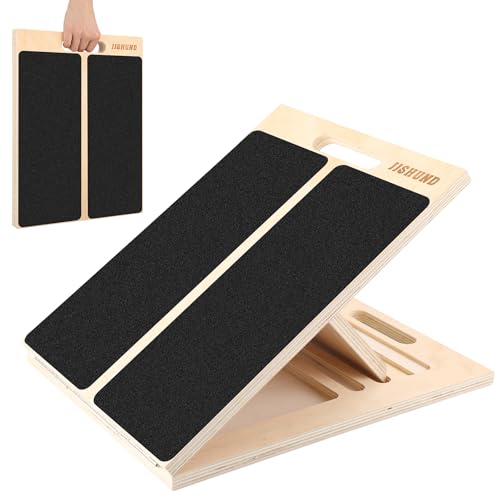
- Angles from 20° to 45°
- Foldable with a built-in carry handle
- Anti-slip top and bottom padding
Best For: Progressive ankle and calf mobility work
Best Overall – StrongTek Adjustable Wooden Slant Board
For shoppers seeking versatile slant boards for stretching, squats, and rehabilitation, the StrongTek Wooden Slant Board offers five incline positions, a hardwood plywood construction, and anti-slip treads. Its side handle also makes this 9-pound board easier to move between workouts.
Best For: Home users who want an adjustable calf and ankle stretching board with a sturdy, full-coverage non-slip surface.
Pros:
- Five adjustable positions from 15 to 35 degrees
- Hardwood plywood construction designed for durability
- Anti-slip safety treads and a side carry handle
- Suitable for stretching, squats, recovery, and rehabilitation exercises
Cons:
- At 9 pounds, it is heavier than some portable alternatives
- The larger wooden design may take more storage space
This is a strong all-purpose choice if stability and adjustability matter more than minimum weight. It arrives assembled and supports a broad range of stretching and exercise routines.
Best for Writing Posture – INNER-ACTIVE Writing Slant Board
Unlike exercise-focused slant boards, the INNER-ACTIVE board creates a 20-degree writing surface intended to support posture, handwriting legibility, and endurance. Its lightweight plastic construction and portable handle make it practical for classrooms, home learning, and therapy settings.
Best For: Children who need a stable, angled surface for handwriting, reading, or other tabletop activities.
Pros:
- 20-degree angle supports ergonomic writing positioning
- Lightweight design weighs less than 1.5 pounds
- Removable heavy-duty clip can hold up to 20 sheets of paper
- Rubber strip helps prevent sliding on work surfaces
Cons:
- Fixed at one angle rather than adjustable
- Designed for writing and reading, not calf stretching or exercise
This is a focused classroom and handwriting tool rather than a fitness board. Its simple, stackable design is well suited to repeated use by children and educators.
Best Portable Exercise Board – Adjustable Wooden Calf Stretcher
This portable wooden slant board is built for calf stretching, squats, Pilates, and physical therapy exercises. It offers four higher-angle settings from 30 to 45 degrees while weighing about 4.5 to 5 pounds, making it easier to carry to a home gym, office, clinic, or workout space.
Best For: Adults who want a lightweight exercise and rehabilitation board with steeper incline options.
Pros:
- Four adjustable positions from 30 to 45 degrees
- Portable design weighs approximately 4.5 to 5 pounds
- Suitable for stretching, squats, weight-bearing exercises, and rehabilitation
- Designed for use across home, office, gym, and clinic environments
Cons:
- Its lowest 30-degree setting may be too steep for some beginners
- The supplied notes do not specify a non-slip tread or carrying handle
This board suits users who prioritize portability and a higher range of inclines. Consider it when you want one compact tool for stretching and lower-leg-focused exercise routines.
Best for Kids' Handwriting – Junior Learning Magnetic Slant Board
The Junior Learning Slant Board is a child-focused writing surface rather than a fitness tool. Its double-sided write-and-wipe design includes lined and blank surfaces, while the integrated paper clip helps keep worksheets in place during handwriting, math, and drawing practice.
Best For: Young children practicing handwriting, pencil control, early math, and creative activities at home or in the classroom.
Pros:
- Double-sided surface with lined and blank options
- Dry-erase coating supports repeated practice and easy cleanup
- Integrated clip holds paper securely
- Rounded, lightweight design is intended for children ages 36 months to 6 years
Cons:
- Not intended for calf stretching, squats, or fitness use
- Cardboard construction may be less rugged than wood or plastic alternatives
This is a useful educational slant board for early learners who benefit from an angled writing position and reusable practice surface. Its child-oriented features make it more specialized than general-purpose writing boards.
Wide-Stance Strength Pick – StrongTek 25° Wooden Slant Board
For shoppers comparing slant boards for strength training, the StrongTek offers a fixed 25° incline and an extra-wide 19.6-inch surface. Its hardwood construction and three-point support are suited to heel-elevated squats, calf raises, lunges, and mobility work.
Best For: Users who want a wide, stable slant board for weighted lower-body training and calf stretching.
Pros:
- Extra-wide surface supports a natural shoulder-width stance.
- 1000-pound capacity with hardwood plywood and three-point support.
- Textured top and anti-slip base strips help improve grip and protect floors.
- Fixed 25° angle provides consistent positioning for squats and stretches.
Cons:
- The angle is not adjustable.
- At 7.7 pounds, it is heavier than some portable alternatives.
The StrongTek is a practical choice when stability and generous foot space matter more than portability or angle adjustment. It fits home gyms, studios, clinics, and other regular-use training spaces.
Portable Grip-Focused Pick – EVERYMATE Wooden Slant Board
The EVERYMATE is a versatile option among slant boards, combining a 19.7-inch-wide hardwood platform with a fixed 5.9-inch height and 1000-pound capacity. Its full anti-slip top, base, and carry handles make it suitable for moving between home, gym, office, and rehabilitation settings.
Best For: Users seeking a portable, high-capacity board for stretching, squats, balance work, and rehabilitation exercises.
Pros:
- Full sandpaper-style top, non-slip baffle, and anti-slip base support secure footing.
- Wide 19.7-inch surface accommodates varied lower-body movements.
- Hardwood plywood and two ribbed bottom panels provide a durable structure.
- Side and rear handle holes make the assembled board easier to carry.
Cons:
- It has one fixed level rather than adjustable incline settings.
- The highly textured surface may feel less comfortable for barefoot use despite the supplied claim of barefoot suitability.
Choose the EVERYMATE if you want one fixed-angle board that can support both loaded exercises and mobility routines. Its handles and relatively light 3.11-kilogram weight add convenience for multi-location use.
Adjustable Beginner Pick – Reinforced 15°–30° Slant Board
For shoppers who want adjustable slant boards, this reinforced wood model provides four angles—15°, 20°, 25°, and 30°. The gradual progression is designed for beginners, seniors, and rehabilitation users who may prefer starting with a gentler stretch before increasing intensity.
Best For: Beginners and rehab users working on progressive calf, Achilles, plantar fascia, hamstring, and mobility stretches.
Pros:
- Four angle settings allow progressive stretching from 15° to 30°.
- Longer, stronger screws are used to reinforce the hinges and adjustment brackets.
- Targets calves, Achilles tendons, plantar fascia, hamstrings, and back mobility.
- Compact format suits home, gym, under-desk, and physical-therapy use.
Cons:
- Its 250-pound capacity is lower than the 1000-pound options in this roundup.
- The shorter 15.7-inch length may provide less footroom for some strength movements.
- Adjustment requires choosing among four settings rather than using a continuously variable angle.
This board stands out for controlled progression rather than heavy-load training. Its lower capacity and compact dimensions make it better suited to stretching and mobility work than demanding weighted squats.
Adjustable Wooden Pick – 5-Angle Portable Calf Board
This portable option among slant boards offers five angle settings for gradually increasing calf and lower-leg stretches. Its foldable wooden design needs no setup and is practical for home workouts, gym use, yoga, or travel.
Best For: Beginners and experienced exercisers who want a lightweight, versatile calf-stretching board.
Pros:
- Five angles from 23° to 45° support progressive stretching.
- Foldable 4.6-pound design is easy to carry and store.
- Can be used with one or both feet for calf, ankle, heel, glute, and leg stretches.
- Includes a workout poster and instructions.
Cons:
- The notes do not specify a maximum weight capacity.
- Its wooden construction may be less suitable for users seeking an all-metal board.
Choose this model if portability and a broad range of adjustable angles matter most. It is a straightforward pick for general stretching and mobility work.
Heavy-Duty Training Pick – EXURA Wide Dual-Platform Slant Board
For strength training, this slant board stands out with two independent metal platforms rather than one connected surface. The separate platforms accommodate wider stances and asymmetric foot angles, while four incline levels support squats, calf stretching, split squats, and mobility drills.
Best For: Lifters, athletes, and physical-therapy users who need a durable board for loaded lower-body training.
Pros:
- Independent platforms support wider stances and asymmetric positioning.
- Four incline levels cover calf stretching and progressive mobility work.
- Metal frame is rated for up to 900 pounds.
- Rubber top grips and base mats help reduce shifting.
Cons:
- At 7.6 pounds, it is heavier than the wooden alternatives listed here.
- The compact platform dimensions may feel limited for users wanting a single broad surface.
- It has four levels rather than five.
This is the specialized choice for users who want slant boards to support both mobility and demanding squat-focused training. Its dual-platform design offers positioning flexibility that standard single boards do not.
Rehabilitation-Friendly Pick – Portable 5-Angle Wooden Slant Board
This wooden model combines five clearly defined angles with a hollow carry handle, making it one of the more convenient slant boards for home, office, gym, or outdoor use. Its angle range starts at 20° for introductory ankle work and reaches 45° for deeper stretching.
Best For: Users seeking a portable board for progressive ankle, calf, heel, and lower-leg stretching.
Pros:
- Five settings from 20° to 45° accommodate gradual progression.
- Foldable design and hollow handle simplify transport and storage.
- Anti-slip surface and bottom pad help limit movement.
- Thickened multilayer wood supports loads of about 200 pounds.
Cons:
- Its stated load recommendation is lower than the EXURA model’s capacity.
- The board weighs 4.8 pounds, so it is not the lightest option in this roundup.
This model makes sense for buyers who value a low starting angle and simple portability. The graduated settings are particularly useful when building from gentle mobility work toward deeper stretches.
How We Picked the Best Slant Boards
We compared these Slant Boards by intended use, adjustability, surface stability, portability, construction, and ease of storage. Because a board designed for handwriting serves a different purpose than a calf stretcher, we also considered the angle, dimensions, and user position each design supports.
Our shortlist includes fixed and adjustable models, compact travel-friendly options, wide boards for squats, and sloped writing surfaces for children or adults working on posture and handwriting control.
Quick Comparison
| Best For | What to Prioritize | Best Board Type |
|---|---|---|
| Calf stretching | Non-slip traction and useful angle range | Adjustable or fixed calf stretcher |
| Squats and heel elevation | Wide platform, weight capacity, and stability | Wide squat wedge |
| Physical therapy | Controlled incline and secure footing | Reinforced adjustable board |
| Handwriting | Suitable writing angle and smooth surface | Desk slant board |
| Travel or small spaces | Low weight and easy storage | Portable wooden board |
Key Buying Factors for Slant Boards
Angle and Adjustability
A fixed angle is simple and often more stable, while an adjustable model lets you start gently and increase the incline as mobility improves. For stretching or rehabilitation, choose a board with angle settings that match your comfort and any guidance from a qualified professional.
Surface Grip and Stability
Look for a textured foot platform, non-slip covering, rubber feet, or side handles. A board should stay planted during calf stretches and squats, especially on hard floors. Wider platforms can provide more confidence when both feet are elevated.
Size, Weight, and Construction
Wooden boards are often sturdy and durable, but they can be heavier than compact plastic or folding designs. Check the platform width and length against your shoe size, stance, and available storage space. For frequent transport, prioritize a lighter board with a secure, uncomplicated design.
Intended Use
Do not assume every slant board works equally well for every task. A writing board is angled to support paper and posture, while a calf stretcher must handle repeated body weight and foot pressure. Select a product built for your primary activity.
Who Should Buy Which Slant Boards?
Choose a wide squat-focused board if you want heel elevation for squats, mobility drills, or strength training. An adjustable calf stretcher is a better fit when you want to change the stretch intensity or use the board for gradual mobility work.
For home physical therapy, prioritize sturdy construction, dependable traction, and controlled angle changes. If you need a board for a child or student, choose a dedicated handwriting model with a suitable writing surface rather than a foot wedge. Frequent travelers and users with limited storage should select a portable, compact design.
Whichever option you choose, begin at a comfortable angle, keep the board on a stable surface, and stop if you experience sharp pain, numbness, or unusual discomfort.