The best waterproof emergency radios help you stay informed, powered, and visible when storms, outages, or remote trips disrupt normal communication. This roundup compares 10 options with NOAA weather alerts, solar and hand-crank charging, backup batteries, lights, and phone-charging features.
Because water resistance, battery capacity, signal quality, and charging speed vary widely, the right model depends on how you plan to use it. Use the guide below to narrow your choices by emergency readiness, portability, and everyday practicality.
Best 10 Waterproof Emergency Radios Picks for 2026
Rain-Ready Bluetooth Pick

- IPX5 water resistance with rugged ABS+TPU housing
- Solar, hand-crank, and USB-C charging
- Bluetooth, NOAA/AM/FM, flashlight, and SOS alarm
Best For: Campers wanting a compact radio with Bluetooth and basic backup power
High-Capacity Powerhouse
12000mAh Solar Emergency Radio

- 12000mAh battery for backup device charging
- Large solar panel and efficient hand crank
- IPX6 protection, NOAA alerts, and dual emergency lights
Best For: Home and outdoor preparedness requiring substantial backup power
Clear-Eyed Preparedness Pick

- 10000mAh battery with USB phone output
- IPX6 splash resistance and three charging modes
- Manual NOAA/AM/FM tuning with flashlight and reading lamp
Best For: Preparedness users comfortable manually monitoring weather broadcasts
Signal and Lighting Specialist

- Clear NOAA, AM, and FM reception design
- 12000mAh battery with five power options
- Large solar panel, flashlight, and reading lamp
Best For: Users prioritizing reception, lighting, and backup battery capacity
High-Capacity Preparedness Pick
10,000mAh Emergency Weather Radio
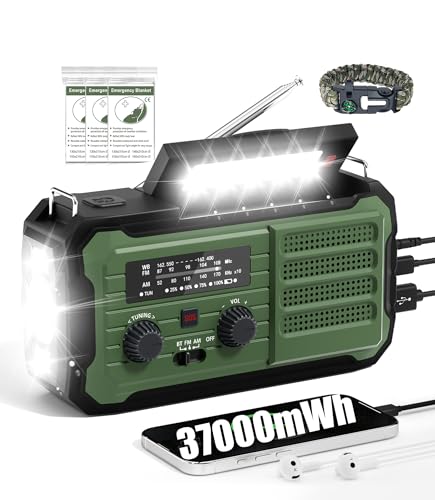
- 37,000mWh battery with three charging methods
- Automatic seven-channel NOAA scanning
- Includes survival accessories and SOS features
Best For: Families and outdoor users wanting a radio-plus-survival bundle
Rain-Ready Home Backup

- IPX6 water-resistant design
- Solar, hand-crank, and USB-C charging
- NOAA, AM/FM, lights, and 120dB SOS alarm
Best For: Home, RV, camping, and storm-preparedness kits
Extended-Run Outdoor Choice

- Up to 35 hours of radio playback
- IPX6 waterproofing and three charging options
- AM/FM/NOAA/SW with extended antenna
Best For: Outdoor users needing long runtime and rain resistance
Reliable Power Pick

- 7400mWh power bank for small devices
- Solar, hand-crank, and AAA power options
- NOAA reception plus flashlight and reading light
Best For: Home emergency kits and basic backup charging
Alert-Focused Choice

- Automatic NOAA alert scanning
- Six charging methods and 5000mAh battery
- IPX3 water resistance with LCD display
Best For: Outdoor use and automatic severe-weather notifications
High-Capacity Pick

- 12000mAh rechargeable battery
- Automatic NOAA alerts and six charging options
- IPX3 water resistance with strong lighting
Best For: Extended outages and high-capacity emergency backup
Rain-Ready Bluetooth Pick – Compact IPX5 Emergency Radio
For shoppers comparing waterproof emergency radios, this compact model combines IPX5 water resistance with NOAA, AM, and FM reception. Bluetooth streaming, multiple charging options, a flashlight, and an SOS alarm make it a versatile choice for emergency kits and outdoor trips.
Best For: Campers and preparedness-minded buyers who want a lightweight radio with Bluetooth and basic backup charging.
Pros:
- IPX5 protection and sturdy ABS+TPU construction help it handle heavy rain and accidental drops.
- Supports solar, hand-crank, and USB-C charging, with a built-in 2000mAh battery.
- Includes NOAA/AM/FM reception, Bluetooth 5.0, a 100-lumen flashlight, and a 95dB SOS alarm.
Cons:
- The 2000mAh battery offers less phone-charging capacity than larger emergency radios.
- Its compact design may provide less lighting and power reserve for extended outages.
This is a practical, portable option when you value rain resistance and everyday entertainment alongside emergency features. Its smaller battery is the main tradeoff for the compact size.
High-Capacity Powerhouse – 12000mAh Solar Emergency Radio
This waterproof emergency radio is built around a large 12000mAh battery, an 8500mm² monocrystalline solar panel, and a fast hand-crank generator. With IPX6 water resistance, NOAA alerts, multiple charging methods, and two lights, it suits serious home and outdoor preparedness.
Best For: Households and campers seeking substantial backup power, lighting, and weather-alert capability.
Pros:
- Real 12000mAh battery supports emergency phone charging and extended device use.
- Large solar panel and reinforced hand crank provide two off-grid charging options.
- IPX6 water resistance, NOAA alerts, a 5W adjustable flashlight, and a 12-LED reading lamp add useful emergency coverage.
Cons:
- At about 824g, it is heavier than compact emergency radios.
- Its larger body may take more space in a small go-bag.
Choose this model when battery capacity and lighting matter more than minimum weight. It offers a broad feature set for blackouts, storms, camping, and hurricane-season preparation.
Clear-Eyed Preparedness Pick – Manual-Tune 10000mAh Radio
Among waterproof emergency radios, this Leaton model offers a 10000mAh battery, IPX6 splash resistance, solar and hand-crank charging, and integrated lighting. It is a compact preparedness tool, but buyers should note that NOAA stations require manual tuning rather than automatic alerts.
Best For: Buyers who want a high-capacity radio for camping, vehicles, or emergency storage and are comfortable tuning weather broadcasts themselves.
Pros:
- 10000mAh internal battery provides USB phone charging, with stated output of approximately 1–1.5 iPhone 14 charges.
- IPX6 water resistance helps protect against splashes and water spray.
- Includes solar, hand-crank, and USB-C charging plus a three-mode flashlight, reading lamp, and compass.
Cons:
- NOAA reception is manual and does not support SAME, automatic, or location-based alerts.
- It is splash-resistant, not intended for heavy rain, immersion, or underwater use.
- Hand-crank runtime and phone-charging performance vary with use and conversion losses.
This radio makes sense for users who prioritize battery capacity and straightforward controls over automated alerts. Its limitations are clearly defined, making it important to plan on actively monitoring NOAA broadcasts.
Signal and Lighting Specialist – 12000mAh Clear-Sound Radio
This waterproof emergency radio emphasizes clear NOAA, AM, and FM reception, substantial 12000mAh power, and easy-to-use controls. Its large solar panel, upgraded hand crank, flashlight, and reading lamp make it a strong fit for storm kits, off-grid use, and outdoor adventures.
Best For: Families and campers who want high-capacity backup power, clear reception, and user-friendly controls.
Pros:
- Uses a stated 12000mAh lithium battery with USB-C input, solar, hand-crank, and AAA battery options.
- High-sensitivity reception system, noise reduction, and extended antenna are designed for clear NOAA, AM, and FM sound.
- Large solar panel, upgraded crank, 260-foot flashlight beam, and soft reading lamp support extended emergency use.
Cons:
- The supplied notes do not specify a waterproof rating, so water protection should be verified before wet-weather use.
- Its 6.8 x 2.9 x 4.7-inch body is less compact than pocket-sized radios.
- Full battery charging is recommended before first use.
This is a compelling choice when reception quality, lighting, and battery reserve are the priority. Because a specific water-resistance rating is not provided, it is less suitable for buyers who need clearly documented waterproofing.
High-Capacity Preparedness Pick – 10,000mAh Emergency Weather Radio
If you want waterproof emergency radios with substantial backup power, this model combines a 37,000mWh rechargeable battery with hand-crank and solar charging. It also adds automatic NOAA weather scanning, lighting, an SOS alarm, and survival accessories for home preparedness or outdoor use.
Best For: Families and outdoor users who want an emergency radio bundled with basic survival gear.
Pros:
- 37,000mWh battery with hand-crank, solar, and internal battery charging options
- Automatically scans seven NOAA weather-band channels, including while in standby
- Includes a bright flashlight, headphone jack, USB charging port, SOS alarm, thermal blanket, and paracord bracelet
Cons:
- The supplied notes do not specify an IPX water-resistance rating
- The extensive accessory bundle may be more than minimal emergency kits require
This is a strong all-in-one choice when long battery capacity and extra survival tools matter more than a streamlined design. Confirm the radio’s water-resistance details if wet-weather protection is a primary requirement.
Rain-Ready Home Backup – 12,000mAh NOAA Radio
For shoppers comparing waterproof emergency radios for storms, blackouts, and camping, this model offers an IPX6 water-resistant design, NOAA, AM, and FM reception, and several ways to restore power. Its large solar panel, clear speaker, flashlight, reading lamp, and SOS alarm make it practical for both home and outdoor kits.
Best For: Home emergency kits, RVs, camping setups, and users who prioritize rain resistance and clear audio.
Pros:
- IPX6 water-resistant construction for rain and splashes
- 12,000mAh rechargeable battery with solar, hand-crank, and USB Type-C charging
- Receives seven NOAA broadcasts plus AM/FM and includes a 5W flashlight, reading lamp, and 120dB SOS alarm
Cons:
- NOAA broadcasts require the radio to be powered on and tuned to a station
- At 1.6 pounds, it is less lightweight than some compact emergency radios
This is one of the more straightforward waterproof emergency radios for wet-weather preparedness, especially if you value a large solar panel and room-filling sound. Its manual NOAA tuning is worth noting before purchase.
Extended-Run Outdoor Choice – 20,000mAh Solar Radio
This QAUYYW model is a compelling option among waterproof emergency radios when extended runtime and outdoor portability are priorities. Its 20,000mAh battery supports up to 35 hours of radio use at medium volume, while IPX6 protection, solar and hand-crank charging, an extended antenna, and an SOS alarm support emergency use away from home.
Best For: Outdoor users and emergency planners seeking long runtime in a portable, rain-resistant radio.
Pros:
- 20,000mAh battery with up to 35 hours of radio playback at medium volume
- IPX6 waterproof design plus USB Type-C, solar, and hand-crank charging
- AM/FM/NOAA/SW reception, 52 cm extended antenna, flashlight, reading lamp, and SOS alarm
Cons:
- NOAA alerts require the radio to be powered on and manually tuned to a local station
- The notes describe the radio as compact but do not provide exact dimensions or weight
- The included warranty is 12 months, shorter than some competing coverage periods
Choose this radio if battery endurance and reception flexibility are more important than automatic alert monitoring. The IPX6 rating and long antenna make it particularly suited to storm preparation, hiking, and other outdoor scenarios.
Reliable Power Pick – FosPower A1 Emergency Radio
The FosPower A1 is a practical choice for anyone comparing waterproof emergency radios for basic weather updates, backup lighting, and device charging. It uses solar, hand-crank, and AAA-battery power sources, while its NOAA, AM, and FM reception helps keep emergency information accessible.
Best For: Home emergency kits and users who want a straightforward radio with a useful phone-charging backup.
Pros:
- 7400mWh (2000mAh) power bank can charge a small tablet or phone.
- Solar and hand-crank charging help maintain the radio, lights, and SOS alarm.
- Includes a 1W flashlight and four-LED reading light.
- Limited lifetime warranty included.
Cons:
- The supplied notes do not specify a water-resistance rating.
- AAA batteries are an additional power option rather than the primary rechargeable source.
This model keeps the feature set focused on essential preparedness. Choose it if dependable backup power and lighting matter more to you than advanced display or automatic-alert features.
Alert-Focused Choice – Raynic 5000mAh Weather Radio
For shoppers seeking waterproof emergency radios with more listening and alert features, this Raynic model combines automatic NOAA weather alerts with AM/FM/SW/WB reception. Its rechargeable battery, solar panel, hand crank, AC adapter, USB input, and AAA-battery compatibility provide multiple ways to keep it ready.
Best For: Campers, hikers, and households that want automatic weather alerts, a readable display, and flexible charging.
Pros:
- Automatically scans for NOAA weather alerts, including while in standby mode.
- Six charging options include rechargeable battery, AC adapter, USB, hand crank, solar, and AAA batteries.
- Large HD LCD shows battery level and tuning frequency.
- IPX3 water-resistant design, SOS alarm, flashlight, reading lamp, and headphone jack.
Cons:
- IPX3 water resistance is intended for light exposure, not full waterproofing.
- Three AAA batteries are not included.
- The supplied notes describe the unit as 1.2 pounds, which may be more than ultralight travelers prefer.
Its automatic alert scanning and broad charging support make it one of the more versatile options here. The IPX3 rating adds outdoor practicality, but it should not be treated as fully waterproof.
High-Capacity Pick – Raynic 12000mAh Weather Radio
This Raynic model stands out among waterproof emergency radios for its large 12000mAh rechargeable battery and broad emergency feature set. It supports automatic NOAA alerts, AM/FM/SW/WB reception, solar and hand-crank charging, and USB device charging for longer preparedness situations.
Best For: Extended outages, emergency kits, and outdoor users who prioritize battery capacity and multiple charging backups.
Pros:
- Large 12000mAh (44400mWh) rechargeable battery provides substantial backup capacity.
- Six charging options include AC, USB, hand crank, solar, rechargeable battery, and AAA batteries.
- Automatic NOAA alerts can notify you of severe weather without continuous listening.
- Includes a 3W flashlight, 2.5W reading lamp, SOS siren, LCD, and headphone jack.
Cons:
- IPX3 water resistance is not the same as full waterproof protection.
- Three AAA batteries are not included.
- The larger battery capacity may be unnecessary for shoppers seeking a simpler, lighter emergency radio.
Choose this version when reserve power is the priority. It offers the same practical alert and lighting features as a compact emergency radio while adding a substantially larger battery for charging devices and sustaining operation.
How We Picked These Waterproof Emergency Radios
We focused on radios that combine emergency information with dependable backup power. Each selected model offers some mix of NOAA weather reception, AM/FM tuning, solar charging, a hand crank, an internal battery, flashlight or SOS functions, and mobile-device charging. We also considered stated water resistance, battery capacity, charging versatility, portability, and useful extras such as shortwave reception, headphone support, and Bluetooth audio.
Capacity claims are not directly interchangeable: a larger mAh or mWh rating may provide more phone-charging reserve, but actual runtime depends on radio volume, lighting use, signal conditions, and device efficiency. Water resistance also varies, so check the specific IP rating and usage limits before exposing a radio to heavy rain or submersion.
Quick Comparison
| Feature | What to look for | Why it matters |
|---|---|---|
| Weather alerts | NOAA reception and alert mode | Provides warnings without relying on cellular service. |
| Charging | Solar, hand crank, USB-C, or USB input | Offers options when wall power is unavailable. |
| Battery reserve | Capacity listed in mAh or mWh | Supports longer radio use and emergency phone charging. |
| Protection | Documented IP rating | Indicates resistance to rain, splashes, or dust. |
| Utility features | Flashlight, SOS alarm, Bluetooth, or headphone jack | Adds value during outages and outdoor use. |
Key Buying Factors for Waterproof Emergency Radios
Water Resistance and Construction
Look for a clearly stated IP rating rather than relying on “waterproof” in the product name. IPX5 generally indicates protection from water jets, while it does not mean the radio can be submerged. Keep ports closed, dry the unit after exposure, and choose a sturdier design if it will live in a vehicle, shelter, or emergency kit.
NOAA Alerts and Reception
NOAA weather-band reception is more important than extra audio features for emergency use. An alert mode can monitor for warnings while conserving attention, but reception depends on location, antenna design, terrain, and weather conditions. Test the radio in your area before an emergency.
Battery Capacity and Charging
Higher-capacity models are better suited to extended outages or repeated phone top-ups, while smaller radios are easier to carry. Solar panels are useful for maintaining a charge over time, but they are typically slow in poor weather. Hand cranks are an emergency fallback, not a substitute for fully charging the unit in advance.
Size, Controls, and Visibility
Choose controls that are easy to operate in darkness or with cold, wet hands. A bright flashlight, readable tuning display, loud alarm, and high-visibility housing can matter more than Bluetooth or a larger speaker. Consider whether the radio fits your go-bag without adding excessive weight.
Who Should Buy Which Waterproof Emergency Radios?
Choose a high-capacity model if you want the longest backup reserve for outages, family emergency kits, or repeated phone charging. A compact radio is better for hiking, commuting, and lightweight go-bags. Models with stronger water resistance suit storm preparation and outdoor storage, while radios with shortwave, headphones, or Bluetooth are better for broader listening needs. For most households, prioritize NOAA alerts, multiple charging methods, a dependable flashlight, and a documented water-resistance rating over headline battery numbers alone.