When severe weather cuts power or cellular service becomes unreliable, an emergency radio with a flashlight can provide critical alerts, illumination, and backup phone power in one compact device.
We selected 10 emergency radios with flashlight based on useful features such as NOAA access, charging options, battery capacity, durability, and ease of use.
Best 10 Emergency Radios with Flashlight Picks for 2026
Best Compact Pick
RunningSnail Hand Crank Weather Radio

- AM/FM/NOAA reception with retractable antenna
- 2000mAh battery plus solar and hand-crank charging
- Compact 1W flashlight and USB charging
Best For: Portable go-bags, outages, and camping
Best High-Capacity Pick
Roxicosly 12000mAh Weather Radio

- Stated 12000mAh battery for emergency charging
- 5W flashlight plus 12-LED reading lamp
- IPX6 waterproof design with NOAA alerts
Best For: Extended outages and rugged outdoor use
Best Cable-Ready Pick
RunningSnail Radio with Built-In Cables

- Built-in Lightning, Micro USB, and USB-C cables
- NOAA alerts, SOS siren, and 7400mWh power bank
- Three-level flashlight and six-LED reading lamp
Best For: Multi-device households and family emergency kits
Best Established Brand Pick

- NOAA weather scan and alert functionality
- Built-in flashlight and ultrasonic dog whistle
- Multiple power sources with six AA batteries included
Best For: Basic home emergency kits and signaling needs
Compact Power Pick

- Bright 140-lumen three-LED flashlight
- Hand-crank, solar, and USB-C charging
- Compact design with NOAA and SOS
Best For: Compact emergency kits and portable outage readiness
High-Capacity Survival Kit
10000mAh Emergency Weather Radio
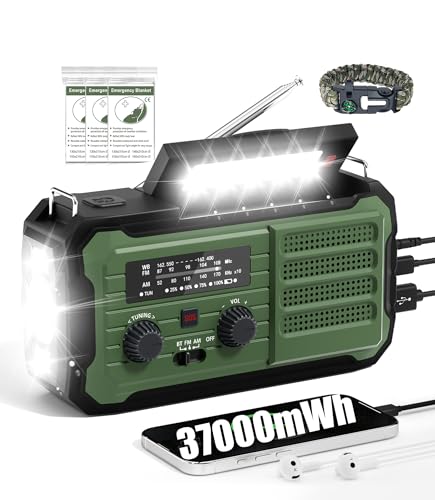
- 37000mWh battery for extended backup
- Automatic scanning of seven NOAA channels
- Includes blanket and survival paracord bracelet
Best For: Families and outdoor users wanting a more complete emergency kit
Feature-Rich Alert Choice
Raynic Weather Radio with Flashlight

- Automatic NOAA alerts and four radio bands
- Six charging options for flexible backup power
- 3W flashlight plus 2.5W reading lamp
Best For: Alert-focused home and outdoor emergency preparedness
Best with Extra Features
Leaton 10,000mAh Emergency Radio

- 10,000mAh battery with USB phone charging
- Solar, hand-crank, and USB-C charging
- Three-mode flashlight plus reading lamp
Best For: Home kits, camping, and backup phone power
Compact Value Pick
FosPower A1 NOAA Emergency Radio

- 2,000mAh power bank for small-device charging
- Four power options including AAA batteries
- Flashlight and four-LED reading light
Best For: Compact kits and basic outage preparedness
Brightest Lighting Pick
OnLyee 12,000mAh Weather Radio

- 12,000mAh battery with USB backup charging
- 5W flashlight and 12-LED reading lamp
- 120dB SOS alarm and large solar panel
Best For: Blackouts, storms, camping, and roadside emergencies
Best Compact Pick – RunningSnail Hand Crank Weather Radio
For shoppers seeking emergency radios with flashlight capability in a compact package, this RunningSnail model combines AM/FM/NOAA reception, a 2000mAh rechargeable battery, and three power options. Its small size makes it practical for a go-bag, power outage kit, or camping setup.
Best For: Buyers who prioritize portability, basic emergency charging, and flexible hand-crank or solar power.
Pros:
- Receives AM, FM, and NOAA broadcasts with a retractable antenna.
- Includes hand-crank, solar, and rechargeable-battery power options.
- Offers a 1W LED flashlight and USB phone-charging capability.
- Compact 5-by-1.8-by-2.4-inch design weighs about 0.5 pound.
Cons:
- The 2000mAh battery is smaller than the capacity offered by several larger models.
- Its water resistance is listed as water repellent rather than fully waterproof.
This is a sensible lightweight choice for everyday emergency preparedness. It covers the core needs—weather information, illumination, and backup charging—without taking much room in storage.
Best High-Capacity Pick – Roxicosly 12000mAh Weather Radio
This Roxicosly model stands out among emergency radios with flashlight features for its stated 12000mAh battery, large solar panel, and multiple lighting modes. It also adds AM/FM/NOAA coverage, an SOS alarm, and an IPX6 waterproof rating for demanding outdoor or blackout conditions.
Best For: Households and outdoor users who want substantial backup power, stronger lighting, and weather-alert coverage.
Pros:
- Provides a stated real 12000mAh battery for phone and device charging.
- Uses a large 8500mm² monocrystalline solar panel and efficient hand crank.
- Combines a 5W adjustable-beam flashlight with a 12-LED reading lamp.
- Supports five charging methods and includes NOAA alerts with a 9-second alarm.
Cons:
- At about 824 grams, it is substantially heavier than compact emergency radios.
- The larger body may be less convenient for small emergency kits.
Choose this radio when capacity and durability matter more than minimizing weight. Its broad charging support and dual lights make it particularly well suited to extended outages and outdoor emergencies.
Best Cable-Ready Pick – RunningSnail Radio with Built-In Cables
For emergency radios with flashlight functionality that reduce cable clutter, this RunningSnail radio includes three built-in charging cables for Lightning, Micro USB, and USB-C devices. It also combines NOAA alerts, multiple power sources, a flashlight, and a reading lamp in one portable unit.
Best For: Families or emergency kits that need flexible device charging without relying on loose cables.
Pros:
- Built-in Lightning, Micro USB, and USB-C cables support many common devices.
- Receives seven NOAA stations and provides an SOS siren with alert lighting.
- Offers rechargeable, USB-C, solar, hand-crank, and AAA-battery power options.
- Includes a three-level flashlight and a six-LED reading lamp.
Cons:
- The backup AAA batteries are not included.
- Its 7400mWh power bank is smaller than the 12000mAh capacity of the larger Roxicosly model.
- It is listed as water resistant, not fully waterproof.
This is a practical all-in-one option for households with several types of phones and small electronics. The built-in cables are its main convenience advantage, while the warning siren and two lighting sources add useful emergency functionality.
Best Established Brand Pick – Midland ER310 Weather Radio
The Midland ER310 is a straightforward option for shoppers comparing emergency radios with flashlight features. It provides AM/FM reception, NOAA weather scan and alerts, multiple power sources, a built-in flashlight, and an ultrasonic dog whistle for emergency signaling.
Best For: Buyers who prefer a recognizable emergency-radio design with included AA batteries and dedicated signaling features.
Pros:
- Includes NOAA weather scan and alert functionality.
- Features a built-in emergency flashlight and ultrasonic dog whistle.
- Supports multiple power sources and USB connectivity.
- Six AA batteries are included.
Cons:
- It supports AM/FM but does not list a wideband or seven-station NOAA tuner.
- The radio is not water resistant according to the supplied specifications.
- Its listed dimensions are larger than the smallest compact models.
The ER310 is a sensible pick for a basic home emergency kit, especially if included batteries and signaling tools are priorities. Consider another model if waterproofing, a large power bank, or multiple built-in charging cables is more important.
Compact Power Pick – Emgykit Hand Crank Radio
For shoppers comparing emergency radios with flashlight, the Emgykit stands out as a lightweight option for basic outage readiness and portable use. It combines AM/FM and NOAA reception with hand-crank, solar, and USB-C charging, plus a 2000mAh battery for backup power.
Best For: Compact emergency kits, power outages, camping, and users who want a lightweight radio with phone-charging capability.
Pros:
- Bright 3W, three-LED flashlight provides 140 lumens for outage lighting.
- Three charging options include hand crank, solar panel, and USB-C.
- NOAA, AM, and FM reception plus an SOS siren support emergency preparedness.
- Small 5.1-by-2.1-by-2.4-inch design weighs about 0.51 pound.
Cons:
- The 2000mAh battery is smaller than the capacities of the other radios in this roundup.
- Its reception is limited to AM, FM, and NOAA bands rather than shortwave.
The Emgykit is a sensible choice when portability matters most. Its flashlight, SOS alarm, weather access, and multiple charging methods cover the essentials without adding much bulk.
High-Capacity Survival Kit – 10000mAh Emergency Weather Radio
This emergency radio with flashlight is designed for extended backup use, pairing a 37000mWh rechargeable battery with hand-crank and solar charging. It also adds automatic NOAA scanning, an SOS alarm, a headphone jack, and survival accessories for broader emergency preparation.
Best For: Families, severe-weather preparedness, outdoor trips, and shoppers seeking a high-capacity radio with added survival gear.
Pros:
- Large 37000mWh battery supports extended operation and device charging.
- Automatic scanning across seven NOAA weather channels helps surface alerts.
- Built-in flashlight, SOS siren with flashing red light, USB port, and headphone jack add versatility.
- Includes an emergency thermal blanket and a survival paracord bracelet with compass, cutter, whistle, and fire rod.
Cons:
- The supplied notes do not specify the flashlight’s brightness or the radio’s dimensions and weight.
- The many included accessories may be more than some buyers need for a basic radio kit.
This model favors capacity and preparedness breadth over minimalism. Its automatic weather scanning and included survival accessories make it especially appealing for households building a more comprehensive emergency kit.
Feature-Rich Alert Choice – Raynic Weather Radio with Flashlight
Among emergency radios with flashlight, the Raynic is a versatile alert-focused option. It combines automatic NOAA warnings with AM, FM, SW, and weather-band reception, six charging methods, a large LCD display, and separate flashlight and reading-lamp functions.
Best For: Users who prioritize automatic weather alerts, tuning visibility, flexible power options, and headphone listening.
Pros:
- Automatically scans for emergency and weather alerts, including while in standby mode.
- Offers six power options: rechargeable battery, AC adapter, USB input, hand crank, solar, and three AAA batteries.
- Includes a 3W flashlight, 2.5W reading lamp, SOS alarm, and USB device charging.
- Large LCD display, AM/FM/SW/NOAA reception, headphone jack, and IPX3 water resistance add convenience.
Cons:
- At about 1.2 pounds, it is heavier than the compact Emgykit.
- AAA batteries are not included.
- Its larger 6.8-by-3.7-by-2.9-inch body may take more kit space.
The Raynic is a strong all-around pick for buyers who want more than a basic crank radio. Its automatic alerts, broad band support, display, and numerous charging choices make it well suited to home and outdoor preparedness.
Best with Extra Features – Leaton 10,000mAh Emergency Radio
The Leaton is a practical choice among emergency radios with flashlight for shoppers who want substantial backup battery capacity, multiple charging methods, and both focused and area lighting. It also receives AM/FM and NOAA broadcasts, though NOAA stations must be tuned manually.
Best For: Home emergency kits, camping, RV travel, and users prioritizing phone backup power.
Pros:
- Large 10,000mAh internal battery provides emergency USB phone charging; the notes estimate roughly 1–1.5 iPhone 14 charges.
- Offers USB-C, solar, and hand-crank charging options.
- Combines a three-mode flashlight, reading lamp, and built-in compass in a compact design.
- IPX6 water resistance helps protect against splashes and water spray.
Cons:
- NOAA reception requires manual tuning and does not provide SAME or automatic alerts.
- IPX6 protection is for splashes and spray, not immersion or heavy rain.
- Actual power-bank output varies because of conversion loss and device efficiency.
This model stands out for its unusually large battery and versatile lighting, making it a strong preparedness option when backup charging matters more than automatic weather alerts.
Compact Value Pick – FosPower A1 NOAA Emergency Radio
The FosPower A1 is a compact option for shoppers comparing emergency radios with flashlight for basic storm readiness. It combines AM/FM/weather-band reception, a small power bank, two light sources, and several ways to keep the unit operating.
Best For: Compact emergency kits, power outages, and buyers who value AAA-battery backup and warranty coverage.
Pros:
- Includes a 7400mWh (2,000mAh) power bank for emergency charging of phones or small tablets.
- Supports solar, hand-crank, USB-C, and four AAA batteries as power options.
- Provides a 1W flashlight and four-LED reading light.
- Includes a limited lifetime warranty.
Cons:
- Its power bank is much smaller than the 10,000mAh and 12,000mAh models in this roundup.
- The supplied notes identify it as water resistant but do not specify an IP rating.
- AAA batteries are required for that backup power method.
With a relatively light 310g body and multiple power sources, the A1 is easy to store in a go-bag or outage kit and offers useful everyday emergency lighting without a large footprint.
Brightest Lighting Pick – OnLyee 12,000mAh Weather Radio
The OnLyee CR1030 is built for shoppers seeking emergency radios with flashlight that emphasize illumination and loud alerts. It pairs a 12,000mAh rechargeable battery with a 5W flashlight, 12-LED reading lamp, SOS alarm, and AM/FM/NOAA weather-band reception.
Best For: Storm preparedness, blackouts, camping, roadside emergencies, and users wanting bright lighting.
Pros:
- Large 12,000mAh battery supports the radio, lights, SOS functions, and emergency USB device charging.
- 5W flashlight and 12-LED reading lamp provide versatile blackout lighting.
- Uses an oversized 8500mm² solar panel plus hand crank and Type-C charging.
- Includes a 120dB SOS alarm and DSP processing intended to improve signal clarity.
Cons:
- The 1.6-pound weight is higher than the FosPower A1’s listed 310g weight.
- NOAA broadcasts require the radio to be powered on and tuned to a station.
- The supplied details do not indicate automatic alert or location-based alert functionality.
This is the lighting-focused choice in the group, with the strongest stated flashlight output and a very large battery. Its heavier build may be a reasonable tradeoff for home, vehicle, or storm-kit use.
How We Picked the Best Emergency Radios with Flashlight
We focused on features that matter during outages, storms, evacuations, and other emergencies. The lineup includes hand-crank and solar-powered models, radios with rechargeable batteries, and options that support AM, FM, NOAA weather broadcasts, or shortwave reception.
We also considered practical differences in battery capacity, charging ports, lighting, alert functionality, portability, and operating simplicity. A larger battery may offer more phone-charging capacity, while a smaller radio can be easier to store in a vehicle, go-bag, or bedside emergency kit.
Quick Comparison
- Best for basic emergency readiness: Choose a compact model with AM/FM and NOAA reception, a flashlight, and both hand-crank and solar charging.
- Best for extended outages: Look for a higher-capacity battery, a larger solar panel, and multiple charging methods.
- Best for severe-weather alerts: Prioritize NOAA reception, alert support, a loud speaker, and controls that are easy to operate without referring to a manual.
- Best for vehicle or travel kits: Select a lightweight radio with a durable design, dependable crank mechanism, and USB output.
Key Buying Factors for Emergency Radios with Flashlight
Power and Charging Options
Hand-crank charging is useful when batteries, outlets, and sunlight are unavailable, but it is generally intended for short-term power rather than fully charging a phone. Solar charging can help maintain the internal battery during extended outages, although performance depends on direct sunlight. USB, wall, or car charging is faster when conventional power is available.
Battery Capacity
Capacity is commonly listed in mAh or mWh. Higher ratings can provide more runtime and phone-charging potential, but they may also increase the radio’s size and weight. Treat advertised capacity as a comparison point rather than a guarantee of real-world phone charges.
Weather Reception and Alerts
NOAA weather-band reception is especially valuable in areas affected by hurricanes, tornadoes, floods, or winter storms. If alerts are a priority, verify that the model supports an audible alert feature—not merely NOAA station tuning—and keep the radio configured for your local broadcasts.
Flashlight and Extra Features
Check whether the light is a focused flashlight, a reading lamp, or both. Useful extras may include an SOS alarm, battery indicator, headphone jack, USB phone output, and multiple radio bands. Avoid paying for features you are unlikely to use if simple operation is your main priority.
Who Should Buy Which Emergency Radios with Flashlight?
Choose a compact crank-and-solar radio for a basic household emergency kit or bedside drawer. Choose a high-capacity model if you expect longer outages or want a stronger backup phone charger. Choose a Midland or similarly rugged, straightforward design for vehicle kits, camping, and users who value simple controls. Choose a model with shortwave, headphone support, or enhanced alert features if you monitor broadcasts frequently or need more flexible listening options.
Whichever model you choose, test the radio before an emergency, charge it periodically, store it where everyone can find it, and keep a separate charging cable compatible with your phone.