When family trips lead beyond dependable cell service, the right satellite communicator can provide a vital connection without adding unnecessary complexity. The best options combine two-way messaging, location sharing, emergency SOS features, and manageable subscription costs.
We selected 10 satellite communicators for families across several use cases, from compact messengers for hiking and camping to rugged GPS units with mapping. The guide below explains the differences that matter most before you buy.
Best 10 Satellite Communicators for Families Picks for 2026
Best Compact Pick

- Two-way messaging and interactive SOS
- Up to 14 days of battery life
- Bluetooth, TracBack, and location sharing
Best For: Families wanting a lightweight communicator with navigation features
Best for Direct Messaging

- Two-way messages to phones and email
- Dedicated U.S. mobile number
- SOS communication with search and rescue
Best For: Families needing standalone and smartphone-connected messaging
Best Connected Safety Platform

- Satellite, cellular, and Wi-Fi messaging
- Immediate SOS with 24/7 monitoring
- IP68 rating and 200+ hours in tracking mode
Best For: Families wanting flexible messaging and structured check-ins
Best Simple Location Messenger

- GPS tracking beyond cell towers
- Motion-activated location updates
- SOS button for emergency alerts
Best For: Families wanting simple tracking and check-ins
Compact Global Link

- Two-way messages and interactive SOS
- Up to 14 days in tracking mode
- TracBack and location sharing
Best For: Families needing a lightweight off-grid communicator
Family Group Tracker
ACR Bivy Stick Satellite Communicator

- GroupTrack for up to 12 people
- Global messaging and GPS tracking
- SOS monitoring through Global Rescue
Best For: Families coordinating shared locations off-grid
Navigation-Focused Safety Hub
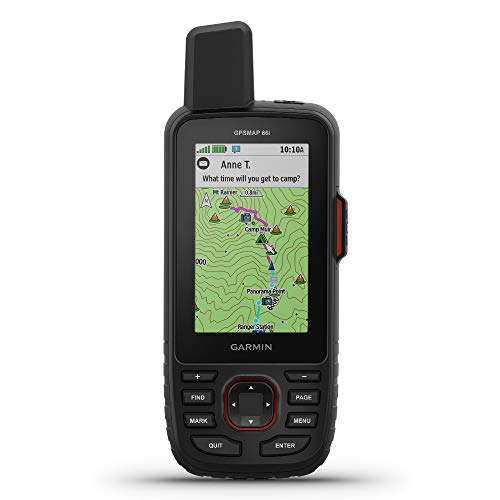
- Three-inch color mapping display
- Two-way messaging and interactive SOS
- Preloaded topo maps and multi-GNSS
Best For: Families prioritizing detailed handheld navigation
Best All-Around Family Messenger

- Two-way global and group messaging
- Interactive SOS and location sharing
- Up to 28 days of battery life
Best For: Families needing messaging and safety features on extended trips
Best Family Bundle
Garmin inReach Messenger Bundle

- Includes car and USB charging accessories
- Supports group chats and location sharing
- Up to 28 days of battery life
Best For: Families wanting added charging gear with their communicator
Best Simple Pick

- Two-way messaging through iOS or Android
- IP68-rated dustproof and waterproof design
- Unlimited SOS with every service plan
Best For: Families wanting a lightweight device for check-ins and emergencies
Best Compact Pick – Garmin inReach Mini 2
For families comparing satellite communicators for families, the Garmin inReach Mini 2 is a compact option for two-way messaging and SOS coverage beyond cell service. It also supports location sharing, navigation features, and smartphone pairing through Bluetooth, though an active satellite subscription is required.
Best For: Families who want a lightweight communicator with messaging, SOS, location sharing, and basic navigation.
Pros:
- Two-way messaging and interactive SOS globally with an active subscription.
- Compact, lightweight design with water resistance.
- Up to 14 days of battery life in 10-minute tracking mode.
- TracBack routing, digital compass, and Garmin Explore app compatibility.
Cons:
- Requires an active satellite subscription for messaging, SOS, and location sharing.
- Small 1.27-inch monochrome display may be less convenient for detailed information.
- Some jurisdictions regulate or prohibit satellite communication devices.
The Mini 2 is a strong family choice when portability, two-way communication, and long battery life matter more than a large screen. Its Garmin app and navigation ecosystem add useful flexibility for trips and outdoor activities.
Best for Direct Messaging – SPOT X Bluetooth Messenger
The SPOT X is a practical choice among satellite communicators for families that want two-way contact with family members, emergency services, phone numbers, and email addresses. It can pair with a smartphone over Bluetooth or operate independently with its own dedicated U.S. mobile number.
Best For: Families prioritizing back-and-forth satellite messaging and a standalone communication option.
Pros:
- Two-way messaging with cell numbers and email addresses virtually anywhere.
- Dedicated U.S. mobile number allows messages without a paired phone.
- Two-way SOS communication with a 24/7 search-and-rescue service.
- Includes a strap, carabiner, kickstand, and USB cable.
Cons:
- Requires activation and a service plan.
- Heavier and larger than some compact communicators at 7.04 ounces and 6.54 inches long.
- Bluetooth pairing is needed to communicate through a smartphone.
SPOT X stands out for families who value an actual two-way conversation during remote travel. Its standalone number is useful when a child or traveler carries the device without a phone, while Bluetooth adds smartphone convenience.
Best Connected Safety Platform – ZOLEO Satellite Communicator
ZOLEO is designed for families who want one messaging platform that can use satellite, cellular, or Wi-Fi connections. Paired with a smartphone, it supports a Safety Circle, location sharing, check-ins, emergency SOS, and direct contact through an assigned SMS number and email address.
Best For: Families wanting flexible network switching, app-based communication, and ongoing safety check-ins.
Pros:
- Uses satellite, cellular, or Wi-Fi through the lowest-cost available network.
- Immediate SOS activation with 24/7 emergency monitoring.
- IP68-rated design and more than 200 hours of tracking-mode battery life.
- Supports unlimited SOS, check-in, and Wi-Fi messaging on listed monthly plans.
Cons:
- Requires a service plan and smartphone app for its main communication features.
- Bluetooth pairing is required to connect with a phone.
- Optional travel risk-management coverage costs extra.
ZOLEO is a compelling family option for users who move between connected and remote areas. Its Safety Circle, assigned contact details, and network flexibility make it especially useful for regular check-ins, while USB-C charging simplifies travel.
Best Simple Location Messenger – SPOT Gen4 GPS Messenger
The SPOT Gen4 is a straightforward option among satellite communicators for families who mainly need location updates, check-ins, and an SOS signal beyond cell coverage. Its tracking feature can transmit updates while moving and stopped, making it suitable for outdoor use or keeping tabs on a child carrying it.
Best For: Families seeking a simple GPS messenger for tracking, check-ins, and emergency alerts.
Pros:
- Transmits GPS coordinates to family members or emergency responders.
- Tracking can send location updates while moving and when stopped.
- Motion-activated functionality and a dedicated SOS feature.
- Includes batteries, USB cable, strap, and carabiner.
Cons:
- Requires a subscription and service-plan activation.
- Focused on GPS messaging and alerts rather than two-way text conversations.
- Uses USB connectivity and does not list Bluetooth support.
The Gen4 makes sense for families who want visibility and emergency signaling without the complexity of two-way messaging. It is particularly practical for tracking outdoor trips or placing in a child’s backpack for a walk home.
Compact Global Link – Garmin inReach Mini 2
For families comparing satellite communicators for families, the Garmin inReach Mini 2 is a compact option for two-way messaging and interactive SOS beyond cell coverage. It requires an active satellite subscription and supports location sharing, navigation, and smartphone pairing.
Best For: Families who want a lightweight communicator for hiking, camping, and keeping loved ones updated off-grid.
Pros:
- Two-way messaging and interactive SOS through satellite coverage
- Compact 99-gram design with up to 14 days of battery life in 10-minute tracking mode
- TracBack routing, digital compass, and Garmin Explore app compatibility
- Can pair with select Garmin wearables and handhelds for messaging and SOS
Cons:
- Active satellite subscription is required for messaging, location sharing, and SOS
- Small 1.27-inch monochrome display and button-based controls may feel limited for map use
- Some jurisdictions regulate or prohibit satellite communication devices
The Mini 2 prioritizes portability and dependable core communication features over a large navigation screen. It is a practical family safety device when size, battery endurance, and simple location sharing matter most.
Family Group Tracker – ACR Bivy Stick Satellite Communicator
The ACR Bivy Stick is built for families who want group messaging and location sharing through an iOS or Android app. Its global Iridium connectivity supports two-way SMS, GPS tracking, offline maps, weather updates, and SOS features, with a separate service plan required.
Best For: Families and groups who want shared tracking, check-ins, and app-based communication during remote adventures.
Pros:
- Global Iridium coverage for messaging, tracking, SOS, and location sharing
- GroupTrack supports messaging and tracking with up to 12 people
- Unlimited GPS check-ins and live maps with breadcrumb trails
- IPX7 and MIL-STD-810 compliant enclosure with iOS and Android support
Cons:
- Requires a service plan with a one-time three-month commitment per device
- Battery life is listed at up to 120 hours
- Many functions depend on the Bivy mobile app and a compatible smartphone
With dedicated SMS and email contact details plus group tracking, the Bivy Stick is especially well suited to coordinating multiple family members. Its subscription structure and app dependence should be considered alongside the device price.
Navigation-Focused Safety Hub – Garmin GPSMAP 66i
For families seeking satellite communicators for families with stronger navigation capabilities, the Garmin GPSMAP 66i combines two-way inReach messaging and interactive SOS with a large color display and preloaded topographic mapping. A satellite subscription is required for the communication features.
Best For: Families who need detailed handheld navigation, route planning, and satellite communication in one device.
Pros:
- Three-inch sunlight-readable color display for easier map viewing
- Two-way messaging and interactive SOS through the global Iridium network
- Preloaded TOPO mapping, multi-GNSS support, and Birdseye imagery downloads
- Garmin Explore compatibility for managing routes, waypoints, activities, and trip data
Cons:
- Satellite subscription is required for messaging and SOS
- Bulkier than compact satellite communicators, with listed dimensions of 6.4 inches in length
- Battery life varies by tracking mode and is listed at up to 35 hours in 10-minute tracking mode
The GPSMAP 66i is a better fit for families who value map visibility and navigation detail more than minimal size. It offers a fuller handheld GPS experience while retaining inReach communication and emergency features.
Best All-Around Family Messenger – Garmin inReach Messenger
For families comparing satellite communicators for families, the Garmin inReach Messenger is a compact, rugged option for two-way messaging beyond cellular coverage. It supports group chats, location sharing, preset check-ins, and interactive SOS through the Garmin Messenger app, with cellular and satellite connectivity options.
Best For: Families who want group messaging, location sharing, and long battery life for extended outdoor trips.
Pros:
- Two-way global messaging and group conversations through the Garmin Messenger app
- Interactive SOS connects with Garmin’s 24/7-staffed monitoring and coordination center
- Up to 28 days of battery life in 10-minute tracking mode
- Preset check-ins do not count toward the allotted text messages
Cons:
- Requires an active satellite subscription for satellite features
- Messaging features rely on pairing with a compatible smartphone for app-based communication
- Satellite communication devices may be regulated or prohibited in some jurisdictions
The inReach Messenger is a strong family-focused choice when staying connected means more than sending occasional emergency signals. Its group messaging, location sharing, and long battery life make it practical for shared adventures, provided everyone understands the subscription requirements.
Best Family Bundle – Garmin inReach Messenger Bundle
This Garmin bundle gives families the inReach Messenger along with charging accessories, a car adapter, cable, portable battery charger, and cleaning cloth. The communicator supports two-way messaging over cellular or satellite networks, group conversations, location sharing, weather updates, and interactive SOS.
Best For: Families who want a ready-to-use messaging kit with extra charging options for road trips and outdoor adventures.
Pros:
- Includes USB charging accessories, a car adapter, and portable battery charger
- Supports two-way global messaging, group chats, and threaded conversations
- Can switch between cellular and satellite networks for connectivity
- Offers location sharing, weather updates, and TracBack functionality
Cons:
- Requires an active satellite subscription for satellite messaging and related services
- The listed bundle weighs 1.2 pounds, making it less streamlined than the standalone device
- Some jurisdictions regulate or prohibit satellite communication devices
For families shopping for satellite communicators for families, this bundle is appealing when charging flexibility matters. It combines the Messenger’s family communication features with accessories that can help keep the device powered in vehicles or away from outlets.
Best Simple Pick – Motorola Defy Satellite Link
The Motorola Defy Satellite Link is a lightweight Bluetooth communicator that pairs with iOS 14 or Android 10 and later smartphones. For families evaluating satellite communicators for families, it provides two-way satellite messaging, check-in coordinates, and SOS assistance in a rugged, waterproof design.
Best For: Families who prioritize a small, durable device for check-ins and emergency communication.
Pros:
- Provides two-way satellite-enabled messaging with compatible iOS and Android phones
- Check-in button can send coordinates or a message to loved ones
- IP68-rated design is dustproof and waterproof to nearly 5 feet for 30 minutes
- Unlimited SOS is included with every service plan
Cons:
- Service plans are required, including for satellite SOS assistance
- Battery life is up to four days on standby, substantially less than the Garmin options here
- Requires a compatible smartphone for its messaging functions
The Defy Satellite Link is a practical pick for families who want a very light communicator with straightforward check-ins and SOS support. Its shorter battery life and smartphone dependence make it better suited to shorter outings or travelers who can recharge regularly.
How We Picked the Best Satellite Communicators for Families
We compared these devices by looking at communication capability, emergency features, network coverage, portability, tracking tools, ease of use, and family practicality. Two-way messaging received particular emphasis because it lets families exchange information instead of relying only on one-way check-ins or preset alerts.
We also considered whether each communicator works independently or pairs with a smartphone, how useful its location and mapping features are, and whether its design suits occasional campers, frequent travelers, or demanding backcountry use. Subscription requirements matter just as much as hardware, so buyers should verify current plan prices, activation fees, message limits, and tracking charges before committing.
Quick Comparison
| Best For | Look For | Products in This Roundup |
|---|---|---|
| Small, lightweight emergency kit | Compact design, two-way messaging, SOS | Garmin inReach Mini 2, ZOLEO, ACR Bivy Stick |
| Simple check-ins and tracking | Preset messages, location sharing, straightforward operation | SPOT Gen4 |
| Messaging with phone flexibility | Bluetooth connectivity and app support | SPOT X, Motorola Defy Satellite Link |
| Navigation and communication together | Integrated GPS, maps, larger display | Garmin GPSMAP 66i |
| Longer trips and group communication | Efficient messaging, strong battery life, shared updates | Garmin inReach Messenger and Messenger Bundle |
Key Buying Factors for Satellite Communicators for Families
Two-Way Messaging and SOS
Two-way messaging is useful when plans change, weather turns bad, or someone needs reassurance. Confirm whether messages are typed on the device, sent through a smartphone app, or handled with preset options. Every family should also understand that SOS service is intended for emergencies, not routine communication, and that response procedures vary by provider and region.
Coverage, Tracking, and Location Sharing
Satellite devices can work where cellular networks do not, but coverage and message delivery depend on satellite visibility, terrain, weather, and device placement. Look for tracking intervals that match your trip, easy-to-share location links, and clear map or coordinate information. If relatives will monitor a trip remotely, test the sharing workflow before leaving.
Battery, Durability, and Ease of Use
Battery life decreases with frequent tracking, messaging, cold temperatures, and weak satellite visibility. Choose a model with enough reserve for the longest outing and consider USB charging compatibility. Water resistance, impact protection, glove-friendly controls, and a simple interface can be more valuable than extra features on family trips.
Subscriptions and Total Cost
Most satellite communicators require an active service plan. Compare annual and flexible options, included messages, tracking fees, weather features, activation costs, and suspension policies. A lower device price may not be economical if the plan is expensive for your actual usage.
Who Should Buy Which Satellite Communicators for Families?
Choose the Garmin inReach Mini 2 for a compact, proven two-way communicator with navigation support. The SPOT X suits buyers who want a dedicated messenger with a physical keyboard, while the ZOLEO and Motorola Defy Satellite Link are strong choices for smartphone-centered messaging.
Pick the SPOT Gen4 if simple one-way check-ins and tracking are enough. The ACR Bivy Stick is worth considering for app-based two-way messaging and global communication features. Families wanting a dedicated navigation device should look at the Garmin GPSMAP 66i.
For longer adventures, the Garmin inReach Messenger models emphasize efficient communication and battery-conscious operation. Finally, compare the standard Messenger with the bundle version to see whether the included accessories justify the additional cost for your setup.