When you’re miles from cell service, a dependable radio can be one of the most useful safety tools in your pack. The best emergency weather radio for hiking should deliver NOAA alerts, multiple charging options, and enough battery life to keep you informed when conditions change fast.
This roundup focuses on portable, practical models that balance size, power, and emergency features for real trail use.
Best 10 Emergency Weather Radio for Hiking Picks for 2026
Compact Power Backup
FosPower NOAA Emergency Weather Radio A1

- 7400mWh power bank for small device charging
- Solar, hand crank, and AAA backup power
- NOAA weather, AM/FM, flashlight, and reading light
Best For: Hikers wanting a compact radio with phone-charging backup
Feature-Rich Emergency Pick

- Solar, hand crank, rechargeable battery, and AA backup
- NOAA Weather Scan + Alert with AM/FM radio
- 130-lumen flashlight plus SOS beacon and dog whistle
Best For: Hikers who want advanced emergency tools and strong weather alerting
Ultralight Trail Backup

- Compact 0.23 kg design for easy packing
- Hand crank, solar, and Type-C charging
- 140-lumen 3-LED flashlight with SOS siren
Best For: Hikers who want the lightest possible emergency radio option
Compact All-Weather Backup
NITIGO Emergency Weather Radio for Hiking

- NOAA alerts plus AM/FM tuning
- 4000mAh battery with solar, crank, and USB charging
- Includes flashlight, reading lamp, and SOS alarm
Best For: Hikers who want a portable, multi-charge emergency radio with phone backup
High-Capacity Trail Light
RunningSnail Emergency Crank Radio

- 14800mWh / 4000mAh rechargeable battery
- Solar, hand-crank, and USB charging
- 3-mode flashlight with motion sensor reading lamp
Best For: Hikers who want a stronger battery and brighter lighting in one emergency radio
Lightweight Pocket Backup
Esky Emergency Hand Crank Radio

- Portable and lightweight for hiking bags or pockets
- USB, solar, and hand-crank charging
- AM/FM/NOAA radio with flashlight and SOS alarm
Best For: Hikers who want a compact, easy-to-carry emergency radio
High-Capacity Backup
Roxicosly Emergency Radio with Large Solar Panel

- Real 12000mAh battery for backup power
- Large solar panel plus hand crank charging
- IPX6 waterproof with NOAA and SOS features
Best For: Hikers needing high-capacity emergency backup
Compact Trail Helper
Eoxsmile NOAA Emergency Radio for Hiking
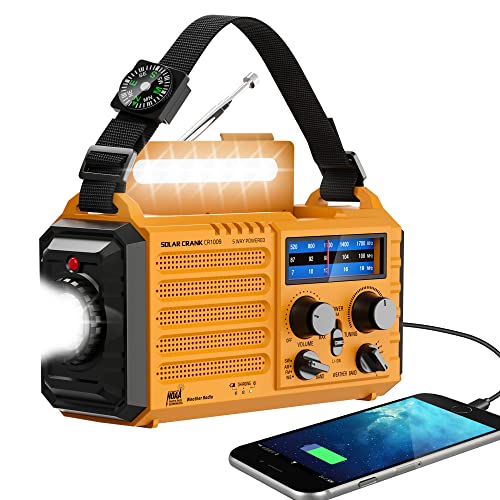
- NOAA alerts with SOS alarm and flashing light
- 5000mAh battery with solar, crank, and USB charging
- Includes compass, flashlight, and reading lamp
Best For: Hikers who want the essentials in a compact radio
Compact Power Backup – FosPower NOAA Emergency Weather Radio A1
If you want an emergency weather radio for hiking that also doubles as a small power backup, the FosPower A1 is built around portability and basic survival features. It covers NOAA and AM/FM broadcasts, adds solar, hand-crank, and AAA battery power options, and includes a 7400mWh power bank for charging a phone or tablet in a pinch.
Best For: Hikers who want a lightweight emergency radio with flashlight and device-charging support.
Pros:
- 7400mWh power bank can provide emergency power to a phone or small tablet
- Three power sources: solar, hand crank, and AAA batteries
- Includes a 4-LED reading light plus a 1W flashlight
- Receives NOAA emergency weather broadcasts plus AM/FM stations
Cons:
- AAA batteries are required for backup use
- Not the most rugged-looking option for heavy outdoor abuse
For hikers who want a simple, multi-function radio without adding much bulk, this FosPower model covers the essentials well. It is especially practical if you want emergency alerts, basic lighting, and the ability to top up a small device when away from power.
Feature-Rich Emergency Pick – Midland ER310 Weather Radio
The Midland ER310 is a strong emergency weather radio for hiking if you want more than just weather alerts. It combines solar, hand-crank, rechargeable battery, and AA backup power with NOAA Weather Scan + Alert, a bright flashlight beacon, USB charging for devices, and even an ultrasonic dog whistle for search and rescue situations.
Best For: Hikers who want a full-featured emergency radio with alerts, lighting, and extra rescue tools.
Pros:
- Three primary power options: solar panel, hand crank, and rechargeable 2600 mAh battery
- NOAA Weather Scan + Alert automatically finds the strongest weather channel
- Bright CREE LED flashlight reaches 130 lumens with SOS beacon mode
- USB output can charge portable devices, and AA batteries work as a backup
Cons:
- Not water resistant
- Larger and heavier than pocket-size options
This is a good choice if you prioritize emergency preparedness over minimal size. The ER310 stands out for its search-and-rescue friendly features and dependable weather monitoring, making it a practical pick for longer hikes and rough weather planning.
Pocket-Sized Survival Radio – SIYEGK Portable NOAA Emergency Radio
For an emergency weather radio for hiking where small size matters, this SIYEGK model keeps the basics in a very compact package. It offers NOAA/AM/FM reception, a 3500mAh power bank, solar charging, hand crank charging, and SOS alarm support, so it works as a simple grab-and-go survival tool for the trail.
Best For: Hikers who want a lightweight, pocket-friendly radio with backup charging.
Pros:
- Very compact and lightweight at 5.9 ounces
- 3500mAh power bank can help charge a smartphone
- Multiple charging methods include solar, hand crank, and charging cable support
- Supports NOAA, AM/FM, and weather radio bands with SOS alarm
Cons:
- Water resistance is only rated as water resistant, not fully waterproof
- Speaker output and build details are less specialized than larger emergency radios
This model makes sense if you want a small emergency radio that is easy to pack and still covers core survival functions. It is best viewed as a lightweight backup for weather alerts, basic communications, and emergency phone charging.
Ultralight Trail Backup – Emgykit Hand Crank NOAA Radio
If you need an emergency weather radio for hiking that slips easily into a pack, the Emgykit model is built around portability. It includes AM/FM/NOAA reception, a 2000mAh rechargeable battery, solar and hand-crank power, USB Type-C charging, and a louder 3-LED flashlight for basic emergency use.
Best For: Hikers who want an ultralight emergency radio with straightforward core features.
Pros:
- Very compact at 5.16 x 2.09 x 2.6 inches and 0.23 kg
- Three power options: hand crank, solar panel, and Type-C charging
- 3-LED flashlight is rated at 140 lumens for emergency lighting
- SOS siren can reach over 80 decibels for distress situations
Cons:
- Built-in battery is smaller than some competing emergency radios
- Speaker output is modest at 1 watt
This is a practical trail companion if you care most about size and essential emergency functions. It packs the weather radio, flashlight, SOS alarm, and backup charging features hikers usually need without adding much weight.
Compact All-Weather Backup – NITIGO Emergency Weather Radio for Hiking
If you want an emergency weather radio for hiking that also covers everyday use, this NITIGO model packs a lot into a small body. It combines NOAA weather alerts with AM/FM tuning, plus solar, hand-crank, and USB charging so you have multiple ways to keep it running on the trail or after you get back to camp.
Best For: Hikers who want a portable, multi-charge radio with flashlight, reading lamp, and phone backup.
Pros:
- NOAA weather band for alerts on tornadoes, hurricanes, floods, and storms
- 4000mAh battery with solar, hand-crank, and USB charging
- Includes USB phone charging for emergency power
- Built-in LED flashlight, 180-degree reading lamp, and SOS alarm
Cons:
- Designed as a multi-function emergency tool, so it may be more feature-heavy than a simple radio
- No specific battery runtime is listed in the supplied details
This is a practical pick if you want one device to handle weather alerts, basic lighting, and emergency charging. For hiking, the compact size and multiple power sources make it a flexible safety item to keep in your pack.
High-Capacity Trail Light – RunningSnail Emergency Crank Radio
This emergency weather radio for hiking is built around a large rechargeable battery and strong lighting features. The RunningSnail MD-090P adds NOAA weather broadcasts, AM/FM reception, solar power, hand crank charging, and USB charging, making it a well-rounded option for trips where backup power matters.
Best For: Hikers who prioritize battery capacity and stronger lighting in an emergency radio.
Pros:
- 14800mWh / 4000mAh rechargeable battery
- Supports USB, solar, and hand-crank charging
- 3-mode flashlight and motion sensor reading lamp
- NOAA weather band with external antenna for hazard updates
Cons:
- Slightly larger and heavier than the most minimal pocket-style options
- The product is focused on emergency use, so it may be more than some hikers need for casual outings
For hikers who want a feature-rich backup, this model stands out for its big battery and improved lighting setup. It looks especially useful when you want a radio that can keep going through longer outages or multi-day outdoor use.
Lightweight Pocket Backup – Esky Emergency Hand Crank Radio
If you need an emergency weather radio for hiking that stays light and simple, the Esky model is designed for portability. It offers AM/FM/NOAA reception, three charging methods, a built-in flashlight, and an SOS alarm, so you can keep it in a pack, trunk, or suitcase without adding much bulk.
Best For: Hikers who want a compact, lightweight emergency radio with basic survival features.
Pros:
- Portable and lightweight enough for a pocket or backpack
- Three charging methods: USB, solar, and hand crank
- AM/FM/NOAA radio for weather and news updates
- Built-in 3-LED flashlight and SOS alarm
Cons:
- 2000mAh battery is smaller than some competing emergency radios
- Lighting and power specs are more modest than higher-capacity models
This is a straightforward choice if your priority is keeping weight and size down. It gives hikers the essentials without loading up on extra features, which makes it easy to stash and carry on shorter trips or as a backup in a larger kit.
Weather-Ready All-Rounder – DreamSky Emergency Radio for Hiking
If you want an emergency weather radio for hiking that does more than just pull NOAA alerts, the DreamSky is a practical all-in-one pick. It combines weather warning coverage with AM/FM/SW/WB reception, multiple charging options, and built-in lighting, making it useful on the trail and during power outages.
Best For: Hikers who want a feature-packed emergency radio with lights, alerts, and phone charging in one unit.
Pros:
- Receives NOAA alerts plus AM, FM, shortwave, and weather band stations.
- Offers Type-C charging, solar power, and hand crank backup.
- Includes SOS siren, flashlight, and a separate reading lamp.
- Built-in battery can also charge a phone through the USB port.
Cons:
- More of a multi-tool emergency unit than a minimalist hiking radio.
- Plastic build may not appeal to buyers wanting a heavier-duty shell.
For hikers who value versatility, this DreamSky model covers the basics well and adds useful backup features for changing conditions. It is a strong choice if you want one radio that can alert, light, and recharge when plans change.
High-Capacity Backup – Roxicosly Emergency Radio with Large Solar Panel
This emergency weather radio for hiking is built for users who want strong backup power and reliable lighting in a rugged outdoor package. With a large solar panel, real 12000mAh battery, NOAA alerts, and waterproof construction, it is a solid pick for extended outdoor trips and emergency kits.
Best For: Hikers and campers who want a high-capacity, weather-ready radio with dependable charging backup.
Pros:
- Large monocrystalline solar panel is designed to capture sunlight efficiently.
- Real 12000mAh battery supports phone charging and emergency power use.
- Includes AM/FM/7 NOAA bands, SOS alarm, flashlight, and reading lamp.
- IPX6 waterproof design adds confidence for outdoor use.
Cons:
- Larger battery and rugged design may be bulkier than simpler trail radios.
- Battery capacity and feature set may be more than casual hikers need.
Overall, this Roxicosly radio is geared toward hikers who want extra power reserve and weather protection, not just basic station access. It stands out most when you expect long outings, uncertain weather, or a need to keep a phone alive.
Compact Trail Helper – Eoxsmile NOAA Emergency Radio for Hiking
For hikers who want a compact emergency weather radio for hiking with core survival features, the Eoxsmile keeps things focused. It covers NOAA weather alerts, multiple band reception, several charging methods, and basic lighting, so it works well as a lightweight preparedness tool for the trail.
Best For: Hikers who want a compact, budget-friendly emergency radio with the essentials.
Pros:
- NOAA weather alerts trigger a loud SOS alarm and flashing red light.
- Supports AM/FM/shortwave reception with a telescopic antenna.
- Built-in 5000mAh rechargeable battery plus solar, hand crank, USB, and AAA backup.
- Includes a flashlight, reading lamp, compass, hand strap, and headphone jack.
Cons:
- 5000mAh capacity is lower than some larger emergency radios.
- More basic than premium models with bigger solar panels or waterproof ratings.
This Eoxsmile radio is a sensible choice if you want the core emergency functions without paying for a larger, more feature-heavy unit. It balances portability and preparedness well for hikes, camps, and backup use.
How We Picked the Best Emergency Weather Radio for Hiking
We looked for radios that make sense for hiking first: compact size, clear weather-band reception, and dependable backup power. Priority was given to models with hand crank and solar charging, built-in rechargeable batteries, and extra functions that genuinely help outdoors, such as flashlights, SOS alarms, and USB device charging.
We also favored options that are easy to operate with cold hands or in low light, since emergency gear should be simple when stress is high.
Quick Comparison
For most hikers, the sweet spot is a lightweight Emergency Weather Radio for Hiking with NOAA coverage, a rechargeable battery, and at least one off-grid charging method. If you want the most packable option, choose a smaller pocket-style unit. If you value backup runtime and phone charging, a larger battery model is usually worth the extra weight. For group trips or storm-prone areas, radios with louder alerts and brighter flashlights can be more useful.
Key Buying Factors for Emergency Weather Radio for Hiking
Power Options
Look for more than one charging method. Hand crank and solar are valuable when outlets are unavailable, while USB charging helps you top off the battery before a trip. A built-in rechargeable battery is usually more practical than relying only on disposable cells.
Alert Reception
NOAA weather alerts are essential if you hike in areas where storms can develop quickly. AM/FM is useful for general broadcasting, and shortwave can be a bonus, but weather-band alert access should remain the priority.
Size and Weight
A good trail radio should fit easily in a side pocket or daypack. Bigger batteries often improve runtime, but they can add bulk. Match the radio to your trip length and pack style.
Emergency Extras
Flashlights, reading lamps, SOS alarms, and phone charging can be helpful, but they should be viewed as backup features rather than the main reason to buy. The core job is still receiving weather updates and staying powered.
Who Should Buy Which Emergency Weather Radio for Hiking?
Ultralight hikers should choose the smallest model with reliable weather alerts and basic charging. Weekend backpackers may prefer a balanced option with a stronger battery and flashlight. If you hike in remote or storm-prone regions, prioritize the largest battery capacity and the most redundant power sources. For family camping or group emergency kits, a louder, feature-rich radio is usually the best fit.
In short, the best Emergency Weather Radio for Hiking is the one you can carry comfortably, charge in multiple ways, and trust to deliver alerts when the weather turns.