Gravel rides demand hydration that stays secure over washboard roads without adding unnecessary bulk. The right pack should balance reservoir capacity, fit, storage, ventilation, and easy access while you pedal.
We compared 10 gravel-ready hydration packs and vests to help you choose a setup for short fast rides, hot-weather endurance efforts, and remote adventures where dependable water storage matters.
Best 10 Hydration Pack for Gravel Riding Picks for 2026
Race-Ready Stability

- Bounce-focused four-point suspension
- 2-liter bladder with insulated sleeve
- Lightweight, ventilated design
Best For: Fast gravel rides where stability and low weight matter
Everyday Ride Utility
CamelBak Classic Bike Hydration Pack

- 85-ounce Crux reservoir included
- Breathable back panel and harness
- Reflective accents and essentials pocket
Best For: Routine gravel rides with light storage needs
Expanded Trail Carry
USWE Airborne Limited Race Edition

- 3 liters of storage with 2-liter bladder
- Bounce-free NDM four-point harness
- Multiple pockets and helmet-carry points
Best For: Longer rides requiring hydration plus extra gear
Low-Profile Off-Road Simplicity

- 2-liter reservoir included
- Slim design helps reduce movement
- High-flow self-sealing bite valve
Best For: Minimalist gravel and off-road hydration
Best Overall

- Bounce-free adjustable vest fit
- 2.0L bladder and 8L total capacity
- Seven pockets with reflective details
Best For: Long gravel rides needing hydration and gear storage
Best Lightweight Pick

- Very light 5.64-ounce design
- 1.5L reservoir included
- Ventilated back panel and harness
Best For: Compact hydration on shorter gravel rides
Best Modular Design
2-in-1 Tactical Hydration Pack

- Separate or combined chest-and-back configuration
- 2.5L BPA-free bladder included
- Eight pockets and durable 500D nylon
Best For: Gear-heavy adventure gravel and off-road rides
Bounce-Free Capacity
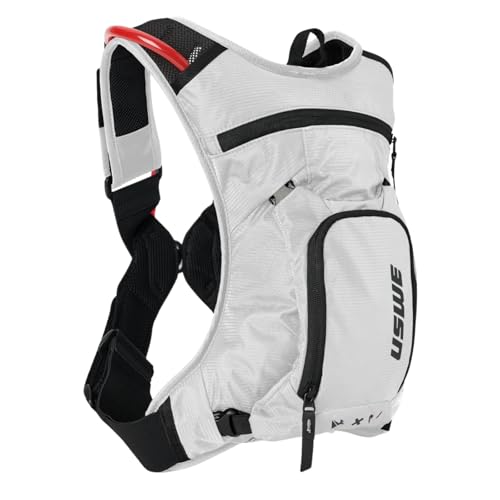
- 2.0L/70-ounce hydration bladder
- NDM 1.2 four-point harness
- Detachable pocket for 2L or 3L setup
Best For: Riders seeking secure fit and more water capacity
Race-Ready Stability – USWE Race 2.0
If you want a lightweight hydration pack for gravel riding that stays secure over uneven terrain, the USWE Race 2.0 emphasizes bounce control and ventilation. It includes a 2-liter bladder, insulated sleeve, and a harness designed for a 33- to 43-inch chest.
Best For: Gravel riders prioritizing low weight, stability, and cooling on long or fast rides.
Pros:
- Four-point suspension is designed to minimize bouncing.
- Lightweight 0.5-pound pack design, excluding the hydration system and sleeve.
- Includes a 2-liter bladder and insulated sleeve.
- Breathable mesh backplate and harness support airflow.
Cons:
- Limited 33- to 43-inch chest fit range.
- Compact dimensions may limit room for larger gear loads.
The Race 2.0 is a focused choice for riders who want hydration and a secure fit without carrying a bulky pack. Its compact design favors speed and comfort over extensive storage.
Everyday Ride Utility – CamelBak Classic Bike Hydration Pack
The CamelBak Classic Bike Hydration Pack is a practical hydration pack for gravel riding with an 85-ounce Crux reservoir, breathable construction, and a small amount of organized storage. It is suited to riders who want straightforward hydration for varied terrain.
Best For: Everyday gravel rides, commuting, and early or low-light outings requiring basic storage.
Pros:
- Includes an 85-ounce Crux reservoir designed to provide more water per sip.
- Air mesh back panel and ventilated harness help manage heat.
- Zippered pocket stores keys, tools, or small personal items.
- Reflective accents support visibility in low-light conditions.
Cons:
- Storage is limited to an essentials-sized zippered pocket.
- The supplied notes do not specify a larger gear capacity or helmet-carry feature.
This pack keeps the feature set simple: substantial hydration, breathable contact points, and enough storage for essentials. It makes sense for riders who do not need a larger adventure-oriented loadout.
Expanded Trail Carry – USWE Airborne Limited Race Edition
For riders needing more than water, the USWE Airborne Limited Race Edition combines a 2-liter bladder with 3 liters of total storage. Its bounce-free harness, phone pocket, organizer pocket, and layer-stash space make it a versatile hydration pack for gravel riding.
Best For: Long gravel and mixed-terrain rides where secure hydration and extra gear organization are important.
Pros:
- NDM four-point harness is designed for a bounce-free individual fit.
- Provides 3 liters of total storage plus a 2-liter bladder.
- Includes organizer, water-resistant phone, and quick-stash pockets.
- Helmet-carry attachment accommodates a full-face helmet.
Cons:
- Fit is limited to a 33- to 43.3-inch torso/chest range.
- More storage may be unnecessary for short, minimalist rides.
The Airborne stands out when a gravel ride calls for layers, tools, and electronics in addition to water. It remains relatively light while offering considerably more organization than a minimalist hydration-only pack.
Low-Profile Off-Road Simplicity – MSR Hydration Pack
The MSR Hydration Pack offers a slim, low-profile option for riders seeking a simple hydration pack for gravel riding. It includes a 2-liter reservoir, adjustable straps, a breathable back panel, and a self-sealing high-flow bite valve.
Best For: Gravel, MTB, and off-road riders who want hydration with minimal bulk and limited storage.
Pros:
- Includes a 70-ounce, 2-liter hydration reservoir.
- Low-profile design is intended to reduce movement and bounce.
- High-flow Blaster valve self-seals and has a twist on/off bar.
- Adjustable straps and breathable back panel support fit and comfort.
Cons:
- Only one pocket is listed, limiting carrying capacity.
- At 1.4 pounds, it is heavier than some ultralight options.
The MSR is best viewed as a durable, no-frills hydration solution rather than a gear-hauling pack. Its low-profile shape and valve design suit riders who want water readily available without a large load.
Best Overall – USWE Rush 8L Hydration Vest
For riders who want a hydration pack for gravel riding with room for more than water, the USWE Rush 8L combines a bounce-free vest fit with a 2.0L bladder and organized access to ride essentials. Its front pockets and rear storage suit longer rides where carrying nutrition, tools, and extra layers matters.
Best For: Gravel riders prioritizing stable fit, accessible storage, and high capacity.
Pros:
- NDM Vest technology and elastic side panels provide an adjustable, no-bounce fit.
- Includes a 2.0L bladder with a Plug-n-Play tube coupling.
- Five front pockets, including two zippered pockets, keep essentials accessible.
- Reflective details and an LED-light attachment point improve visibility in low light.
Cons:
- The vest-style design may feel more substantial than a minimalist cycling pack.
- Its 8L capacity can be more storage than needed for short rides.
The Rush 8L is a strong all-around choice when a gravel setup needs secure hydration and meaningful carrying capacity without relying on jersey pockets alone.
Best Lightweight Pick – CamelBak Hydrobak Light
The CamelBak Hydrobak Light is a straightforward hydration pack for gravel riding when low weight and essential carry space are the priorities. It includes a 1.5L reservoir, ventilated support, and a secure zippered pocket for small valuables.
Best For: Shorter gravel rides and riders who prefer a compact, lightweight pack.
Pros:
- Lightweight construction weighs 5.64 ounces.
- Air Support Light back panel uses body mapping for ventilation and comfort.
- Ventilated harness helps promote breathability while riding.
- Secure zippered pocket holds keys, a phone, or other essentials, and a helmet carry adds versatility.
Cons:
- The 1.5L reservoir is smaller than the other options in this roundup.
- Two pockets and 1L of cargo capacity provide limited room for extra gear.
Choose the Hydrobak Light for efficient hydration without excess bulk, especially when your gravel route does not require extensive tools, clothing, or nutrition storage.
Best Modular Design – 2-in-1 Tactical Hydration Pack
This modular option gives gravel riders a hydration pack for gravel riding that can be configured as a backpack, chest pack, or combined system. A 2.5L bladder, MOLLE storage, and adjustable front-and-rear fit make it suited to riders carrying more equipment across demanding terrain.
Best For: Adventure-oriented riders who want configurable storage and a larger bladder.
Pros:
- Two-piece design can be used separately or joined with quick-release buckles.
- Includes a BPA-free, leak-proof 2.5L bladder with a high-flow drinking tube.
- Eight pockets provide dedicated access for devices, snacks, and other gear.
- 500D nylon, 3D mesh straps, and a ventilated back panel support durability and airflow.
Cons:
- At 1.5 pounds, it is considerably heavier than the lightweight CamelBak option.
- The tactical modular design may be more equipment than casual gravel riders need.
- Supplied capacity details are inconsistent, listing a 10L pack capacity and a 10L tank volume despite the included 2.5L bladder.
The 2-in-1 system stands out for flexible organization and high water capacity, but its weight and tactical layout make it better suited to ambitious, gear-heavy outings than minimalist rides.
Low-Riding Stability – CamelBak M.U.L.E. 5 Waist Pack
If you prefer to keep weight off your shoulders, this waist-style hydration pack for gravel riding places its 50-ounce reservoir low on the hips. It also combines ventilation, repair-item storage, and stretch overflow space for practical all-day versatility.
Best For: Gravel riders who want stable lumbar hydration with quick access to tools and an extra layer.
Pros:
- Low-positioned 50-ounce reservoir is designed to support a stable feel while riding.
- Air Support back panel helps promote ventilation during sustained efforts.
- Magnetic tube trap keeps the drinking tube secure and accessible.
- Includes tool pockets, dual bottle pockets, and stretch bungee overflow storage.
Cons:
- Its 1.5-liter reservoir is smaller than the USWE pack’s 2.0-liter bladder.
- Waist-pack design may offer less shoulder and torso storage than a vest or backpack.
With 3.5 liters of cargo capacity and five pockets, the M.U.L.E. 5 is a focused choice for riders prioritizing a low, unobtrusive load over maximum water capacity.
Race-Ready Access – CamelBak Chase Race 4 Vest
The Chase Race 4 is a lightweight hydration vest for gravel riding when fast access and a close fit matter. Its 50-ounce reservoir, front Command Center storage, and dual sternum straps are suited to demanding efforts where you want essentials within reach.
Best For: Fast road and gravel riders who want a lightweight vest with organized on-body storage.
Pros:
- 3D Grid Mesh harness is designed for airflow and lightweight comfort.
- Command Center harness keeps a phone, fuel, and essentials accessible.
- Dual adjustable sternum straps help fine-tune stability at speed.
- Includes integrated tool organization and stretch overflow storage.
Cons:
- The 1.5-liter reservoir provides less water capacity than the USWE’s 2.0-liter bladder.
- Its 4-liter total capacity is more compact than a larger day-riding pack.
At 9.8 ounces, this is the lightest of the two CamelBak options listed here, making it a strong fit for riders who value race-oriented access and minimal bulk.
Bounce-Free Capacity – USWE MTB Hydro Pack
For rougher routes and longer stretches between refills, the USWE MTB Hydro offers a 2.0-liter bladder and a harness built to limit movement. This hydration pack for gravel riding adds ventilated shoulder straps, a water-resistant phone pocket, and configurable storage for race or trail use.
Best For: Gravel riders who want a higher-capacity bladder and a bounce-resistant fit for rough terrain.
Pros:
- NDM 1.2 four-point harness is designed for a snug, bounce-free fit.
- 2.0-liter bladder has a slider opening, ice compatibility, and Plug-n-Play coupling.
- Ventilated straps and an air-vented back panel support airflow and weight distribution.
- Detachable organizer pocket can reduce the pack from 3 liters to 2 liters for race mode.
Cons:
- Its listed 33–43-inch chest range may not suit every rider.
- At 0.59 kg, it weighs more than the CamelBak Chase Race 4.
- The listed warranty is 30 days.
The MTB Hydro stands out for capacity and suspension, while the removable pocket lets you switch between a more useful 3-liter setup and a leaner 2-liter race configuration.
How We Picked the Best Hydration Pack for Gravel Riding
We focused on the features that matter most on mixed-surface rides: stable fit, usable water capacity, low weight, ventilation, storage, and practical access while riding. The selection includes compact backpacks, race-oriented hydration vests, waist packs, and larger designs for riders who need extra layers or equipment.
We also considered reservoir size and the likely use case for each style. A lightweight 1.5- to 2-liter system can be ideal for supported rides or cooler conditions, while longer, hotter, and more remote routes may justify additional storage or supplemental bottles.
Quick Comparison
| Pack style | Best for | Main advantage |
|---|---|---|
| Minimalist hydration backpack | Fast gravel rides | Low weight and simple access |
| Hydration vest | Racing and endurance riding | Stable fit with front storage |
| Waist pack | Shorter rides | Minimal upper-body coverage |
| Larger backpack | Remote or all-day routes | More water and gear capacity |
Key Buying Factors for a Hydration Pack for Gravel Riding
Capacity and Refill Planning
Choose capacity based on route length, temperature, resupply points, and how much you already carry on the bike. A 2-liter bladder is a versatile starting point, while a 2.5-liter option or larger pack can be useful for isolated routes. Remember that water is heavy, so carrying more than necessary can affect comfort.
Fit and Stability
Gravel vibration makes movement especially noticeable. Look for adjustable chest or sternum straps, a secure waist strap when appropriate, and a close-fitting shape that does not bounce. Vests often spread weight more evenly, while compact backpacks may feel less restrictive.
Storage and Access
Check whether the pack has room for a phone, repair kit, nutrition, wind shell, and keys. Front pockets are convenient for frequently used items, but a streamlined back compartment may be better for riders who prefer to keep essentials off the handlebars.
Ventilation and Hose Design
Breathable back panels and ventilated shoulder straps help in warm conditions. A reliable bite valve, secure hose routing, and easy-to-clean reservoir are equally important for everyday use.
Who Should Buy Which Hydration Pack for Gravel Riding?
Choose a minimalist backpack such as the USWE Race 2.0 or CamelBak Classic for short-to-medium rides where low bulk is the priority. The CamelBak Hydrobak Light is another practical choice for riders who want a compact, familiar bike-pack format.
Racers and aggressive riders should consider a close-fitting vest such as the USWE Airborne, USWE Rush 8L, or CamelBak Chase Race 4. These designs are suited to fast riding and can keep water and small essentials accessible without a loose, bouncing feel.
For longer outings, the USWE MTB Hydro, MSR hydration pack, or a larger modular design may make more sense when extra food, clothing, or tools are required. The CamelBak M.U.L.E. 5 waist pack is worth considering for riders who prefer lower-back carry and need a compact alternative to a shoulder pack. Finally, treat capacity claims, included reservoirs, and adjustment details as specifications to verify before purchase, since product versions can vary.