Reliable navigation matters when trails are remote, weather changes quickly, or cellular coverage disappears. The best waterproof handheld GPS devices provide dependable positioning, durable construction, and controls you can use outdoors.
This roundup compares 10 Garmin handheld navigators, from simple monochrome units to advanced models with multi-band satellite support, marine charts, solar charging, and expanded mapping options.
Best 10 Waterproof Handheld Gps Devices Picks for 2026
High-Accuracy Trail Navigator

- Multi-band GNSS for challenging locations
- 2.6-inch sunlight-readable color display
- TopoActive maps and public land boundaries
Best For: Hikers, hunters, and campers navigating difficult terrain
Solar-Powered Adventure Navigator

- Solar charging can extend battery life substantially
- Up to 200 hours without solar charging
- IPX7 water-resistant design
Best For: Long hikes and trips in sunny conditions
Floating Marine Navigator
- IPX7 waterproof and floats in water
- Worldwide basemap with microSD support
- Up to 20 hours on two AA batteries
Best For: Boating, watersports, and wet environments
Value Trail Mapping Pick

- Routable TopoActive maps included
- GPS and GLONASS satellite support
- Up to 25 hours on two AA batteries
Best For: Hikers and cyclists wanting simple trail navigation
Rugged Marine Pick
- Floating, rugged design with IPX6 water resistance
- Worldwide basemap and multi-GNSS support
- Stores up to 10,000 waypoints and lasts up to 20 hours
Best For: Boaters and anglers needing a durable floating GPS
Long-Battery Outdoor Pick

- Up to 168 hours standard or 1,800 hours expedition mode
- IPX7 water-resistant design with sunlight-readable display
- Pairs with Garmin Explore for updates and trip planning
Best For: Hikers and campers seeking maximum battery endurance
Coastal Charting Pick
- Preloaded BlueChart g3 coastal charts
- Floating rugged design with IPX6 water resistance
- Multi-GNSS tracking plus compass and altimeter
Best For: Coastal boaters and anglers needing built-in charts
Best Budget Waterproof GPS

- IPX7 water-resistant construction
- Worldwide basemap and GLONASS support
- Up to 20 hours on two AA batteries
Best For: Simple hiking and geocaching on a budget
Best Feature-Rich Waterproof GPS

- Sunlight-readable color display
- TopoActive routable maps included
- Compass, altimeter, and microSD support
Best For: Hiking and cycling with detailed outdoor navigation
Best Midrange Waterproof GPS

- Sunlight-readable 65K-color display
- Worldwide shaded-relief basemap
- WAAS, HotFix, and GLONASS positioning
Best For: Outdoor navigation with flexible color mapping
High-Accuracy Trail Navigator – Garmin GPSMAP 65
For hikers, hunters, and campers comparing waterproof handheld GPS devices, the Garmin GPSMAP 65 stands out for its multi-band positioning and expanded satellite support. Its button controls, sunlight-readable color display, and preloaded mapping suit demanding outdoor navigation.
Best For: Outdoor users who need improved positional accuracy around steep terrain, dense forests, and urban canyons.
Pros:
- Multi-band technology and expanded GNSS support help improve accuracy in challenging locations.
- 2.6-inch sunlight-readable color display is easy to view outdoors.
- Includes routable TopoActive maps and U.S. federal public land boundaries.
- Garmin Explore compatibility supports management of tracks, routes, and waypoints.
Cons:
- Battery life is rated at up to 16 hours, shorter than some simpler handheld options.
- Smartphone pairing is required for Garmin Explore features.
The GPSMAP 65 is a strong choice when navigation accuracy matters more than having the longest battery runtime. Its rugged button-operated design and useful preloaded maps make it practical for serious backcountry trips.
Solar-Powered Adventure Navigator – Garmin eTrex Solar
The Garmin eTrex Solar is one of the more distinctive waterproof handheld GPS devices for extended outings. Its solar charging, multi-band GPS, simple button interface, and IPX7 water-resistant design are geared toward users who want dependable navigation with less concern about battery replacement.
Best For: Hikers and outdoor travelers spending long periods away from power in sunny conditions.
Pros:
- Can provide unlimited battery life in sunny conditions rated at 75,000 lux.
- Offers up to 200 hours without solar charging.
- Multi-band GPS supports improved positional accuracy.
- IPX7 water resistance and a high-contrast 2.2-inch display suit outdoor use.
Cons:
- Solar performance depends on sufficiently sunny conditions.
- The smaller 2.2-inch screen provides less viewing area than the GPSMAP 65.
- Additional mapping and smart features require a compatible smartphone connection.
Choose the eTrex Solar when battery endurance is the priority. It combines unusually long runtime with a compact design, digital compass, geocaching support, and practical smartphone connectivity.
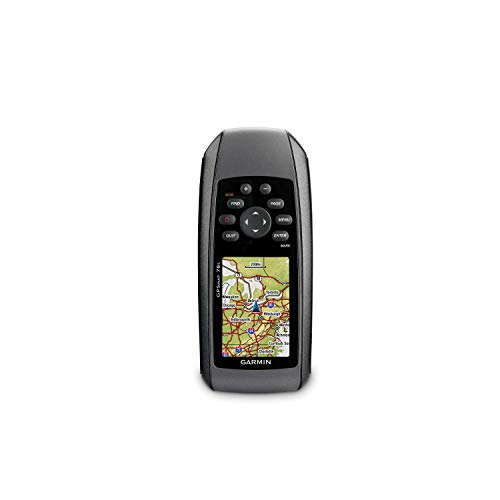
Floating Marine Navigator – Garmin GPSMAP 78
Among waterproof handheld GPS devices, the Garmin GPSMAP 78 is tailored especially to boating and watersports. Its IPX7 waterproof construction, floating design, high-sensitivity receiver, worldwide basemap, and microSD expansion make it useful around the water.
Best For: Boaters and watersports users who want a floating handheld GPS with marine-oriented mapping support.
Pros:
- IPX7 waterproof design helps protect it in wet conditions.
- Floats in water, reducing the risk of losing it overboard.
- Includes a worldwide basemap and supports additional maps via microSD.
- Up to 20 hours of battery life with two AA batteries.
Cons:
- Two AA batteries are required and are not included.
- The model dates from 2010, so its feature set is older than newer Garmin handhelds.
- The supplied display specification is 160 x 240 pixels.
The GPSMAP 78 remains appealing when flotation and water resistance are more important than newer satellite features. It is a sensible marine-focused option for users who value a simple, durable handheld design.
Value Trail Mapping Pick – Garmin eTrex 22x
The Garmin eTrex 22x is a straightforward option for shoppers seeking waterproof handheld GPS devices for hiking and cycling. It combines a sunlight-readable 2.2-inch color screen, preloaded routable TopoActive maps, GPS and GLONASS support, and up to 25 hours of battery life.
Best For: Hikers and cyclists who want reliable basic mapping without a touchscreen.
Pros:
- Preloaded TopoActive maps include routable roads and trails.
- GPS and GLONASS support can help in more challenging environments.
- 8 GB of internal memory plus a microSD card slot supports map downloads.
- Runs for up to 25 hours with two AA batteries.
Cons:
- It lacks a touchscreen and uses button-based operation.
- The 2.2-inch display is smaller than the GPSMAP 65’s screen.
- The supplied notes do not specify an IP water-resistance rating.
The eTrex 22x offers a practical balance of mapping, storage, and battery life for everyday trail use. Consider it when you prefer replaceable AA batteries and simple controls over advanced multi-band positioning.
Rugged Marine Pick – Garmin GPSMAP 79s
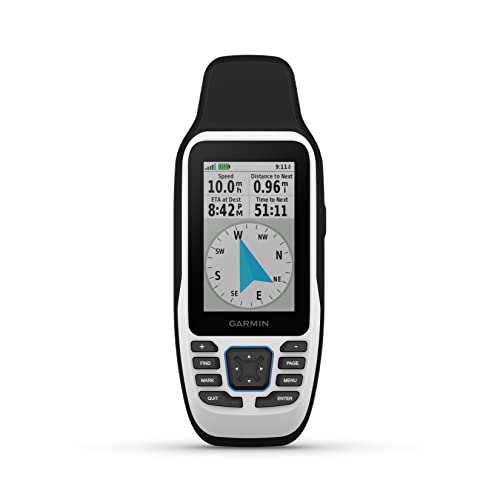
Garmin GPSMAP 79s, Marine GPS Handheld with Worldwide Basemap, Rugged Design and Floats in Water
Check Price On AmazonFor shoppers comparing waterproof handheld GPS devices, the Garmin GPSMAP 79s emphasizes marine-ready durability, reliable satellite tracking, and simple button controls. Its floating design, IPX6 water resistance, worldwide basemap, and 20-hour GPS battery life make it a practical choice for boating, fishing, and wet outdoor conditions.
Best For: Boaters, anglers, and outdoor users who want a rugged floating GPS with worldwide satellite support.
Pros:
- Floats in water and has IPX6 water resistance at the unit level.
- Supports GPS, GLONASS, BeiDou, Galileo, QZSS, and SBAS satellite systems.
- Stores up to 10,000 waypoints, 250 routes, and 300 fit activities.
- Includes a 3-axis electronic compass and barometric altimeter.
Cons:
- Battery life is limited to up to 20 hours in GPS mode.
- Uses push-button controls rather than a touchscreen.
- The supplied notes specify IPX6 water resistance for the unit level only.
The GPSMAP 79s is a strong fit when floating capability and marine durability matter more than extended battery life or smartphone-connected features.
Long-Battery Outdoor Pick – Garmin eTrex SE
The Garmin eTrex SE is a compact option among waterproof handheld GPS devices, combining IPX7 water resistance with exceptionally long battery life. Its sunlight-readable display, multi-GNSS support, and optional Garmin Explore app pairing suit hikers, campers, and geocachers who want dependable navigation without frequent battery changes.
Best For: Hikers, campers, and geocachers prioritizing long battery life and a compact, water-resistant design.
Pros:
- Offers up to 168 hours in standard mode and up to 1,800 hours in expedition mode.
- Uses two field-replaceable AA batteries.
- IPX7 water-resistant design and a display readable in bright sunlight.
- Pairs with the Garmin Explore app for updates, trip planning, weather, and notifications.
Cons:
- AA batteries are not included.
- Its 2.2-inch display is smaller than the marine GPSMAP models in this roundup.
- Some connected features require a compatible smartphone and Garmin Explore app.
Choose the eTrex SE if extended field time is the priority. It is less marine-focused than the GPSMAP 79 series, but its battery endurance and IPX7 rating are useful for hiking and camping.
Coastal Charting Pick – Garmin GPSMAP 79sc
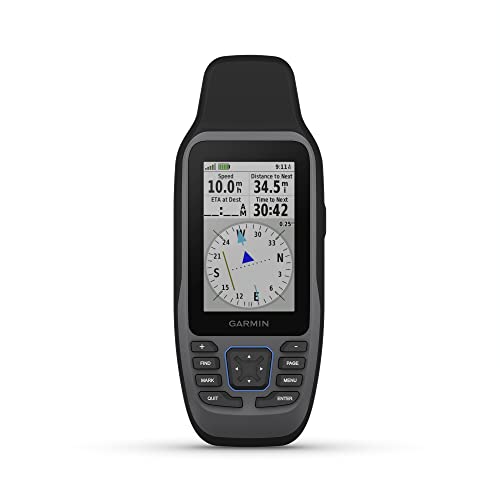
Among waterproof handheld GPS devices, the Garmin GPSMAP 79sc stands out for marine navigation because it floats and includes preloaded BlueChart g3 coastal charts. Its rugged IPX6 water-resistant housing, multi-GNSS tracking, compass, and barometric altimeter make it well suited to boaters and anglers working near the coast.
Best For: Coastal boaters and anglers who want a floating handheld GPS with built-in BlueChart g3 coastal coverage.
Pros:
- Floats in water and has IPX6 water resistance at the unit level.
- Includes preloaded BlueChart g3 coastal charts.
- Supports GPS, GLONASS, BeiDou, Galileo, QZSS, and SBAS.
- Stores up to 10,000 waypoints, 250 routes, and 300 fit activities.
Cons:
- Battery life is up to 20 hours in GPS mode.
- The supplied notes specify IPX6 water resistance for the unit level only.
- It is primarily designed around marine use, which may be more than hikers need.
The GPSMAP 79sc is the more specialized choice for coastal navigation in this group. Its preloaded BlueChart g3 coverage adds value for marine users who do not want to start with a basic worldwide basemap.
Best Budget Waterproof GPS – Garmin eTrex 10
For shoppers seeking waterproof handheld GPS devices without unnecessary extras, the Garmin eTrex 10 offers a straightforward, durable navigation tool. Its IPX7 water resistance, worldwide basemap, WAAS-enabled GPS, HotFix, and GLONASS support make it practical for hiking, geocaching, and general outdoor use.
Best For: Budget-minded hikers and geocachers who prefer simple button-based navigation and long battery life.
Pros:
- IPX7-rated protection helps guard against splashes and rain.
- Worldwide basemap with GPS, HotFix, and GLONASS support.
- Runs for up to 20 hours on two AA batteries.
- Supports paperless geocaching and track-based waypoint storage.
Cons:
- Monochrome 2.2-inch display is less readable and detailed than a color screen.
- Limited 6 MB storage restricts mapping flexibility.
- Does not include the advanced compass and altimeter found on the eTrex 32x.
The eTrex 10 is a sensible choice when dependable basics matter more than detailed maps or advanced sensors. Its rugged design, simple controls, and replaceable AA batteries keep it useful for uncomplicated outdoor navigation.
Best Feature-Rich Waterproof GPS – Garmin eTrex 32x
The Garmin eTrex 32x is one of the more capable waterproof handheld GPS devices for outdoor navigation. It combines a sunlight-readable color display, preloaded routable TopoActive maps, GPS and GLONASS tracking, expandable storage, and useful elevation and direction sensors.
Best For: Hikers, cyclists, and outdoor users who want detailed maps plus a 3-axis compass and barometric altimeter.
Pros:
- 2.2-inch sunlight-readable color display with 240 x 320 resolution.
- Preloaded TopoActive maps include routable roads and trails.
- GPS and GLONASS support helps with tracking in challenging environments.
- Includes 8 GB of internal memory, microSD expansion, a 3-axis compass, and barometric altimeter.
Cons:
- Small 2.2-inch screen may feel cramped for viewing extensive map detail.
- Relies on two AA batteries rather than an integrated rechargeable battery.
- Its added navigation features may be unnecessary for users who only need basic wayfinding.
Choose the eTrex 32x if you want a compact handheld navigator with more mapping and sensor capability than an entry-level unit. Its 25-hour battery rating and expandable storage also suit longer trips.
Best Midrange Waterproof GPS – Garmin eTrex 20x
The Garmin eTrex 20x is a practical middle ground among waterproof handheld GPS devices, pairing a 65K-color sunlight-readable display with expanded map support and reliable positioning features. Its worldwide basemap, microSD slot, WAAS, HotFix, and GLONASS support make it adaptable for a range of outdoor activities.
Best For: Outdoor users who want a color-screen navigator with room for additional maps without stepping up to the eTrex 32x.
Pros:
- 2.2-inch sunlight-readable color display with 240 x 320 resolution.
- Supports multiple map options, including TOPO 24K, HuntView, BlueChart g2, and City Navigator NT.
- Worldwide basemap includes shaded relief.
- High-sensitivity GPS with WAAS, HotFix, and GLONASS support helps maintain positioning.
Cons:
- Does not include the eTrex 32x’s 3-axis compass and barometric altimeter.
- Some map products, including BirdsEye Satellite Imagery, require a subscription.
- Its listed 3.7 GB internal memory is less generous than the eTrex 32x’s 8 GB.
The eTrex 20x is a well-balanced option for buyers who value a readable color display and flexible map loading. It offers stronger visual navigation than the eTrex 10 while keeping the interface compact and button-controlled.
How We Picked These Waterproof Handheld Gps Devices
We focused on handheld GPS units that are built for outdoor use and offer meaningful advantages for hiking, hunting, boating, geocaching, or emergency navigation. Key considerations included water resistance or flotation, satellite reception, display readability, physical controls, battery options, map support, storage, and overall usability.
The selection includes both current and established Garmin models so shoppers can compare newer features with proven, budget-friendly designs. Because needs vary widely, no single device is ideal for every trip.
Quick Comparison
| Best For | Look For |
|---|---|
| Accurate hiking navigation | Multi-band reception, expanded satellite support, and a readable color display |
| Simple emergency backup | Basic waypoint navigation, long battery life, and easy physical controls |
| Long trips away from power | Replaceable batteries or solar charging |
| Boating and coastal use | Floating construction and marine chart compatibility |
| Geocaching and route planning | Color mapping, wireless connectivity, and generous internal storage |
Key Buying Factors for Waterproof Handheld Gps Devices
Water Protection and Durability
Check the stated water-resistance rating rather than assuming every rugged GPS is suitable for immersion. Marine-focused models that float can be especially useful on kayaks, boats, and docks. A durable case and buttons that remain usable with wet hands also matter.
Satellite Accuracy and Reception
Multi-band technology and support for multiple satellite systems can improve positioning in forests, canyons, and areas with reflected signals. For casual trail use, a standard receiver may be sufficient; demanding navigation benefits more from advanced reception.
Maps and Display
Color screens make roads, trails, and topographic details easier to interpret, while monochrome displays often conserve power and remain simple to read. Confirm whether desired maps are included, downloadable, or sold separately.
Battery Life and Controls
Replaceable AA batteries are convenient for extended trips because you can carry spares. Solar charging can reduce battery use in suitable conditions. Physical buttons are generally more dependable than touchscreens in rain, cold, or when wearing gloves.
Who Should Buy Which Waterproof Handheld Gps Devices?
Choose a higher-end GPSMAP model if you need stronger reception, marine navigation, or specialized chart support. The GPSMAP 65 is a strong fit for hikers who prioritize satellite accuracy, while the GPSMAP 79 series suits boaters who value flotation and marine mapping.
Pick an eTrex Solar if minimizing battery changes is important. The eTrex 22x, 32x, and 20x are sensible choices for color mapping and general trail navigation, while the eTrex SE offers a modern option for straightforward outdoor use. For the lowest-cost backup or basic waypoint navigation, the eTrex 10 remains a practical choice.